
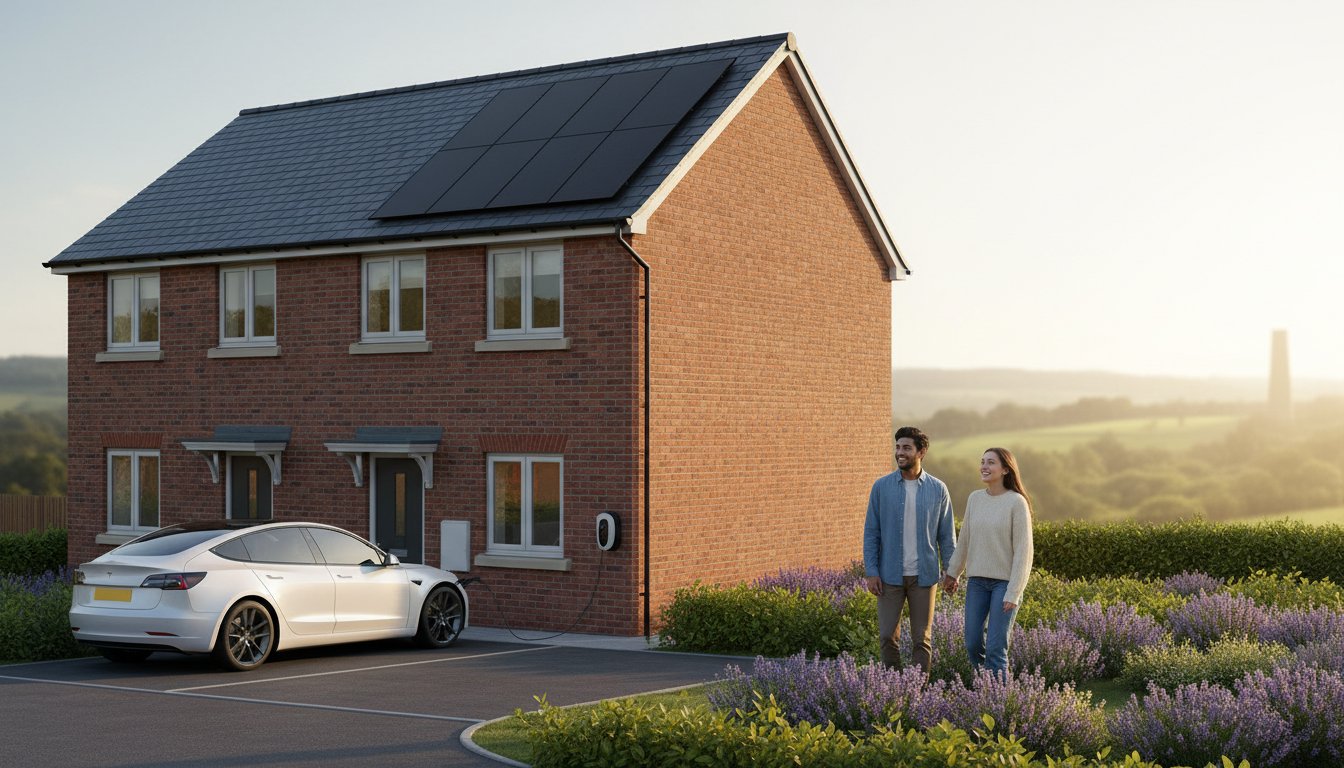
Did you know that over 1.3 million UK households have already made the switch, with Staffordshire seeing a 15% increase in local installations during 2024 alone? You've likely watched your energy bills fluctuate wildly over the last 24 months and wondered if the grey skies over the Potteries can actually generate enough electricity. It's a common concern, especially when you're trying to figure out which solar power for your home setup will actually deliver on its promises without falling victim to rogue traders.
We agree that the transition should be transparent and stress-free rather than a gamble with your hard-earned savings. This guide provides a clear roadmap to help you achieve energy independence, from using the Smart Export Guarantee (SEG) to choosing the right battery storage for a typical Stafford semi-detached house. You'll learn how to maximize your return on investment and potentially add up to 4% to your property's value by the end of 2026. We'll cover everything from roof angles to the latest West Midlands installation standards to ensure your home stays powered for decades.
Key Takeaways
- Discover why Staffordshire’s local climate is surprisingly effective for energy generation and how to properly assess your roof's suitability for 2026.
- Understand the vital role of the inverter and PV technology in providing reliable solar power for your home while maximizing energy conversion.
- Learn how to navigate the UK installation process by choosing MCS-certified experts and designing a bespoke system tailored to your specific needs.
- Calculate your potential ROI by breaking down hardware costs and leveraging the Smart Export Guarantee (SEG) to get paid for excess electricity.
- Explore how to future-proof your property by integrating smart battery storage and EV charging to achieve maximum energy independence.
Assessing Solar Power for Your Home in Staffordshire
As we approach the 2026 UK energy landscape, the drive toward the government's target of 70GW of solar capacity by 2035 makes residential adoption more critical than ever. Installing solar power for your home isn't just an environmental choice; it's a strategic move to bypass the extreme volatility of the national grid. A Rooftop solar power system captures daylight and converts it into usable electricity, allowing Staffordshire residents to decrease their reliance on external suppliers. This shift provides a much-needed buffer against the fluctuating Ofgem price caps that have impacted West Midlands households since the energy crisis began in 2022.
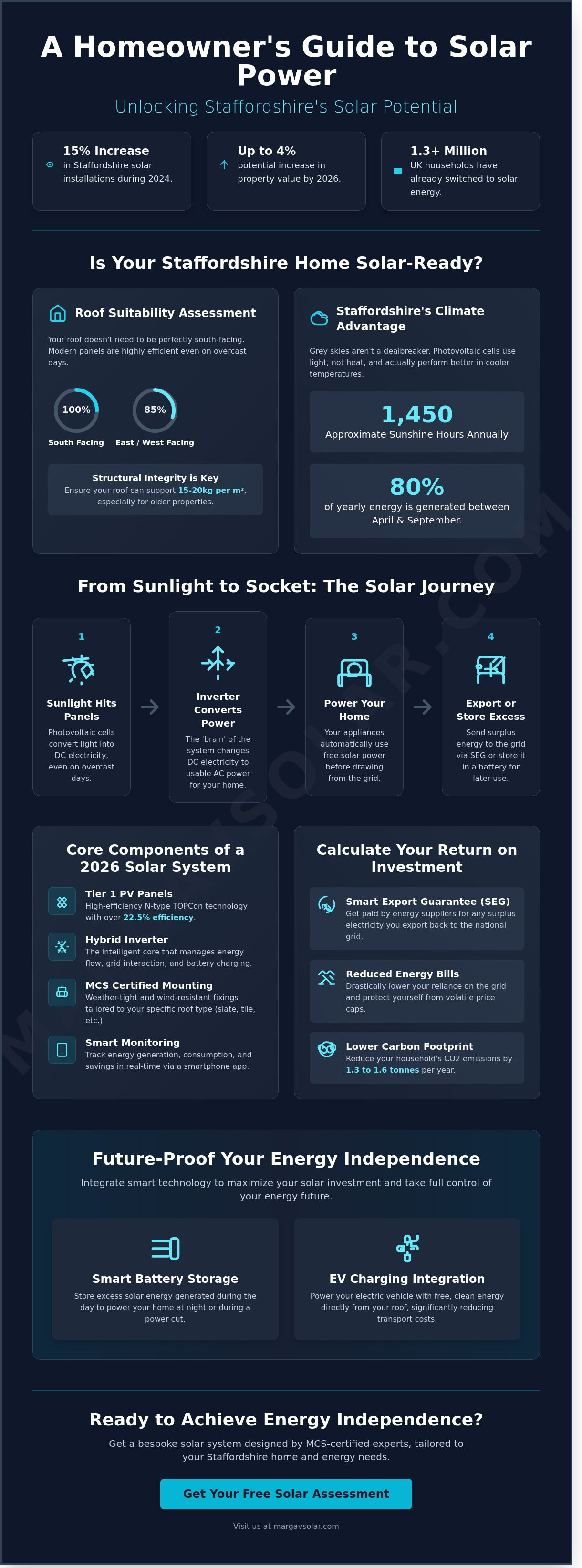
Staffordshire offers a surprisingly strong environment for solar generation. While myths about grey West Midlands skies persist, the region receives approximately 1,450 hours of sunshine annually. This is more than enough to provide a substantial return on investment. Local homeowners can lower their carbon footprint by roughly 1.3 to 1.6 tonnes of CO2 per year while simultaneously earning through the Smart Export Guarantee (SEG), which pays you for the excess energy you send back to the grid.
Is Your Staffordshire Property a Good Candidate?
Your roof doesn't need to face perfectly south to be effective. East and west-facing roofs in Stafford often retain 85% of the efficiency of a south-facing counterpart. You should check for shade from local landmarks or mature trees common in areas like Cannock Chase. For those living in historic barn conversions or Victorian terraces in Leek, a structural survey is vital. These older buildings must support the extra 15kg to 20kg per square metre that a typical panel array adds to the existing roof load.
Understanding Local Solar Yield and Weather Patterns
Photovoltaic cells don't require direct, scorching heat to function. They rely on light, not temperature. On a typical overcast day in the Potteries, panels still generate power using diffuse solar radiation. The Staffordshire Moorlands microclimate can bring cooler temperatures, which actually improves panel efficiency, as hardware performs better when it isn't overheating. You can expect about 80% of your total yearly energy production to occur between April and September, with shorter winter days providing a smaller, though still useful, baseline of power for your daily needs.
How Solar PV Systems Generate Electricity for You
Understanding how solar power for your home actually works helps you get the best return on your investment. It starts with the photovoltaic effect. When Staffordshire sunlight hits the silicon cells within your panels, it excites electrons to create a flow of direct current (DC) electricity. Even on overcast days typical of the West Midlands, these cells capture diffuse light to keep the current flowing. Because your home appliances run on alternating current (AC), this raw energy travels immediately to the system inverter.
Think of the inverter as the brain of the operation. It converts DC into usable AC power and constantly adjusts to ensure the voltage matches your household needs. Getting this right is vital for long-term performance. A professional solar panel installation requires precise inverter placement in a cool, ventilated area to prevent overheating and ensure the unit operates at peak efficiency.
Your system is designed to be intelligent. It automatically prioritises the free electricity you generate over expensive grid power. If your panels produce 3kW and your kettle and washing machine need 2kW, the system covers your needs entirely from the sun. If your demand exceeds your generation, it pulls the remaining balance from the National Grid seamlessly. According to the Energy Saving Trust guide to solar panels, most UK domestic systems range between 1kWp and 4kWp in size, which is sufficient to offset a large portion of annual electricity bills.
Key Components of a Modern Home Solar Setup
For 2026, Tier 1 high-efficiency panels are the industry standard. These often use N-type TOPCon technology, reaching efficiency ratings above 22.5%. Your mounting system must be tailored to your property. Whether you have traditional Staffordshire slate, clay tiles, or a flat extension, the fixings must be weather-tight and wind-resistant. You can now track every watt generated through smartphone monitoring software, which provides real-time data on your carbon savings and daily generation peaks.
The Difference Between On-Grid and Hybrid Systems
Standard grid-tied systems are the most straightforward and cost-effective initially, but they don't provide power during a blackout. Hybrid systems include a specialised inverter that manages both solar power for your home and a battery storage unit. MarGav Solar recommends hybrid-ready setups for 92% of new installations. This approach future-proofs your property, allowing you to add a battery later without the expense of replacing your main inverter. If you want to see how these components fit your specific roof, you can speak with our local specialists for a technical assessment.
A Step-by-Step Guide to Going Solar in Staffordshire
Transitioning to solar power for your home in the West Midlands requires a structured approach to ensure safety and financial eligibility for export tariffs. You must choose an installer certified by the Microgeneration Certification Scheme (MCS). This certification isn't just a badge of quality; it's a mandatory requirement if you want to access the Smart Export Guarantee (SEG) and receive payments for the excess energy you send back to the grid. The process begins with a technical survey and a bespoke system design. Unlike "off-the-shelf" kits, a custom design accounts for your specific roof orientation in areas like Cannock or Tamworth to maximise yield. Expect the journey from your first enquiry to the final commissioning to take between 4 and 10 weeks, depending on equipment lead times and local network approvals. Before your technician arrives, review our local guide to energy solutions to prepare your property for the initial site visit.
Planning Permissions and Local Regulations
Most Staffordshire homeowners benefit from "Permitted Development Rights" established under the 2015 General Permitted Development Order. This means you typically don't need full planning permission for roof-mounted panels. However, if you live in the Lichfield City Conservation Area or a listed building in Stafford, special restrictions apply. Your installer must also manage the Distribution Network Operator (DNO) notification. They'll submit a G98 or G99 application to Western Power Distribution or National Grid Electricity Distribution. This ensures the local grid infrastructure can safely handle the solar power for your home without causing local voltage issues.
The Installation Day: What Homeowners Should Expect
A standard residential installation usually takes 1 to 2 days to complete. Scaffolding is erected first to comply with UK Health and Safety Executive (HSE) work-at-height regulations. During the electrical hook-up, your power will typically be switched off for 1 to 3 hours while the inverter is integrated into your consumer unit. If you're adding storage to your setup, this solar panel battery storage guide from the Energy Saving Trust provides excellent data on how these systems manage energy flow. Once the panels are fixed and the wiring is tested, your installer will provide a final handover. This includes your MCS certificate and a demonstration of the monitoring app so you can track your generation in real-time.
Calculating Costs, Savings, and ROI for UK Homeowners
Investing in solar power for your home involves more than just buying panels. You need to understand the split between hardware and labour to budget effectively. Typically, hardware like Tier 1 monocrystalline panels, inverters, and mounting racks accounts for 65% of your total bill. The remaining 35% covers professional labour, scaffolding, and the MCS certification required to access export tariffs. For a standard 4kWp system in Staffordshire, you're looking at a total investment that often pays for itself through reduced bills and export income.
The Smart Export Guarantee (SEG) is a vital part of your financial recovery. Instead of letting excess energy go to waste, you sell it back to the grid. While rates vary between suppliers, some leading UK energy firms now offer up to 15p per kWh for exported electricity. In the Staffordshire region, a well-positioned 4kWp system can reach its break-even point within 9 to 11 years, depending on your household electricity consumption. Based on current energy price cap projections, Staffordshire homeowners can expect an average annual ROI of 10.8% on their solar investment by 2026.
Maximising Your Savings with Smart Usage
To get the best results from solar power for your home, you must practice load shifting. This means running heavy appliances like dishwashers and washing machines between 10 AM and 3 PM when generation peaks. You can track this through your generation meter, which shows exactly how much power your roof produces versus what you're sending to the grid. With energy prices forecast to remain 20% higher than pre-2021 levels through 2026, every kilowatt you use directly from your panels saves you significantly more than the export credit you'd receive.
Maintenance and Long-Term Value
Solar systems are remarkably low-maintenance because they have no moving parts. A quick professional cleaning every two years and an annual visual check of the inverter are usually enough to keep the system efficient. This durability adds tangible value to your property. Data from Rightmove suggests that sustainable upgrades can increase UK house prices by an average of 4.1%. Most manufacturers provide 25-year linear power warranties, ensuring your system continues to produce at least 80% of its original capacity for over two decades. This long-term security makes solar one of the safest financial upgrades for any Staffordshire property owner.
Future-Proofing: Battery Storage and EV Integration
Generating clean energy with solar panels is a brilliant first step, but it's only half the story for modern Staffordshire households. Most families aren't home during the peak generation hours between 10 am and 4 pm. Without a way to capture that electricity, you're forced to sell your surplus back to the grid for a fraction of what you pay to buy it back at night. This is why solar power for your home works best when paired with a smart storage strategy.
Integrating battery storage and electric vehicle (EV) infrastructure creates a closed-loop energy ecosystem. This setup allows you to eliminate petrol costs and slash utility bills by as much as 80%. You can manage this entire process through smart software. For instance, you should explore the GivEnergy Cloud guide for smart storage to see how data-driven insights help you maximize every kilowatt. Connecting your panels to EV charging points ensures your car runs on sunshine rather than expensive public chargers or fossil fuels.
The Role of Battery Storage in 2026
By 2026, battery technology will be a standard component for every installation. Storing daytime surplus for evening use is a game-changer for working families who consume most of their electricity after sunset. Modern systems also provide emergency backup power. This feature keeps your lights on and fridge running during local grid outages, which affected over 1 million UK customers in 2023 alone. While many brands exist, GivEnergy remains a top choice for Staffordshire homes. Their systems offer superior discharge rates and seamless UK-based support compared to many budget alternatives.
Why MarGav Solar is the Right Choice for Your Home
Choosing the right partner for solar power for your home matters as much as the hardware you select. MarGav Solar brings 20 years of local expertise serving Staffordshire and the West Midlands. We understand the specific regional weather patterns and the unique requirements of local housing stock. We don't believe in guesswork.
- Fixed-price contracts: You won't face hidden fees or "solar surprises" after the work begins.
- Local Expertise: We've spent two decades refining installations for UK weather conditions.
- End-to-End Service: From initial design to MCS certification and final commissioning.
Contact us today for a bespoke Staffordshire solar assessment. Our team will analyze your roof orientation and energy usage to build a system that delivers genuine energy independence.
Take Control of Your Staffordshire Energy Future
Staffordshire is perfectly positioned to lead the UK's renewable energy shift. By 2026, integrating battery storage and EV charging will be the standard for achieving true energy independence. Data from the Energy Saving Trust (2024) indicates that a typical UK household can reduce electricity bills by up to £400 or more each year through smart solar adoption. Choosing solar power for your home isn't just about immediate savings; it's about securing your household against volatile global market prices for decades to come.
MarGav Solar brings over 20 years of industry experience to every local project. Our MCS and NICEIC Certified Installers provide dedicated, Staffordshire-based support to ensure your system meets the highest safety and performance standards. We'll help you navigate the technical details and ensure your installation is fully optimized for maximum ROI. You'll join thousands of UK homeowners who've already slashed their carbon footprint while increasing their property's value.
Book your free Staffordshire solar assessment with MarGav Solar and start your journey toward a cleaner, more affordable home today. It's time to let the sun work for you.
Frequently Asked Questions
Do I need planning permission for solar panels in Staffordshire?
Most domestic solar installations in Staffordshire fall under Permitted Development rights, so you won't usually need formal planning permission. These rules apply as long as the panels don't protrude more than 200mm from the roof slope. If you live in a Grade I or II listed building or a conservation area like Cannock Chase, you must consult your local planning authority before starting work.
How much can I actually save on my electricity bill with solar power?
You can typically save between £400 and £500 per year on your energy bills by using solar power for your home. These figures from the Energy Saving Trust assume you're using a standard 3.5kWp system and are home during the daylight hours. Your actual savings depend on your specific electricity tariff and how much generated energy you consume rather than exporting it back to the grid.
What happens to my solar panels when it is cloudy or raining?
Solar panels continue to generate electricity on cloudy or rainy days by capturing diffused sunlight. While direct sunshine provides the best results, panels typically operate at 10% to 25% of their full capacity during heavy cloud cover. Rain is actually beneficial for your system's efficiency. It washes away dust, pollen, and debris that might otherwise block light from reaching the silicon cells.
Is my roof strong enough to hold a full solar PV system?
Most modern UK roofs are structurally sound enough to handle the weight of a solar PV system without extra reinforcement. A standard solar panel weighs approximately 18kg to 20kg, which equates to roughly 15kg per square metre once the mounting frames are included. An MCS certified installer will perform a structural integrity check to ensure your rafters can support the total load of 10 to 14 panels.
How long do solar panels last before they need replacing?
Most solar panels last between 25 and 30 years before their power output drops below 80% of its original capacity. Manufacturers usually provide a performance warranty guaranteeing this 80% efficiency level for the first 25 years of the system's life. While the panels themselves are very durable, you'll likely need to replace the solar inverter every 10 to 12 years as its internal components wear out faster.
What is the Smart Export Guarantee (SEG) and how do I apply?
The Smart Export Guarantee is a government backed initiative that requires energy suppliers to pay you for the excess electricity you send to the National Grid. To apply, you need an MCS certified installation and a smart meter capable of providing half hourly export readings. Rates vary between suppliers, with some companies offering over 15p per kWh as of 2024, so it's vital to shop around for the best deal.
Can I add a battery to my solar system later on?
You can definitely add a battery storage unit to your existing setup at a later date. This is usually achieved through AC coupling, where the battery has its own dedicated inverter independent of the solar panels. Adding a 5kWh or 10kWh battery allows you to maximize solar power for your home by storing daytime energy for use after sunset, which significantly reduces your reliance on expensive grid electricity.
How do I maintain my solar panels to ensure they stay efficient?
Solar panels require very little maintenance because they have no moving parts that can break or wear down. You should check your generation meter once a month to ensure the system is performing according to its predicted estimates. Professional cleaning every 1 to 2 years is recommended to remove bird droppings or salt spray, as these can improve light absorption and boost efficiency by up to 5%.


