

What if the limitations of British Gas solar packages aren’t about the panels themselves, but about how well a standard offer fits your home? A package can look straightforward while leaving important details about roof suitability, system design and household energy use unclear.
A familiar provider and a joined-up offer may be appealing. But the package is only one part of the decision. What’s included, how battery storage fits in, which tariff applies and how export payments work can all affect whether the arrangement suits your priorities.
This guide explains what to compare across scope, system design, warranties, payment routes and aftercare. It also looks at how solar, battery storage and export arrangements relate to one another. For Staffordshire homeowners, a property assessment and custom energy plan from MarGav Solar can show how residential solar PV, with optional battery storage, could fit your roof and household needs. The aim is a clearer comparison and a practical next step, without treating headline features as proof that a package is right for your home.
Key Takeaways
- Separate British Gas’s published package details from assumptions about how a system will perform on your property.
- Assess the limitations of British Gas solar packages by comparing design scope, hardware, warranties, payment routes and aftercare side by side.
- Consider battery choices and export arrangements separately from the solar installation, because tariffs and payment terms affect the overall fit.
- Before reviewing a written quotation, record your electricity use, roof constraints, future plans and interest in battery storage.
- Use a Staffordshire property assessment and custom energy plan to compare a tailored solar installation with a standard package.
What British Gas’s solar package says it includes, and what that means
A package page describes an offer, but it doesn’t show how a system would fit a particular roof or household. That distinction matters when weighing the limitations of British Gas solar packages. The published offer can explain what the company promotes, while a property-specific assessment addresses whether the system is suitable for your home.
What the published British Gas offer describes
British Gas presents its solar installation service in association with Hive and describes a customer journey from an initial enquiry through survey and design to installation. The page also promotes benefits such as lower electricity bills, energy management and export payments. These describe the offer, but they don’t promise that every household will achieve the same results.
The page describes paying in full, paying monthly and a membership discount. Each route may have different terms. Review what each one covers and how any discount applies rather than assuming the options are interchangeable. Compare the total scope and applicable terms, not just a monthly figure or headline discount.
It also helps to distinguish a conventional rooftop installation from other ways of generating solar electricity. The overview of solar power technologies provides wider context, but it can’t replace the installation scope and design information needed to assess a specific package.
What a package overview cannot tell you about your home
Suitability depends on more than a headline system description. Roof layout affects where panels may fit, while shade from nearby buildings or trees can affect the sunlight they receive. Household electricity use matters too. A home that uses more power during daylight may have different priorities from one where demand is higher later in the day. These are reasons to assess the property, not evidence of a flaw in any provider’s service.
Project scope also shapes the comparison. A savings illustration may rely on assumptions about generation, electricity use and exported power. Your outcome depends on your property and the terms that apply, so treat projected benefits as estimates rather than guaranteed results. Export payments relate to electricity sent to the grid and the applicable tariff, not simply to having panels installed.
A package description explains the offer; a property-specific proposal explains how a system is designed around your roof, energy use and project scope. For Staffordshire homeowners, an assessment can make that distinction tangible. MarGav Solar’s process includes a consultation, property assessment and quotation, followed by a custom energy plan. This gives you a practical basis for comparing a published package with a design shaped around your home, including whether optional battery storage belongs in the plan.
Where British Gas solar packages may have limitations for your property
A package can be a reasonable starting point and still be a poor match for a particular home. The limitations of British Gas solar packages are best considered as questions about fit, priorities and terms, not as evidence of a fault in the service. Separate those factors to identify what matters for your decision.
Property fit, roof design and household electricity use
Roof orientation, available space and shading can all affect panel placement and expected generation. A roof partly shaded by a chimney, tree or neighbouring building may need a different design approach from an open roof. The roof’s shape and construction can also influence mounting choices, especially if preserving the property’s appearance is important.
Usage matters just as much. If your household uses most of its electricity during daylight, it may be able to use more solar generation as it happens. If demand is higher in the evening, you may want to consider whether battery storage fits your priorities. Neither pattern determines the right system on its own. A property assessment and a record of electricity use help put the options in context.
A standard system size or savings illustration can’t account for every roof and routine. Treat projected generation, bill reductions or export income as estimates shaped by their assumptions, not fixed outcomes. The suitability of a solar package depends on the property and how the household uses electricity.
Package terms, payment routes and ongoing expectations
Compare written proposals on the same basis. Review the design and equipment scope, responsibility for each installation stage, the wording and coverage of warranties, and what aftercare includes. A payment route advertised on a package page doesn’t establish the total value or show that it fits your budget and circumstances. Read the applicable terms rather than comparing a monthly figure with an upfront option in isolation.
Keep the installation separate from the export tariff. British Gas’s SEG information concerns payments for electricity exported to the grid and the terms of the tariff. It isn’t, by itself, a complete description of the solar installation. Export income depends on how much surplus electricity is sent out and the applicable rate. Bill savings depend on generation, household use and import costs. Neither should be treated as guaranteed. For official information about energy schemes and regulation, consult Ofgem, the UK's energy regulator.
For a Staffordshire home, a property-led assessment can make these trade-offs clearer. MarGav Solar’s process includes a consultation, property assessment and quotation, then a custom energy plan that can consider solar with optional battery storage. A tailored solar assessment gives you a practical proposal to compare against your roof, usage and priorities.
How to compare a British Gas solar package with a tailored installation
Compare written proposals on equivalent scope, not brand recognition or headline claims. The limitations of British Gas solar packages, or any package, become clearer when you place the design, equipment, responsibilities and assumptions alongside a property-led proposal. If a detail is missing or differs, mark it as unknown or not directly comparable rather than treating the offers as like for like.
Compare the written proposal, not just the headline
Use the same household information when reviewing each proposal, including electricity use, roof constraints and plans that could change demand. Then compare each item below in writing. This helps show whether a difference comes from the design, the project scope or an assumption, rather than simply the provider’s name.
| Comparison point | What to record |
|---|---|
| Design scope | Proposed layout, response to roof shape and shading, and how the design relates to your property. |
| Hardware | Equipment included in the written proposal, with optional components identified separately. |
| Installation | Stated installation responsibilities and the work covered by the quoted scope. |
| Warranties | Warranty wording, what it applies to and any stated terms. Compare the documents, not broad phrases. |
| Payment | Payment route, applicable terms and what the proposal says is included. Don’t assume monthly and upfront routes are equivalent. |
| Aftercare | What support or aftercare is described and whether it is part of the proposal. |
| Battery option | Whether storage is included, optional or outside the stated scope, and how its role is explained. |
| Export arrangements | Keep tariff rate and eligibility details distinct from the installation proposal. |
| Savings assumptions | Record assumptions about generation, household use, exported electricity and tariff rates behind each illustration. |
Compare solar, batteries and export arrangements separately
A battery can change how a household uses generated electricity, but compare it as a distinct part of the project. Note whether it appears in the quoted scope or as an option, then consider its proposed role alongside your household’s usage pattern. The Staffordshire solar battery storage guide offers more local context for considering storage.
SEG payments are tariff details, not guaranteed package savings. Export income depends on electricity sent to the grid and the applicable tariff terms. Compare those assumptions separately from the value of electricity used in the home. Energy Saving Trust’s solar panel advice provides independent context on solar and export arrangements.
For local considerations such as roof design and project planning, see this Staffordshire solar installation guide. MarGav Solar’s property assessment, quotation and custom energy plan give Staffordshire homeowners a tailored proposal to compare with a package using the same practical criteria.
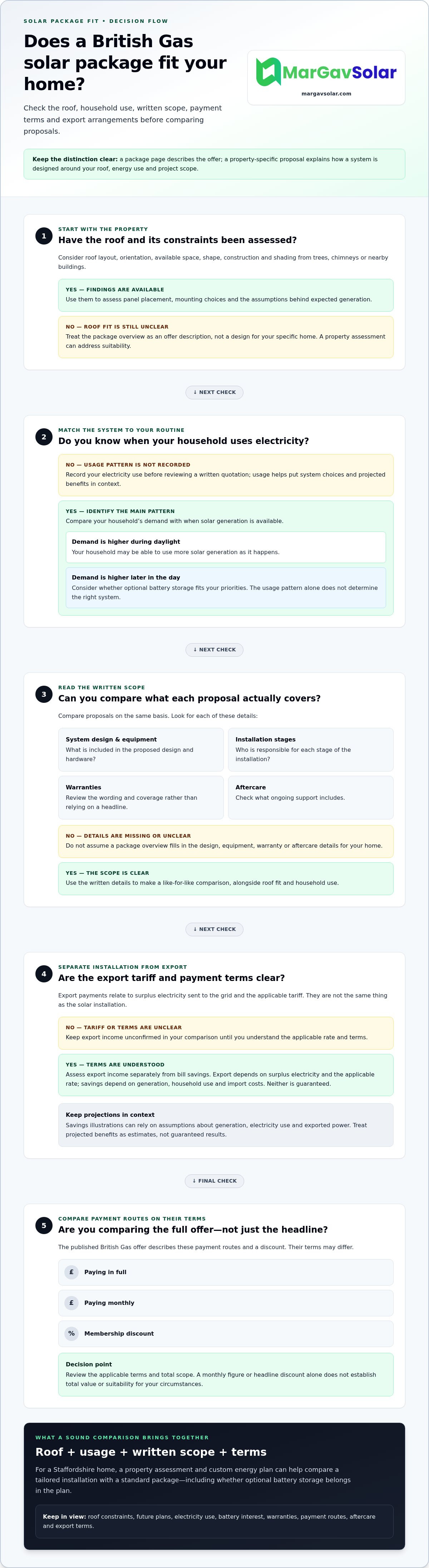
A Staffordshire homeowner’s checklist before choosing a solar package
A useful comparison starts before you review the quote. Put your household’s priorities and property details in one place, then use them to judge whether each proposal answers the same questions. This makes the limitations of British Gas solar packages easier to assess against your needs instead of relying on general descriptions.
- Gather electricity-use information. Review recent bills or account records to understand how much electricity your household uses. Note when demand is usually highest, such as during the day, in the evening or at weekends. This helps connect a proposed system to your routine.
- Record roof details and constraints. Note the roof areas you can see, their orientation if known, nearby trees or buildings that may cause shade, and any features that could affect panel placement. You don’t need to diagnose the roof yourself. These observations give an assessor useful context.
- List future plans. Consider whether household changes could affect electricity use, such as an extension, a change in occupancy or plans to add an electric vehicle. You don’t need to predict exact consumption. The aim is to include future priorities in the discussion.
- Decide what matters most. Rank your priorities, whether that’s generating electricity, using more solar power at home, considering battery storage, preserving the property’s appearance or understanding aftercare. A clear order helps reveal where proposals make different trade-offs.
- Compare the proposed scope. For each written quotation, record what the design includes, how it responds to your roof and what assumptions sit behind any generation or savings illustrations. Mark gaps or differences rather than treating proposals as equivalent.
- Review payment and export separately. Write down the payment route and its terms, then note any export tariff details separately from the installation. This keeps tariff income from being mistaken for a guaranteed saving or an included part of the system.
A property assessment turns those notes into a practical design discussion. The proposed layout can be considered alongside roof constraints, household use and your priorities. A custom energy plan can then explain how solar panels and optional battery storage relate to the project. For local project context, the Staffordshire solar installation guide can help you understand what to expect, while an assessment addresses the details of your own home.
Before deciding, make sure the written quotation describes the proposed work and the assumptions behind its figures in terms you can compare. If storage or aftercare affects your decision, include it in your notes and look for a clear explanation in the proposal. MarGav Solar’s process includes a consultation, property assessment and quotation, followed by a custom energy plan for the project.
Ready to compare a package with a plan shaped around your home? Arrange a free, no-obligation solar consultation for your Staffordshire property.
A tailored Staffordshire solar assessment: the practical next step
Once you’ve compared package details and noted what matters to your household, see how a proposed system fits your property. MarGav Solar provides residential solar installations and battery storage for UK homes, with Staffordshire as a local focus. A property-led plan gives you a practical point of comparison by connecting your roof, electricity use and priorities to a proposed project rather than relying on a generic package description.
What MarGav Solar’s assessment-led process offers
The process begins with a free, no-obligation consultation to discuss your aims and property. A property assessment informs a quotation and custom energy plan, helping relate the proposed solar PV system to your roof and household needs. The plan can consider solar panels alongside optional battery storage, so you can compare the roles of generation and storing electricity within one project outline.
System design can include high-efficiency solar systems designed to preserve architectural integrity while maximising generation and return on investment, as well as custom mounting solutions for different property types. MarGav Solar also provides industry-leading warranties. The relevant warranty wording belongs in the project documents, so you can review the stated terms as part of your comparison.
Where storage is part of the plan, MarGav Solar’s battery solutions use smart lithium-ion technology with peak-time optimisation and smart energy management. Whether that option fits depends on your priorities and energy use. The assessment-led approach keeps the discussion grounded in your home rather than assuming every household needs the same equipment.
After the plan and quotation, the process continues through professional installation and aftercare and support. Together, these steps provide a clearer view of the project, from design through to what follows installation. They also give you information to compare against a British Gas package on scope, design and stated terms.
Choose a low-pressure next step
If you’re still exploring, MarGav Solar’s free quick-scan tool offers a no-commitment way to begin. For a more property-specific discussion, the free, no-obligation consultation is an opportunity to talk through your roof, household priorities, future plans and interest in battery storage. Bring your comparison notes to focus the conversation on the questions that matter to you.
Book a free, no-obligation solar consultation to discuss a tailored Staffordshire plan. Comparing it with a British Gas offer doesn’t require deciding that one approach suits every home. It means weighing the written scope and design against your property and priorities, then choosing with a clearer understanding of the fit.
Make your next solar decision property-led
The limitations of British Gas solar packages aren’t a verdict on whether solar is right for your home. They’re a prompt to make your decision around the details that matter to you, from how a proposed design fits your property to the terms and assumptions behind the offer.
For Staffordshire homeowners, a tailored proposal can make those details easier to weigh. MarGav Solar considers different property types with custom mounting solutions and provides industry-leading warranties, with the relevant terms set out for your review. If you’re still at the research stage, the free quick-scan tool offers a no-commitment way to take an initial step.
Choose a route that suits where you are now: explore the quick-scan tool or start a conversation about your home and priorities. Either way, focus the comparison on a plan that feels clear, considered and relevant to your property.
Book a free, no-obligation solar consultation and take the next step towards a more informed choice.
Frequently Asked Questions
What are the main limitations of British Gas solar packages?
The main limitations to consider are gaps between a package overview and the details needed to judge a specific home. The British Gas page promotes solar through Hive, describes payment routes and outlines a customer journey, but that doesn’t show whether the design fits your roof or routine. Assess the limitations of British Gas solar packages by reviewing the written proposal, including what it covers and the assumptions behind any stated benefits.
Are British Gas solar packages suitable for every UK home?
No package description can establish that it suits every home. A roof with limited usable space, for example, may call for a different design discussion from a home with broad, unobstructed roof areas. Household routines matter too: someone working from home may use electricity at different times from a household that’s empty during the day. A property-specific design helps show how these circumstances affect the proposed system.
Does a British Gas solar package include a battery?
Don’t assume a battery is included just because solar and battery storage appear together in headline marketing. Check the specific package and written proposal. Look for the battery as a separately identified item and note whether it’s included or optional. That distinction helps you compare the system’s scope and decide whether storage aligns with your household plans.
Does the British Gas solar package guarantee the advertised savings?
No, a headline illustration shouldn’t be treated as a guaranteed saving for your home. Actual results can vary with system design, electricity use, energy prices and exported power. A household that uses little electricity while panels are generating, for example, may have different outcomes from one that uses more during those hours. Check the assumptions behind an estimate and use your own bills and usage pattern to assess its relevance.
Is the Smart Export Guarantee included with a British Gas solar package?
Don’t assume a particular tariff is included in an installation package. British Gas’s solar installation and SEG tariff information are presented separately. Export payments relate to electricity sent to the grid and depend on the applicable tariff terms and eligibility. Keep the installation proposal and export tariff information separate in your comparison, and consider how much electricity your household may use before exporting any surplus.
Can I compare British Gas solar with a local Staffordshire installer?
Yes. Compare proposals using the same property details and note where their scopes or assumptions differ. If one proposal describes battery storage separately and another combines it with solar, for instance, record that distinction before comparing overall value. MarGav Solar offers Staffordshire homeowners a free, no-obligation consultation and a free quick-scan tool with no commitment. These options can help you explore a property-specific plan alongside a package offer.
What is the difference between British Gas plug-in solar and an installed solar package?
They are different approaches and shouldn’t be treated as equivalent. The British Gas plug-in article describes a smaller system intended for a suitable outdoor space, while its solar page describes an installation journey through partners. Consider what each option is designed to do, how it relates to your property and what installation or use terms apply. Assess a rooftop solar proposal on its own written design and scope.


