

Could solar help run your irrigation pump without turning productive Staffordshire farmland into a large solar development? It depends on when the pump uses electricity, how much it needs and what your property can accommodate. When assessing solar panels for farms Staffordshire, look at those factors together rather than assuming solar generation and irrigation demand will automatically match.
Solar electricity can support pumping when the pump runs during periods of generation. Battery storage may help make some generated electricity available later. To assess the fit, gather information about pump use, the farm’s wider electricity consumption, potential panel locations and the property’s electrical setup.
This guide explains how solar can contribute to irrigation, what affects system performance and which site details help shape a practical plan. It also distinguishes on-site solar for a farm’s own energy use from utility-scale solar farms, a separate land-use issue that has prompted debate in Staffordshire.
Key Takeaways
- On-site solar can generate electricity for farm operations, including a compatible irrigation pump. This is different from a utility-scale solar development designed to export electricity to the grid.
- Compare the pump’s electrical requirements and operating schedule with solar generation to see how well they may align.
- Assess roof or ground-mounted options by usable space, shading, orientation, structural suitability and connection to the farm’s electrical system.
- For solar panels for farms Staffordshire, gather pump specifications, operating schedules, electricity information and seasonal demand patterns to support a practical assessment.
- MarGav Solar’s commercial solar process includes property assessment and a custom energy plan to consider a farm’s generation potential and electricity needs.
Solar panels for farms in Staffordshire: what solar-powered irrigation means
For solar panels for farms Staffordshire, the key question is how electricity generated on site could fit the farm’s workload. Solar-powered irrigation means using solar-generated electricity to help operate an electrically powered water pump. Panels generate electricity; the pump and the wider irrigation setup move and distribute water.
Put simply: on-site farm solar generates electricity for use in farm operations, including a compatible irrigation pump. A utility-scale solar farm is a larger development designed to generate electricity for export to the grid, rather than simply serve one farm’s needs.
How can farm solar electricity support irrigation?
Solar panels generate electricity that can be converted and supplied through the property’s electrical system to equipment such as a pump. A system may include battery storage to help manage when generated electricity is used, but storage doesn’t guarantee power whenever irrigation is needed. Solar-powered pump systems for irrigation offer a useful overview of how solar pumping can be applied.
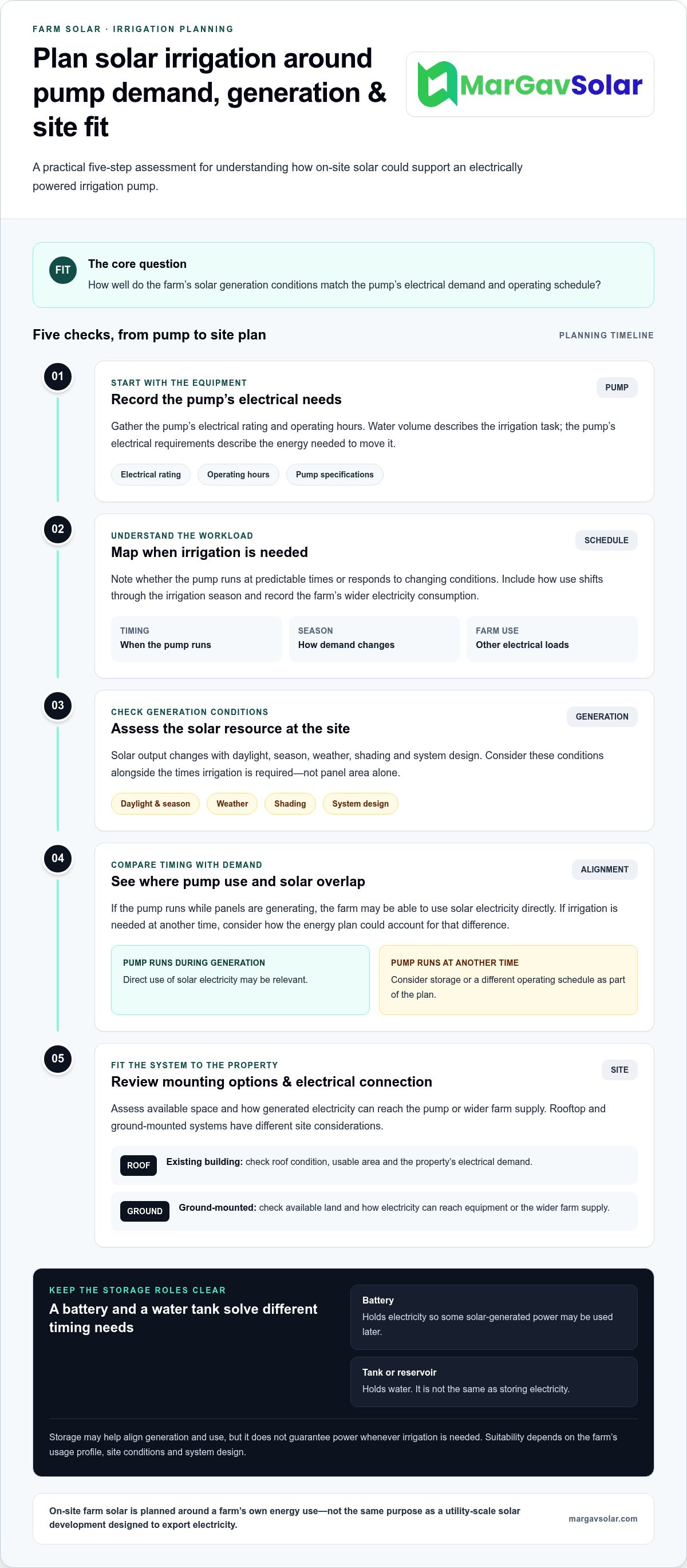
Timing matters. If the pump runs while the panels are generating, the farm may be able to use solar electricity directly. If irrigation is needed at another time, the energy plan needs to account for that difference, including whether storage or a different operating schedule is appropriate. A battery holds electricity; a tank or reservoir holds water. They address different needs, so consider them separately.
Start with the pump’s electrical requirements and operating schedule, then compare them with likely solar generation and site conditions. Pump demand, seasonal irrigation patterns, daylight, weather, shading and system design all affect how well the two align. Solar can contribute to pumping, but the panels alone don’t determine how much water can be moved or when.
Farm solar versus a utility-scale solar farm in Staffordshire
An on-site system is assessed against a particular farm’s electricity use. Panels on an existing building, for example, need to be considered in relation to roof condition, usable area and the property’s electrical demand. A ground-mounted system requires a different assessment, including the available land and how the electricity can reach equipment or the wider farm supply.
Utility-scale proposals have a different purpose and scale: they generate electricity for export and may involve substantial areas of countryside. In Staffordshire, debate around these developments can involve food security, landscape, habitats and local priorities. Those concerns don’t automatically determine whether an individual farm’s on-site system is suitable, but they help explain why the distinction matters.
For irrigation planning, focus on the farm’s own demand and site. Assessing an existing building and its electrical use is not the same as considering a large ground-mounted development on agricultural land.
How solar generation, irrigation pumps, and battery storage work together
Matching solar electricity to irrigation is a question of timing and demand. Panels generate electricity when daylight is available, but output changes with season, weather, shading and system design. A bright period may provide useful generation while a pump is running; cloud, shade or a different operating schedule can change how much electricity is available at that moment.
Solar-to-pump suitability depends on how well the site’s generation profile matches the pump’s electrical demand and operating schedule. Panel area alone can’t tell you whether the system is a good fit. For solar panels for farms Staffordshire, assess the farm’s equipment, site conditions and seasonal irrigation pattern together.
What determines an irrigation pump’s electricity demand?
Start with the pump’s electrical rating, its operating hours and how use changes through the irrigation season. Note whether it runs at predictable times or in response to changing conditions, and record the farm’s wider electricity use. These details help show whether pump demand is likely to coincide with solar generation, rather than relying on a generic estimate that may not reflect the farm’s setup.
Water volume and electricity demand are related, but they aren’t interchangeable measures. Water volume describes the irrigation task; the pump’s electrical requirements describe the energy needed to move it. Pump specifications and operating records provide a more useful starting point than water volume alone.
When could battery storage help with solar-powered irrigation?
A battery can store some solar-generated electricity for use after it’s produced, potentially helping align daytime generation with a later operating period. Whether that is useful depends on the site’s generation and usage profile, including when the pump runs and what other equipment draws power. Consider storage as part of the whole energy plan, not as a guarantee that irrigation will always be available.
For example, if the pump’s schedule rarely overlaps with solar generation, storage may be worth considering alongside other ways of planning operations. If the pump runs during sunny periods, direct use may be more relevant. Neither pattern guarantees a particular result: suitability depends on system design and the farm’s conditions.
- Generation: Consider daylight, seasonal changes, weather and shading at the proposed panel location.
- Pump demand: Gather the electrical rating, typical operating hours and seasonal schedule.
- Storage: Compare when electricity is generated with when the pump and other equipment need it.
- Site fit: Include the property’s electrical setup and the locations of the panels and pump.
This information helps distinguish a system that can contribute to irrigation from one expected to meet every pumping need. A tailored commercial solar assessment can consider a farm property’s generation potential and electricity use, including how storage might affect when solar electricity is used.
Rooftop or ground-mounted solar for Staffordshire farms?
Choosing where panels might go means balancing generation potential with farm operations and the route electricity must travel to where it’s needed. An existing barn roof may make use of developed space, while a ground-mounted array may be an option where roof area or condition is unsuitable. Neither is automatically right for every farm. For solar panels for farms Staffordshire, the practical choice depends on the property, its electrical demand and the wider land-use context.
| Option | Key checks | Irrigation-planning consideration |
|---|---|---|
| Existing building roof | Roof condition and structure, orientation, shading, usable area, electrical layout | Consider how the proposed system connects with the property’s electrical demand and pump location. |
| Ground-mounted array | Available land, access, relationship to farm operations, landscape context, electrical connection | Consider the route from the array to the farm’s electrical system and the pump’s operating needs. |
When might a farm building roof be worth assessing?
Barns, machinery sheds and other existing buildings can be starting points for a site assessment. Their potential depends on more than roof area: condition and structural suitability matter, as do orientation, shade from trees or nearby buildings, and the property’s electrical layout. The distance between a roof, the electrical connection and a pump may inform system design, but proximity alone doesn’t guarantee a particular level of performance.
Consider how the building is used, too. A roof that appears available may have constraints that become clear during a closer property assessment. Reviewing structure, shading and electrical layout together helps establish whether it’s a practical location to explore.
What should farms consider before ground-mounted solar?
Ground-mounted panels use land rather than an existing roof, so consider how the proposed area relates to grazing, crops, access routes and other farm operations. Landscape and habitat impacts, along with concerns about food security, are part of the wider Staffordshire discussion around solar development. Consider these issues without assuming that every on-site project has the same scale or effect as a utility-scale proposal.
Before progressing a ground-mounted idea, review current requirements and guidance from the relevant Staffordshire planning authority. Planning considerations depend on the proposal and location, so don’t assume a ground-mounted system will receive approval. An individual farm’s on-site energy project is distinct from a large development intended to export electricity and affect a broader area of countryside.
Use the site assessment to connect location with purpose. A roof may be worth exploring if it is suitable and can serve the farm’s electrical needs. Ground mounting may be appropriate where land, access and operational requirements align. In either case, a project-specific assessment should bring together structural suitability, shading, orientation, usable area and electrical connection, then relate those factors to the farm’s energy demand.
Plan a solar-powered irrigation project: five practical steps
A useful assessment starts with information from your own farm, not a guessed panel or battery size. For solar panels for farms Staffordshire, bring together irrigation demand, electricity use and site details so the proposed system can be considered alongside daily operations and seasonal needs.
Five steps to prepare for a property assessment
- Document irrigation demand. Gather pump specifications, including electrical details, and note typical operating periods. Record how irrigation needs change through the season, including when pumping is most likely to be needed.
- Review possible locations. List suitable barns, machinery sheds and other buildings, as well as any land you want assessed. Note known roof condition, usable area, shade, access and the distance between potential panel locations, the electrical connection and relevant equipment.
- Collect electricity information. Bring available electricity bills or usage records and details of the property’s electrical infrastructure. This helps show how irrigation fits alongside other farm loads. Avoid using incomplete information to assume a guaranteed system size.
- Assess generation against demand. Compare the site’s solar generation potential with the pump’s operating pattern and other electricity use. Seasonal demand, daylight, weather, shading and system design can all affect the relationship.
- Consider storage and next actions. Discuss whether battery storage could make some solar electricity available at a different time. Note any planning questions for the relevant Staffordshire authority, and review applicable requirements and funding terms before including them in a project plan.
How do consultation, assessment and funding fit into planning?
These notes create a practical foundation for a professional property assessment. MarGav Solar’s process includes consultation, property assessment and a quotation, followed by a custom energy plan, professional installation and after-care. The assessment considers generation potential alongside the farm’s electricity needs. Your pump specifications and operating records help make that assessment relevant to irrigation.
Commercial solar panel installations may receive up to 50% funding. Funding is an opportunity, not a guaranteed amount for every farm or project. Review the applicable eligibility requirements and terms before including funding in a project plan. Planning requirements also depend on the proposal and location, so use current guidance from the relevant planning authority.
With pump details, operating records and site notes prepared, you can have a more focused discussion about what to assess. MarGav Solar offers a free, no-obligation solar consultation to explore your property’s generation potential and energy use.
Explore farm solar with MarGav Solar in Staffordshire
Planning solar panels for farms Staffordshire starts with understanding how a property could generate electricity and how that generation relates to the farm’s energy use. MarGav Solar’s commercial solar service assesses those needs. The discussion can include irrigation demand as part of the wider picture, without assuming that one system will meet every pumping requirement.
Good preparation makes the discussion more useful. Bring information about the pump and site, along with a clear view of when electricity is needed. This gives the property assessment practical context and helps shape a custom energy plan around the farm rather than a generic assumption about agricultural use.
What happens during a MarGav Solar assessment?
The process begins with a consultation, followed by a property assessment and quotation. The property’s generation potential and electricity needs inform a custom energy plan. If you proceed, professional installation and after-care follow. Each step supports a considered plan for the site and its energy use.
MarGav Solar also provides battery storage, which can help manage when some generated electricity is used. Its role depends on the farm’s generation and usage profile, so consider it alongside the overall energy plan rather than as a promise of uninterrupted pump operation.
What should you do next if farm solar looks relevant?
Before a consultation, collect the details that explain the farm’s requirements and constraints. A concise set of notes can be more useful than trying to estimate a system size yourself:
- Pump specifications and electrical information, plus typical operating periods.
- Seasonal irrigation patterns and changes in when pumping is required.
- Available electricity information, such as usage records for the property.
- Potential building or land locations, with notes on shading, access and electrical infrastructure.
This gives the assessment a starting point for considering generation potential, site suitability and how energy is used across the property. The aim is to share enough context for a tailored discussion and identify which details should inform the next planning decisions.
MarGav Solar’s free quick-scan tool is available with no commitment. Treat any early indication as a starting point for discussion, not a guaranteed savings estimate or final system design. A consultation and property assessment can bring the farm’s energy information and site conditions together for a fuller view.
To discuss your property and its electricity needs, arrange a free, no-obligation consultation with MarGav Solar.
Take the next step towards a farm-specific solar plan
The value of a solar project depends on how well it fits your farm, not on a one-size-fits-all estimate. If you’re considering solar panels for farms Staffordshire, use your irrigation and electricity records as a starting point for a tailored discussion about your property’s generation potential and energy needs.
MarGav Solar’s free quick-scan tool offers an initial way to explore your property’s potential, with no commitment. Commercial solar panel installations may receive up to 50% funding, though the amount is not guaranteed for every project. Review applicable eligibility and terms before factoring funding into your plans.
A measured next step can help you decide what deserves closer assessment before making plans around land, buildings or irrigation schedules. Arrange a free, no-obligation consultation with MarGav Solar to discuss your farm’s energy needs and explore a project-specific plan.
Frequently Asked Questions
Can solar panels power irrigation pumps on a farm?
Solar-generated electricity can help run an electrically powered irrigation pump when the system is designed around the pump’s demand. For a Staffordshire farm, consider whether irrigation runs at set times or responds to changing crop or weather conditions. That helps show how predictable the electricity requirement is. A property assessment can consider pump needs alongside other farm electricity use, without assuming solar will cover every pumping period.
Do solar-powered irrigation systems work in cloudy weather?
Panels can still generate electricity in cloudy conditions, though output varies with daylight and weather. The practical question is whether enough electricity is available for the pump when it needs to run. If a farm’s irrigation schedule can shift, its energy plan can be assessed against different operating periods. Cloudy-day generation varies, so don’t assume pumping will continue uninterrupted in all conditions.
Can a farm battery store solar power for irrigation at night?
A battery can make some solar-generated electricity available after it was produced, potentially including during evening or night-time pumping. Whether it can support a particular schedule depends on the farm’s generation, electricity use and storage design. Don’t assume a battery will run a pump all night or satisfy every irrigation need. Include other farm loads in the discussion, since they may also use stored electricity.
Are rooftop solar panels better than ground-mounted solar for farms in Staffordshire?
Neither option is automatically better; the farm’s buildings, land and operational priorities shape the comparison. A roof assessment may focus on structural suitability and shading, while a ground-mounted proposal also involves land use, access and landscape. Staffordshire farms may weigh these choices alongside food production and habitat concerns. Current guidance from the relevant planning authority can clarify considerations for a specific site and proposal.
What information is needed to assess solar for an irrigation pump?
Gather the pump’s electrical specifications, usual operating periods and records of how irrigation needs change through the season. Add available electricity information, such as bills or usage records, and note potential panel locations, shade and the electrical setup. For solar panels for farms Staffordshire, these details help make an assessment specific to the property. They’re a starting point, not enough on their own to promise a system size or performance.
Is funding available for commercial solar panels in Staffordshire?
Commercial solar panel installations may receive up to 50% funding, but this isn’t guaranteed for every farm or project. Review applicable eligibility requirements and terms before including funding in a budget or business case. Treat the percentage as a potential opportunity, not a confirmed award.
Does MarGav Solar install irrigation pumps as part of a solar system?
MarGav Solar assesses a property’s solar generation potential and electricity needs, develops a custom energy plan and installs solar systems. For irrigation planning, bring pump details and operating patterns into the assessment so the electrical demand can be considered. MarGav Solar also provides battery storage, which can help manage when generated electricity is used, depending on the project design and energy profile.


