

Can solar power for listed buildings Staffordshire provide clean energy while preserving the features that make a historic home special? It may be possible, but the answer depends on more than the roof. Consent, the building’s setting and a design tailored to the property all matter.
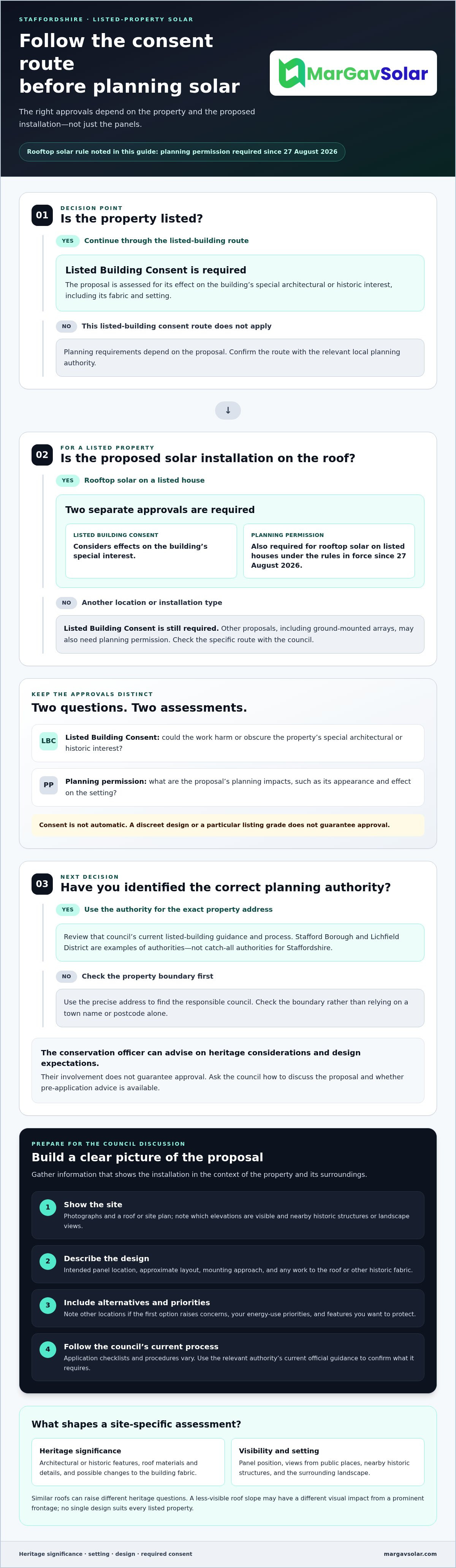
It’s understandable to hesitate if visible panels could affect a property’s character or the approval route is unclear. Listed Building Consent is required, and since 27 August 2026, planning permission is also required for rooftop solar installations on listed houses. The local planning authority considers the proposal’s impact on the building and its surroundings, with advice from its conservation officer.
This guide explains the consent process and the key considerations for Staffordshire homeowners. It compares potential panel locations and design approaches, then outlines how to prepare for a property assessment and explore a custom energy plan. The aim is to help you understand the options before deciding whether solar is right for your home.
Key Takeaways
- Solar power for listed buildings Staffordshire needs a design that considers energy generation alongside the property’s heritage significance.
- Understand the approval route and the roles of your local planning authority and its conservation officer before progressing with a proposal.
- Compare less-visible roof areas, suitable outbuildings and ground-mounted options. Each location needs a site-specific assessment.
- Prepare for a property assessment by noting roof orientation, visible elevations, nearby structures and your household energy priorities.
- MarGav Solar’s consultation, property assessment and custom energy plan provide a structured way to explore practical next steps.
Can solar power work on a listed building in Staffordshire?
Heritage status doesn’t automatically rule out solar, but the design and location must be considered in light of the property’s special architectural or historic interest. The key question isn’t just how much electricity you want to generate. It’s also how the proposed installation could affect the building and its setting.
Solar photovoltaic (PV) panels convert sunlight into electricity for use in the property. You might also consider battery storage as part of your energy plan. These choices help define your energy goals, but they don’t resolve the separate planning and conservation questions. Listed-building solar feasibility depends on significance, setting, design and required consent.
What listed status means for a solar project
Listing recognises a building’s special architectural or historic interest, which must be considered when work is proposed. An assessment looks at what makes the property special and whether an installation could harm or obscure those features. The impact can depend on panel position, mounting approach and any changes to the building fabric.
Listed Building Consent is required for solar installations on listed buildings. Rooftop work may also need planning permission. These are separate considerations: one focuses on the listed building’s significance, while the other addresses planning impacts such as appearance and setting. Consent isn’t automatic, and neither a particular grade nor a discreet design guarantees approval. For general UK context on solar and planning, see Solar Power in the United Kingdom.
Why Staffordshire properties need a site-specific view
Two homes with similar roofs can raise different heritage questions. Panels on a slope hidden from public viewpoints may have a different visual impact from panels on a prominent frontage. Nearby historic structures, roof materials and details, and views across the surrounding landscape can all affect which designs are worth exploring. A site assessment connects these details to a practical system design instead of assuming one solution suits every listed property.
Staffordshire addresses fall under different local planning authorities, so the relevant council depends on the property’s location. Identify the correct authority early, then review its application guidance and the process for discussing a proposal.
An online guide can help you frame questions, but it can’t assess your building’s significance, visibility or physical constraints. Start by noting your priorities: how you hope to use the electricity, which roof areas are visible and which features you want to protect. MarGav Solar’s consultation and property assessment can help explore an energy plan tailored to the property, balancing generation with architectural integrity. This gives you a clearer basis for considering the design and approval route before making installation decisions.
Listed Building Consent for Staffordshire solar: understand the approval route
For solar power for listed buildings Staffordshire, start with the property and the proposed work, not a one-size-fits-all rule of thumb. Listed Building Consent is required for a solar installation on a listed building. The assessment considers how the proposal could affect the building’s special architectural or historic interest, including its fabric and setting. This is general guidance, not legal advice or a promise of approval. Check current requirements and procedures with the relevant local planning authority.
Listed Building Consent addresses the effect of work on a listed building’s special interest. Planning permission is a separate assessment of the proposal’s planning impacts. For rooftop solar on a listed house, planning permission is also required under the rules in force since 27 August 2026. Other proposals, including ground-mounted arrays, may also need planning permission, so establish the route for your project with the council.
Find the right planning authority for your Staffordshire address
Use the property’s precise address to identify its local planning authority. Stafford Borough and Lichfield District are examples, not catch-all authorities for Staffordshire. Check the boundary rather than relying on a town name or postcode alone. The council’s conservation officer can advise on heritage considerations and design expectations, but their involvement doesn’t guarantee approval.
Prepare a clear application discussion
Before approaching the council, gather information that explains the proposal in context. Photographs, a roof or site plan and a concise description can help focus the discussion. Application checklists and procedures vary, so use the relevant authority’s current official guidance to establish what it requires.
- Identify the authority. Confirm which council handles planning for the exact property address, then find its listed-building and planning guidance.
- Describe the proposal. Note the intended panel location, approximate layout, mounting approach and any work to the roof or other historic fabric. Include alternative locations if the first option raises concerns.
- Seek guidance early. Ask the council how to discuss the scheme with its conservation officer and whether pre-application advice is available. Explain which elevations are visible and how the design aims to limit harm to the building’s character.
- Follow the council’s process. Check its current requirements for application forms, supporting documents and any separate planning application. Submit the information it requests and wait for the necessary decisions before arranging work.
Keep the discussion specific: explain why you’re considering that location, what can be seen from nearby viewpoints, and how the proposed fixings and layout relate to historic details. Don’t assume that a rear roof, outbuilding or discreet system removes the need for consent. Include it in the proposal for assessment.
If you’re still shaping the idea, MarGav Solar’s solar consultation can help connect your property’s constraints with a tailored energy plan before you make installation decisions.
Compare discreet solar options for listed properties in Staffordshire
No single solar layout suits every historic property. A less prominent roof, an outbuilding or a ground-mounted array may be worth considering, but visibility, heritage significance and site constraints all shape the design discussion. These are options to assess, not shortcuts to approval.
For solar power for listed buildings Staffordshire, compare each location against two practical aims: limiting visual impact and meeting your energy priorities. Use the table to prepare questions, not to predict consent or guarantee a particular level of generation.
| Option | Visibility | Potential site fit | Assessment questions |
|---|---|---|---|
| Less-visible roof area | May be less prominent from public viewpoints than a principal elevation. | A roof slope with suitable space and site conditions. | Can it be seen from nearby streets or important views? What fixings and roof alterations are proposed? |
| Suitable outbuilding | Depends on its position, scale and visibility within the property. | A building that can accommodate the system without compromising its own significance. | Is the structure historic? How does it relate to the listed house and its setting? |
| Ground-mounted array | Could be screened in some locations, but may be visible across the site or landscape. | Land with suitable space and access, subject to the property’s setting and constraints. | Would it affect important views, landscaping or the relationship between historic structures? |
| Roof-integrated or tile-style approach | May sit differently within the roof plane than conventional panels, depending on the design. | A roof where the proposed materials and intervention are suitable for assessment. | What historic fabric would be replaced or altered? How does the appearance compare with the existing roof? |
Roof-mounted panels and less-visible elevations
A rear or secondary slope can be less noticeable than a principal roof facing a road, but “less visible” doesn’t automatically mean acceptable. Consider views from public spaces and neighbouring land, along with the roof’s materials, shape and detailing. MarGav Solar offers custom mounting solutions for different property types, which can help tailor a design to the site. The mounting approach doesn’t establish that work will be accepted or remove the need for consent.
Outbuildings, ground mounts and integrated approaches
Panels on an outbuilding may shift attention away from the main roof, but the structure’s own heritage value and its relationship to the house still matter. Ground-mounted systems need suitable space and can affect the wider setting through their position or visibility. Their potential depends on the site, not simply on being separate from the main building.
Roof-integrated or tile-style systems may look different from conventional panels, but can involve changes to roofing materials and historic fabric. That makes a property-specific assessment important. No mounting method guarantees consent. Available roof area, orientation, shading and system design also influence generation. A tailored assessment can compare these trade-offs before you settle on a preferred option.
Assess whether your Staffordshire listed property is ready for solar
Start by organising what you already know about the property. A few observations and photographs can make an assessment more focused, helping connect practical constraints and heritage considerations with a system design. You don’t need to arrive with technical answers. Clear notes about the building, its surroundings and your energy priorities are a useful starting point.
What to record before a property assessment
If you can, walk around the property and note which roofs and elevations are visible from the house, garden and public viewpoints. Take clear photographs from these angles, along with any plans or records that show the building’s layout. Previous planning correspondence may also provide useful context.
- Roof orientation: Note which direction each roof slope faces and any obvious shading from trees, chimneys or neighbouring buildings.
- Visible elevations: Record which parts of the roof can be seen from roads, paths or nearby properties, and which are less prominent.
- Building details: Gather known information about roof materials, historic features and areas you’re particularly keen to protect.
- Plans and correspondence: Collect available floor plans, roof or site plans, and previous planning or conservation-related letters.
- Other possible locations: Note outbuildings or open ground that might be worth discussing, without assuming either is suitable for panels.
- Energy priorities: Consider whether your main aim is to use solar electricity during the day, explore battery storage or meet another household need.
These notes turn a broad question into a practical conversation about your home. They may also reveal gaps, such as a roof area you can’t view clearly or an outbuilding whose condition needs further consideration.
Turn heritage priorities into a custom energy plan
Readiness isn’t just about finding a place where panels might fit. A useful assessment considers the property’s layout, visibility and significant architectural details alongside your preferred energy outcomes. The aim is to explore how a tailored system could balance generation with architectural integrity, while recognising that design choices depend on the property and its constraints.
MarGav Solar’s process includes a property assessment and a custom energy plan, giving you a structured way to consider the site before moving towards installation. For a broader overview of residential systems and installation planning, the Solar Panel Installation in Staffordshire: A Comprehensive Guide offers a related starting point.
When you’re ready to discuss your notes and priorities, arrange a free, no-obligation consultation to explore a tailored approach for your Staffordshire property.
Plan heritage-sensitive solar with MarGav Solar in Staffordshire
Once you’ve gathered information about your property, the next step is to turn those observations into a considered project plan. MarGav Solar’s process connects the building’s character and site conditions with your energy needs. Its high-efficiency solar panel systems are designed to preserve architectural integrity while maximising generation and return on investment (ROI), with a custom design for the property rather than a one-size-fits-all approach.
For solar power for listed buildings Staffordshire, that tailored approach matters. The roof’s appearance, the location of historic features and your energy priorities all inform the discussion. Exploring options doesn’t commit you to installation. It helps you understand what a proposal could involve before deciding how to proceed.
What MarGav’s tailored process covers
The process begins with a consultation, followed by a property assessment and quotation. This establishes the building’s context and your requirements, including the features you want to protect and the energy outcomes you want to explore. Your photographs, plans and notes can help make the discussion more focused.
MarGav then develops a custom energy plan shaped around the property. The plan considers how the system design can balance potential generation with the building’s architectural integrity. The assessment and plan provide a basis for discussing the proposed approach before work begins.
- Consultation: Discuss your property, priorities and initial questions about solar.
- Property assessment and quotation: Consider the site and project requirements, then establish the proposed work and quotation.
- Custom energy plan: Set out a tailored approach that considers the property and your energy goals.
- Professional installation: Install the agreed system once the project is ready to proceed.
- After-care: Continue with support after installation, alongside industry-leading warranties. Specific warranty terms depend on the relevant warranty.
This sequence gives you clear points to consider the project, rather than treating an initial conversation as a commitment. MarGav Solar also offers custom mounting solutions for different property types.
A clear next step for Staffordshire homeowners
A free, no-obligation consultation is a straightforward way to discuss your property and the options you’re considering. You can explain what matters most, whether that’s keeping panels out of prominent views, exploring possible locations or understanding how solar might contribute to household energy use. The conversation gives you space to consider the project without committing to installation.
For a listed home, start with a design discussion grounded in the property itself. Book your free, no-obligation consultation to explore solar potential while keeping the building’s historic character in view.
Take the next step towards a considered solar plan
Choosing whether to pursue solar doesn’t mean rushing into a design or installation. Take time to weigh what matters for your home: its historic character, the views around it and the role you’d like a system to play. A focused conversation can help turn those priorities into a practical direction for solar power for listed buildings Staffordshire.
MarGav Solar designs high-efficiency systems to balance architectural integrity with generation and return on investment, and offers custom mounting solutions for different property types. Industry-leading warranties are also part of the picture, with specific terms set out for the project.
Your first step can simply be exploring the possibilities for your property. A free, no-obligation consultation gives you space to discuss its requirements and consider a tailored way forward, without committing to installation.
Arrange your free, no-obligation consultation with MarGav Solar to explore solar for your Staffordshire home while respecting its historic character.
Frequently Asked Questions
Can I install solar panels on a Grade II listed building?
Potentially, but Grade II status doesn’t mean a proposal will automatically be accepted or refused. The assessment focuses on the building’s special interest and how the panel location and installation could affect it. For solar power for listed buildings Staffordshire, identify the features that contribute to the property’s character and consider how different layouts might affect them. The relevant authority decides on the proposal.
Do solar panels on a listed building always require Listed Building Consent?
Yes. Under current guidance, Listed Building Consent is required for a solar panel installation on a listed building because the work can affect its character. Don’t assume that a small system or a less visible position removes this requirement. Separate planning permission may also be needed, including for rooftop solar on a listed house under the rules in force since 27 August 2026. Confirm the current application route with the local planning authority.
Can solar panels go on an outbuilding within a listed property's grounds?
They may be considered, but an outbuilding’s position away from the main house doesn’t automatically make it a simpler option. The structure may have heritage value of its own, and the installation could affect the listed property’s wider setting. Listed Building Consent requirements can extend to structures within the listed building’s curtilage. Describe the outbuilding’s location, appearance and proposed work to the relevant authority so the effects can be assessed.
Are solar roof tiles suitable for listed buildings?
They may be worth assessing, but roof tiles designed to incorporate solar aren’t automatically suitable for a historic roof. Their appearance, how they relate to existing materials and whether installation would alter historic fabric all matter. Compare them with conventional panels as part of a property-specific design discussion. A different visual profile alone doesn’t ensure consent, and expected generation depends on the roof and design.
Does a listed building's grade change the solar approval process?
The grade is relevant context, but it doesn’t replace assessment of the specific building and proposed work. The decision-maker considers the property’s significance and the possible effect of the installation. A higher grade isn’t a simple yes-or-no answer, just as Grade II status doesn’t guarantee approval. Include the features that make the property distinctive in your project information, and ask the relevant local planning authority which application route applies.
Can a listed church have solar panels?
It may be possible, subject to the applicable consent and planning requirements and an assessment of the church’s significance. Roof visibility, historic materials and the building’s setting can all shape the proposal. Churches may also have ownership or governance arrangements that affect who needs to be involved in a project. Establish the responsible decision-makers for the building and discuss the proposed work with the relevant planning authority before progressing.
Can adding solar panels affect a property's listed status?
Installing panels doesn’t automatically change a property’s listed status. Listing identifies the building’s special architectural or historic interest, and a solar proposal is assessed as work that could affect that interest. The key concern is whether the installation has the necessary approvals and how it affects the building, not an automatic change to its designation. Keep consent decisions and project records with the property documents for future owners and maintenance planning.


