

Choosing a solar installer by postcode alone can be as misleading as choosing one by brand recognition. If you’re wondering why choose a local solar installer over a national brand, the useful difference isn’t simply company size. It’s how clearly the installer assesses your Staffordshire property, explains the system and supports you from installation through aftercare.
A familiar national name may feel reassuring, while a local company may seem easier to reach. But neither size nor proximity tells you who will design and fit your system, or how support works once the panels are in place. Compare the practical details: property-specific design, clear responsibilities, what the quote includes and what happens after installation.
This guide explains how to compare those details for your home. We’ll look at who handles each stage, how a proposal accounts for your property and energy needs, and what to look for in aftercare and warranty information. MarGav Solar’s process starts with a free, no-obligation consultation, followed by a property assessment and quotation, a custom energy plan, professional installation and aftercare. Custom mounting solutions help shape a system around each property while preserving its architectural integrity.
Key Takeaways
- Company size alone doesn’t show who will design, install or support your system. Compare the work behind each offer to understand why choose a local solar installer over a national brand.
- Local and national installers can both provide a clear process. Focus on who is responsible for each stage and how communication is handled.
- Compare proposals by reviewing the property assessment, system design, installation responsibilities and aftercare, not just the headline offer.
- Use practical questions to understand how a proposed system suits your Staffordshire home and what support follows installation.
- MarGav Solar’s project process and free quick-scan tool offer ways to explore a solar plan for your property.
Why your choice of solar installer matters for a Staffordshire property
A familiar national name can feel like a shortcut to reliability, while a nearby company may seem more accessible. Neither impression tells you how a solar project will be planned or who will be responsible at each stage. To decide why choose a local solar installer over a national brand, look beyond the logo at the team and process behind the proposal.
Solar panels are a long-term home energy project, not simply equipment delivered to your door. The system design needs to reflect the property and household energy needs. Installation then turns the plan into a working system, while aftercare matters if questions arise later. For background on the technology and its uses, see the Solar Power Overview.
What counts as a local installer or national brand?
“Local” usually describes a business with a more limited operating area and a customer-facing presence in or near the communities it serves. A national brand operates across a wider area and may have a larger, more layered organisation. These labels describe reach and structure, not the quality of the work.
Installation arrangements can vary within either model. A local business may use its own team or work with other installers; a national company may deliver projects through regional teams or contractors. Company size alone doesn’t establish who will assess a Staffordshire property, prepare its design or carry out the installation.
Why the installer relationship matters after the quotation
A quotation is one point in a longer relationship. It should make the proposed work understandable, but the experience also depends on how design decisions are explained, how installation is coordinated and what support is available afterwards. Clear responsibility at each stage helps you understand what the offer includes and who you’ll deal with as the project progresses.
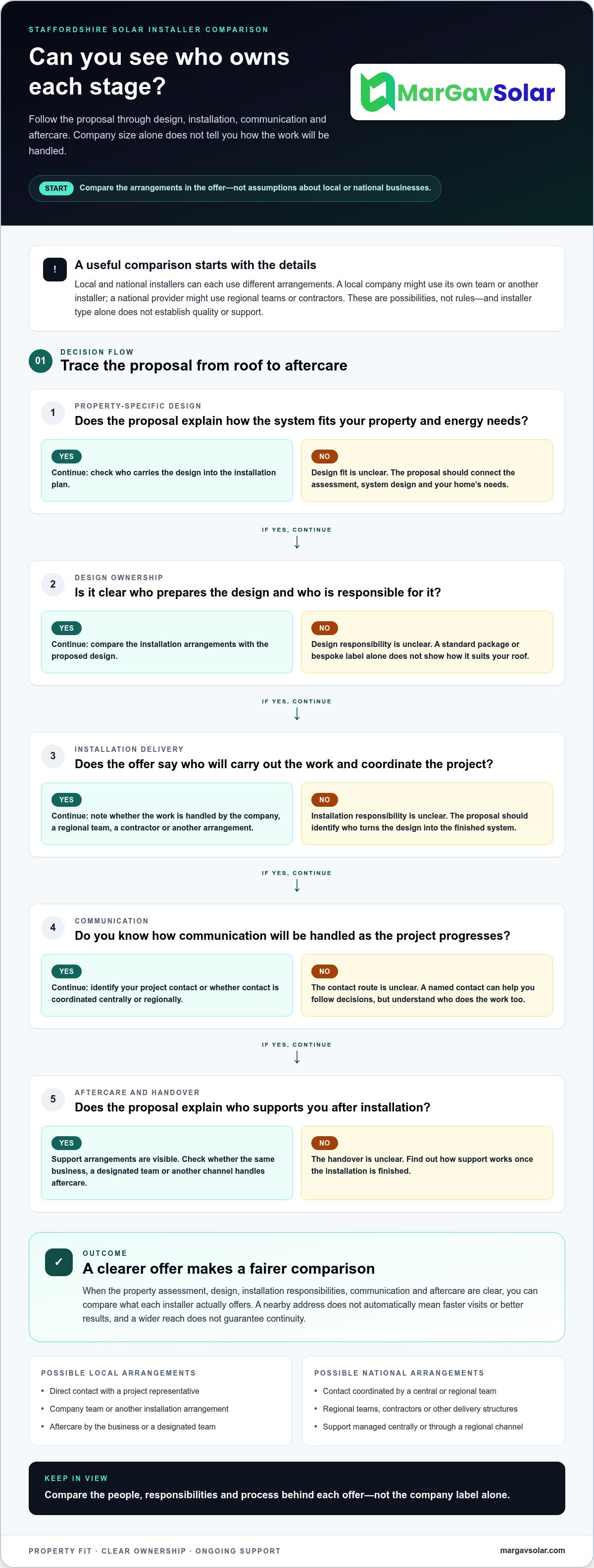
- Design: Does the proposal explain how the system relates to your property and energy needs?
- Installation: Is it clear who will carry out the work and coordinate the project?
- Aftercare: Do you understand how support is handled once installation is finished?
These points matter whether the provider is a local company or a national brand. A nearby address doesn’t automatically mean faster visits or better results, just as a wide reach doesn’t guarantee continuity. Focus on the practical arrangements and the clarity of the answers. For a property with particular architectural features, property-specific planning can include mounting solutions designed to respect the building’s character.
The takeaway: compare the people, responsibilities and process behind each brand, not company size alone. That gives you a more useful basis for deciding whether an installer’s approach suits your Staffordshire home.
Local versus national solar installers: compare the work behind the offer
Local and national installers can both provide an organised project, but their arrangements for design, fitting and support can differ. A local company might offer direct contact, while a national brand might coordinate through a central team. Those are possible structures, not rules. For a fair comparison, look at the responsibilities and process set out for your project instead of guessing how a business works based on its size.
Installer type alone does not establish installation quality or support. What matters is who owns each stage and how the handover works. A standardised package isn’t automatically unsuitable, and a bespoke label doesn’t explain how the design fits your roof. Compare the proposed system with your property’s layout and architectural features. Make sure the proposal also identifies who is responsible for turning the design into the finished installation.
Who designs and installs the solar system?
Look for a clear link between the property assessment, the proposed design and the installation plan. A named project contact can make it easier to follow decisions, but it is also important to understand who performs the design work and installation. Consumer guidance from the US-based National Consumer Law Center highlights issues relevant to rooftop solar arrangements; its Rooftop Solar Consumer Protection resource is useful background, though it isn’t UK-specific guidance.
How communication and aftercare may differ
Centralised support can provide a defined contact route; direct contact may feel more personal. Neither guarantees a particular response or outcome. Compare the stated aftercare process and written warranty information, including which organisation is responsible if you need support. MarGav Solar’s process runs from consultation to property assessment and quotation, then a custom energy plan, professional installation and aftercare. Its custom mounting solutions suit different property types while helping preserve architectural integrity. Learn more about MarGav Solar’s consultation and assessment process.
Does a national solar brand offer more security than a local installer?
A national name can feel reassuring because it suggests scale, established processes and a broad organisation behind the project. Those may be advantages, but reach alone doesn’t show whether your system will be well designed, responsibilities will be clear or support will be continuous. A local installer may offer direct contact, but proximity alone doesn’t demonstrate expertise either.
So, why choose a local solar installer over a national brand? The answer depends on the proposal and the people responsible for delivering it, not on a general rule about business size. A large provider may coordinate design, installation and support through separate teams, which can be efficient but involve several handovers. A smaller company may offer a more direct relationship, but its size alone doesn’t show what process it brings to your project.
Compare what each proposal documents. Look for a clear description of the planned system, who takes responsibility for each project stage, how installation is managed and what aftercare is included. Review written warranty information separately. These details give you a more useful picture of the offer than a national logo or local address on its own.
Can a smaller company manage a complete solar project?
Judge capability by the proposed scope and how the work is organised, not by assumptions about company size. A defined process shows how a project moves from early planning to support after installation. MarGav Solar’s process includes consultation, property assessment and quotation, followed by a custom energy plan, professional installation and aftercare. That makes the stages clear without suggesting every local installer works in the same way.
When comparing proposals, note whether the assessment informs the system design and how the installation relates to the plan. If battery storage is part of your wider discussion, consider how it fits into the home’s energy setup without losing sight of who manages the solar installation itself.
What do warranties and aftercare actually tell you?
A warranty is useful information, but its existence alone doesn’t explain its duration, terms or which organisation is responsible for responding to a claim. Keep those questions separate from aftercare: support arrangements and warranty cover are related, but they aren’t interchangeable. MarGav Solar describes its solar installations as having industry-leading warranties. For a particular project, review the written information alongside that description.
Read the warranty details supplied with the proposal and compare them with the named responsibilities for installation and aftercare. Check that you can distinguish what the warranty covers, how long it applies and who provides it. A clear written explanation helps you compare offers on substance, whether the installer is local or national, and understand what has actually been promised.
Bottom line: scale may shape how a company organises its work, but it doesn’t settle the question of security. Judge each offer by its documented responsibilities, project stages and warranty information, then decide which process gives you the clarity you need for your Staffordshire home.
How to compare solar installers for your Staffordshire home
Put proposals side by side and use the same checks for each one. This shifts the comparison away from sales language and towards what’s planned for your home: how the property assessment informs the design, who manages installation and what support is described afterwards. Keep the details in writing so you can spot differences and resolve unclear points.
- Start with the property assessment. Compare what each proposal says about your home and how those observations inform the plan. A useful proposal connects the assessment to the recommended system instead of leaving the design detached from the property.
- Compare the proposed system design. Look at how each layout responds to the roof and the building’s features. Check that the explanation makes clear why the proposed arrangement suits your property.
- Identify installation responsibility. Note who coordinates professional installation and explains the project stages. The provider’s size doesn’t answer those questions; the proposal and consultation should make the process clear.
- Review aftercare and warranty information. Compare what’s set out in writing, including the aftercare process and warranty details. Keep them distinct: one explains support arrangements, while the other sets out warranty information.
- Compare the whole offer. Once the design, responsibilities and support are clear, consider which proposal best fits your home and gives you confidence in the process.
Questions to use when comparing proposals
Use the same prompts in each consultation. How does the property assessment inform the custom energy plan? Who coordinates professional installation and explains the stages? What aftercare and warranty information is provided in writing? These questions bring out practical differences without assuming that a local or national business follows one particular model.
Quick comparison checklist
- Assessment: Can you see how details about the property shape the plan?
- Design: Is the proposed layout explained in relation to the home?
- Responsibility: Is it clear who coordinates installation and communicates each stage?
- Support: Are aftercare and warranty details described in writing?
How to compare system design for your property
Look beyond a system summary and consider how the proposed layout relates to your roof and the character of your home. Building features can affect design choices, so compare the reasoning behind each proposal, not just its headline description. MarGav Solar provides custom mounting solutions for every property type, with systems designed to preserve architectural integrity.
For more context on the installation journey and panel choices, the related guides Solar Panel Installation in Staffordshire: A Comprehensive Guide and How to Choose the Right Solar Panels for Your Home explore those topics in greater detail.
MarGav Solar’s process moves from consultation and property assessment to quotation, a custom energy plan, professional installation and aftercare. To discuss how that process can apply to your home, arrange a free, no-obligation consultation.
Choosing MarGav Solar for a Staffordshire project: consultation to aftercare
Choosing a solar installer is easier when you can see how the work progresses, not just what equipment is proposed. MarGav Solar’s process gives Staffordshire homeowners a clear sequence to consider: consultation, property assessment and quotation, a custom energy plan, professional installation and aftercare. This shows how the relationship continues beyond the first conversation.
What happens from first conversation to installation?
The first step is a free, no-obligation consultation to discuss your home and solar plans. MarGav Solar also offers a free quick-scan tool with no commitment, providing another way to begin exploring a project.
Next, a property assessment informs the quotation. This connects the proposal to your home rather than treating solar as a one-size-fits-all purchase. A custom energy plan sets out the project approach before professional installation. For properties with particular features, custom mounting solutions support property-specific planning while helping preserve architectural integrity.
Solar panels are the focus of a residential solar project. Battery storage can also form part of the home energy setup. The aim is to make the proposed arrangement clear before installation begins, so you can understand how the stages fit together rather than relying on assumptions about how local or national companies usually work.
What support can homeowners expect after installation?
Aftercare is a stated stage in MarGav Solar’s process, so the relationship doesn’t end at installation. The company also describes its solar installations as having industry-leading warranties. Read the written warranty information for your project alongside the aftercare details. This distinction helps you understand both the warranty and the support process.
For homeowners weighing up why choose a local solar installer over a national brand, compare the experience each provider describes from first contact onwards. MarGav Solar’s consultation-to-aftercare sequence gives you a clear process to consider, while the property assessment and custom plan keep the discussion centred on your home.
If you’re considering solar panels for your Staffordshire property, start with MarGav Solar’s free, no-obligation consultation to explore your project. You can also use the free quick-scan tool with no commitment. Both offer a straightforward first step towards discussing a solar plan shaped around your property, with battery storage as an additional part of the home energy setup.
Take the next step towards a solar plan that fits your home
The question of why choose a local solar installer over a national brand doesn’t have one answer for every Staffordshire household. What matters is finding a process that makes sense for your property and gives you clarity as you decide. A useful next step is to explore what a tailored solar project could involve, without needing to settle every detail at once.
MarGav Solar provides custom mounting solutions for every property type, helping shape a system around the home. Its process runs from consultation through assessment, planning and installation to aftercare, so the relationship isn’t framed as a single transaction. You can also use the free quick-scan tool with no commitment to begin exploring your options.
Ready to discuss solar panels for your home? Book a free, no-obligation consultation with MarGav Solar and take an informed first step towards a plan shaped around your property.
Frequently Asked Questions
Is a local solar installer always cheaper than a national brand?
No, a local installer isn’t automatically cheaper, and a lower quote doesn’t necessarily cover the same work. Compare what each proposal includes, such as the solar system, design, installation and any related equipment, so you’re judging like for like. The question of why choose a local solar installer over a national brand isn’t settled by price alone. Consider whether the proposed system and project arrangements suit your Staffordshire property and priorities.
Can a local solar installer work on commercial properties as well as homes?
Yes, some local installers work on both residential and commercial properties, though the scope varies between businesses. MarGav Solar provides solar panel systems for UK homes and commercial properties. For a Staffordshire business, the project discussion may involve different property needs and energy use than a domestic installation. Compare proposals based on the specific site and intended project, rather than assuming a local focus means a company only works on homes.
What happens if a local solar installer stops trading after installation?
If an installer stops trading, the support available may depend on the terms and provider of any product or installation warranties. Keep copies of your proposal, invoices, system documents and warranty information, and note which company is responsible for each part. This makes it easier to understand what paperwork you have if you need help later. Before choosing an installation, read the written warranty details rather than relying on a verbal summary.
Do local solar installers offer maintenance and aftercare?
Aftercare and maintenance services vary between businesses, so review the written information for the installation. MarGav Solar offers solar panel maintenance and cleaning, as well as inverter upgrades and replacements. These services can be useful if your system needs attention after installation. Keep the system information and installation records together so they’re easy to refer to when arranging maintenance or discussing an inverter replacement.
Can a local installer design solar panels for different property types?
Yes, installers may design systems for a range of properties, but the approach depends on the provider and the building. MarGav Solar offers custom mounting solutions for every property type, with system planning intended to preserve architectural integrity. For a Staffordshire home with distinctive rooflines or building features, look for an explanation of how those details have informed the proposed layout.
How can I compare solar installation quotes fairly?
Compare the scope and assumptions behind each quote, not just the final figure. Check whether the proposals describe the same project, including the system being installed, any related battery storage, installation work and aftercare. Note differences in what’s included or described separately, and have unclear points explained in writing. This gives you a more useful comparison and helps prevent a lower headline figure from obscuring a different project scope.
Does choosing a local installer guarantee faster support?
No, being nearby doesn’t guarantee a faster response or a particular support outcome. Response arrangements depend on each business’s process, workload and the type of help needed. Review the support information provided and keep it alongside your installation documents. MarGav Solar includes aftercare in its stated project process, but local proximity by itself isn’t a promise of response times.


