

Inverter clipping happens when solar panels produce more DC power than the inverter can convert into AC, so the system’s output is capped at the inverter’s limit. For example, a 7 kW solar array paired with a 6 kW inverter can produce more power than the inverter can deliver. Understanding what inverter clipping is helps you judge whether that cap is an acceptable design trade-off or a sign to reconsider system capacity.
It’s natural to assume that unused solar power means a system is underperforming. But some inverter clipping is expected when panels and inverter capacity are sized together. Its impact depends on how often the array reaches the inverter’s limit.
This guide explains what inverter clipping is, what affects it in residential, commercial and utility-scale systems, and how adding panels compares with choosing a larger or additional inverter. You’ll also learn why the right balance depends on system design and when reducing clipping may matter more than accepting occasional capped output.
Key Takeaways
- Learn why an inverter caps output when panel production exceeds its conversion capacity, and how to recognise this in system performance.
- See how factors such as panel layout, weather and system size influence when clipping occurs.
- Compare the trade-offs between adding panels and increasing inverter capacity, rather than assuming one option is always better.
- Understand when an inverter upgrade or replacement may be worth considering for your solar system.
What Is Inverter Clipping?
Inverter clipping occurs when a solar array’s DC power exceeds the inverter’s maximum AC output, limiting the electricity delivered. A 7 kW array paired with a 6 kW inverter illustrates the mismatch.
Solar Generation Curves and Clipping
A solar generation curve shows output rising after sunrise, peaking around midday, then falling as daylight fades. Clipping flattens the curve’s highest point when panel production exceeds inverter capacity. This matters because the lost output is concentrated in peak periods, not spread evenly across the day. The International Electrotechnical Commission (IEC) identifies IEC 61724-1 as the international standard for photovoltaic system performance monitoring, including guidance on measuring and reporting clipping losses.
Effects on Solar Use and Grid Reliance
Clipping reduces the solar electricity available for home use or export during high-output periods. A DC-coupled battery can store surplus solar energy directly as DC power, bypassing the inverter’s AC output limit. If the battery has room, it may absorb more surplus; clipping can return once it is full. An AC-coupled battery cannot capture excess DC energy before conversion. If demand rises after sunset, clipped daytime energy is unavailable, potentially increasing reliance on the grid. Monitoring helps distinguish a flat output peak from lower production caused by shading or other losses.
Export Limits and Inverter System Effects
Export limits restrict electricity sent to the grid, while inverter clipping occurs when DC input exceeds conversion capacity. G98/G99 connection arrangements and local DNO export restrictions can affect system design and the permitted export level, so they matter when sizing an inverter. For example, if panels produce 8 kW, export is limited to 4 kW, and on-site use is 3 kW, the remaining 1 kW is curtailed. That is export limitation, not necessarily inverter clipping. Routine clipping should not damage appropriately balanced equipment. However, a DC-heavy design may void the inverter warranty, while excessive stress on AC components can accelerate wear. Shading, heat and conversion inefficiency reduce output through different mechanisms, rather than creating the same capped curve.
In UK residential systems, a common example pairs around 4 kWp of panels with a 3.68 kW inverter on a single-phase supply. Commercial and utility-scale systems use the same basic principle: compare array DC capacity with inverter AC capacity, then account for export limits and how much power can be used or stored. The useful measure is not just a brief peak, but how clipping affects delivered energy and potential savings over time.
How inverter clipping occurs
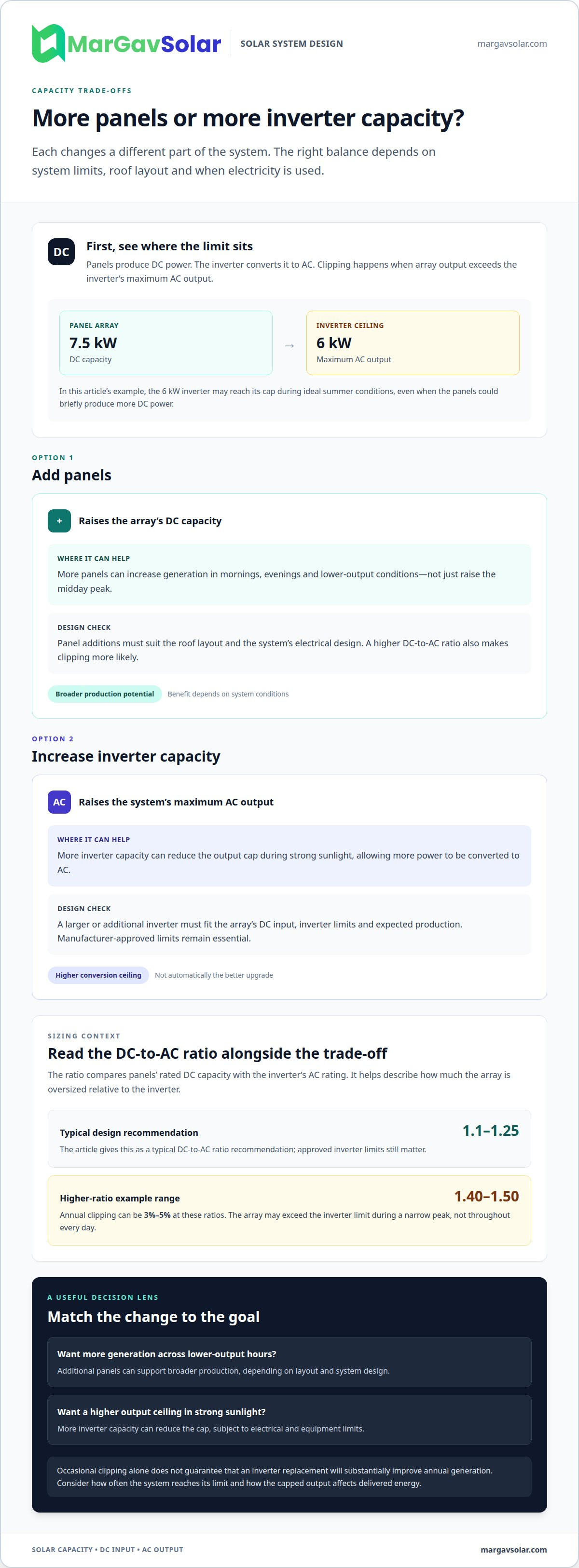
Clipping starts when a solar array’s DC production rises above the inverter’s maximum conversion capacity. The inverter limits its output rather than delivering more AC electricity than it can handle. For example, a 6 kW inverter paired with 7.5 kW of panels may reach its cap during strong summer sunshine, even though the panels could briefly produce more DC power.
Most, but not all, inverters self-limit during clipping. A typical response is to move the panels’ operating voltage above their maximum power point voltage, reducing DC current and therefore input power. Newer inverters can also reduce DC input without stressing their components. The exact response depends on the inverter design, its configured limits and the array’s operating conditions.
Clipping is most likely around midday on bright days, when production approaches its daily peak. Cloud, panel orientation, pitch, heat and seasonal light levels all affect whether the array reaches the inverter’s capacity. It may occur briefly on some days and not at all on others. A flat-topped output trace in monitoring can indicate clipping, while a consistently low trace may point to another issue.
Annual losses depend on the DC-to-AC ratio and how often conditions push production above the cap. For ratios of 1.40 to 1.50, annual clipping can be 3% to 5%. A higher ratio makes clipping more likely, but it doesn’t mean the same amount of energy is lost every day. The array may operate below the inverter limit for much of the year, then exceed it during a narrow peak.
If monitoring shows repeated capping and the lost peak output matters to your system, inverter upgrade options can help address the capacity mismatch. Any change needs to account for the array’s DC input, inverter limits and expected production, rather than simply selecting a larger unit.
Comparing additional panels with larger or additional inverters
Adding panels raises the array’s DC capacity, while a larger or additional inverter can increase how much power is converted to AC electricity. The right balance depends on the existing system’s limits, roof layout and when the property uses electricity.
Panels Versus Inverter Capacity
More panels can increase generation during mornings, evenings and lower-output conditions. More inverter capacity can raise the system’s maximum AC output during strong sunlight. For example, a 6 kW inverter paired with 7.5 kW of panels may clip during ideal summer conditions, while extra inverter capacity can reduce that cap. The practical reason to add panels is often broader production, not simply a higher midday peak. Either option must suit the system’s electrical design.
DC-to-AC Ratio and Panel Oversizing
The DC-to-AC ratio compares the panels’ rated DC capacity with the inverter’s AC rating. A 6 kW inverter paired with 6.6 to 7.5 kW of panels illustrates slight oversizing. A ratio around 1.1 to 1.25 is a typical design recommendation, but the inverter manufacturer’s approved limits remain essential. A higher ratio makes clipping more likely, while additional panel capacity can support useful output beyond peak conditions.
Replacing an inverter just to eliminate occasional clipping may not substantially improve annual generation. Consider how often the system reaches its maximum output, as well as the energy additional panels could generate in less intense sunlight. Inverter efficiency also varies with operating load, so its AC rating alone does not describe performance throughout the day.
Panel orientation changes the generation profile. A south-facing array tends to concentrate production around midday, while east-west panels create two smaller peaks, one in the morning and another later. Spreading output can reduce peak concentration and affect the capacity balance. Assessing orientation alongside monitoring data helps show whether additional panels or inverter capacity would better suit the system.
Before changing either part, consider the inverter’s DC input limits, array orientation and expected production together. Accepting some clipping can still make sense if the overall design produces useful electricity throughout more of the day.
Clipping in residential, commercial and utility-scale systems
In Staffordshire homes, roof space, orientation and household demand shape how solar panels contribute throughout the day. A common UK single-phase example pairs around 4 kWp of panels with a 3.68 kW inverter. The panels’ rated capacity doesn’t mean they produce that output continuously; actual generation changes with sunlight, temperature and roof direction. For a household, the useful question is how much electricity is available when people need it, not simply whether the midday curve reaches a cap.
Commercial systems have different demand patterns. A business using electricity during working hours may use more solar generation directly, while a site with varying equipment demand may have surplus at some times and draw from the grid at others. Clipping analysis should consider the site’s load profile alongside array and inverter sizing. The same panel-to-inverter balance can have different practical effects at two Staffordshire premises with different operating schedules.
Utility-scale solar uses the same design relationship across a much larger installation, but the assessment focuses on total generation and how it can be delivered or used. A broad array may include panels with different orientations, spreading production rather than concentrating it at one peak. The significance of clipping depends on the project’s generation profile and system limits, not just the array’s headline capacity. Scale changes the amount of energy involved, but not the basic design question.
Across residential, commercial and utility-scale projects, compare expected generation with the purpose of the installation. A household may prioritise using solar power at home; a business may focus on matching daytime demand; a larger project may assess output across the whole site. For a system-specific discussion of solar sizing and capacity in Staffordshire, discuss your system sizing.
MarGav Solar: Inverter Upgrades and Replacements
MarGav Solar provides inverter upgrades and replacements for systems where inverter capacity no longer suits the solar array or household needs. An upgrade may be worth considering when monitoring shows repeated clipping that limits useful generation, or when an inverter needs replacing. Occasional peak clipping alone does not automatically mean a larger inverter is the right choice.
The decision also depends on how the panels, battery storage and electricity use work together. MarGav Solar can help align inverter choices with a residential solar PV system, battery storage solution or EV charging point, keeping the wider energy setup in view. The aim is to address the capacity issue that matters, rather than changing equipment without considering the system as a whole.
To discuss inverter upgrades or replacements for your system, contact MarGav Solar.
Make your next solar decision with confidence
Understanding inverter clipping gives you a useful starting point, but the next decision is about what you want your solar system to do over time. Your plans for home energy use, battery storage or electric vehicle charging can all shape which system changes are worth considering.
MarGav Solar offers Residential Solar PV Systems, Battery Storage Solutions and EV Charging Points. Bringing these needs into the same conversation can connect decisions about generation and inverter capacity to how you expect to use electricity. An inverter change is not automatically the right move: the system’s performance and your priorities both matter.
If you’re weighing up your next step, contact MarGav Solar for advice. A considered plan can help you move forward with greater clarity about the role your solar system can play.
Frequently Asked Questions
I have 4kWp installed. Why is my sizing maxing out at 3.68kW when it is really sunny outside?
A 4kWp array can be paired with a 3.68kW inverter, a common example for UK single-phase systems. The panel rating is DC capacity, while the inverter figure describes its AC output rating, so the readings use different sides of the system. Bright sunshine doesn’t guarantee the panels reach their rated output. Compare monitoring readings over several clear periods to see whether output repeatedly levels near the inverter’s rating.
What is solar clipping?
Solar clipping is a limit on usable output when the system could produce more than its inverter can deliver. For example, a graph may rise through the morning, flatten near midday, then fall later. That flat section can represent capped output rather than a sudden fault. The impact depends on how often the curve reaches the cap and how much energy the system produces outside that period.
Why would you undersize a system?
Designers may choose an inverter with a lower AC rating than the panels’ combined DC rating to balance capacity across changing daylight conditions. The panels can generate useful electricity while operating below peak, even if the inverter limits the highest output. This approach can suit a roof whose orientation spreads generation across the day. The key is staying within the inverter manufacturer’s approved input limits and considering the full generation profile.
What does inverter clipping mean in a solar PV system?
It means the inverter’s output reaches its ceiling, so some potential solar generation is not converted into electricity for the home or grid. This differs from an export restriction, which limits electricity sent to the grid, and from shading, which reduces panel production. Knowing which limit is shaping the readings helps explain why household use, exported power and total solar generation may not match.
How does inverter clipping happen when solar panels produce more power than the inverter can convert?
As panel DC power rises above the inverter’s permitted input or conversion level, the inverter limits how much power it processes. Many inverters do this by moving the operating voltage away from the panels’ maximum power point, reducing current and input power. The output then stays capped instead of following the array’s potential peak. The precise control response depends on the inverter design.
How can you tell if a solar inverter is clipping from monitoring data or a power curve?
Look for a repeatable flat-topped section near the inverter’s rated output on bright days, especially around the daily peak. A smooth rise and fall without a plateau usually has a different explanation. Compare several days and, where available, panel-side DC and inverter-side AC readings. Temperature-related limits, shading, dirt or monitoring gaps can also change the curve, so one day’s graph may not identify the cause.


