

A home battery isn’t automatically the best fit for every home. Home battery systems in Burton upon Trent can store daytime solar generation for use in the evening, or charge from the grid when electricity is cheaper. According to HM Revenue & Customs, domestic solar and battery storage is zero-rated for VAT until 31 March 2027.
It makes sense to weigh the upfront cost against how much electricity your household can use later. The right choice depends on your energy habits, whether you already have solar panels, and how your tariff prices electricity at different times.
This guide compares battery options, explains what an electrical assessment may involve, and shows how solar generation and off-peak tariffs can shape a system. You’ll get a clearer idea of when storage may suit your home and what to consider before installation.
Key Takeaways
- Match storage to when your household uses electricity, not just how much it consumes overall.
- An electrical assessment should consider the consumer unit and whether it can accommodate the battery connection.
- Compare solar-charged storage with a standalone battery charged at cheaper times; the best fit depends on your setup and tariff.
- Battery capacity, household demand and charging patterns all shape which system option makes sense for your home.
Why Battery Storage in Burton upon Trent?
Solar panels generate electricity during daylight, while household demand often continues after sunset. Battery storage can make some of that daytime generation available in the evening.
Using Solar Power in the Evening
A home battery stores surplus solar electricity instead of sending all unused generation to the grid. After sunset, it can supply household appliances, helping match daytime production with evening demand. The useful capacity depends on how much electricity your home uses after the panels stop generating. An assessment considers your household routines and where the battery can be positioned, so the system can be planned around practical needs.
Reducing Bills with Stored Solar Energy
Using stored solar electricity can reduce how much power you buy from the grid in the evening. The benefit depends on how much surplus your panels produce, how much electricity your household later uses, and when you need it. A home that uses more power after sunset may value storage differently from one that uses most electricity during daylight. Compare these patterns before deciding on capacity.
Solar and Battery Storage in Burton-on-Trent
In Burton upon Trent, solar panels and a battery work together: panels generate electricity, while storage keeps some surplus available for later. An assessment considers the roof, property layout, electrical connection and potential battery location before installation is planned. Solar panels generate most effectively in direct sunlight, but can still produce electricity in varied weather. Shade, roof condition and available space all affect a property’s suitability.
Using more electricity generated by solar panels can also reduce reliance on grid electricity from fossil fuels. The VAT treatment matters when planning an install: according to HM Revenue & Customs, domestic solar and battery storage in the UK is zero-rated for VAT until 31 March 2027. HM Revenue & Customs states that the UK VAT rate on home batteries is currently set to return to 5% after 31 March 2027. Consider that timing alongside your household’s energy use and system plans.
Preparing the consumer unit and electrical installation
Before specifying a battery, the electrical installation needs to be assessed. This includes checking the consumer unit and its capacity, as the existing board may need upgrading to accommodate the battery connection.
For grants and tax relief, ECO4 funding is available to eligible lower-income households in Burton upon Trent for solar-plus-battery packages. HM Revenue & Customs’ domestic solar and battery VAT treatment, including the scheduled return to 5% after 31 March 2027, is also relevant when planning installation timing.
Planning permission is not generally required for home batteries, but householders should check with their local council’s planning office. A battery connected to the grid must also be notified to the Distribution Network Operator (DNO). A G99 application is required for batteries above 3.68 kW per phase.
Battery life depends on the system, while most solar batteries are designed to last up to 15 years and UK manufacturer warranties typically run for 10 years. Installation planning should account for ventilation and access for maintenance. These practical details help determine a suitable position and support routine inspection.
An installation assessment should consider how a standalone battery or a solar-and-battery system connects to the home’s electrical supply. At handover, the system is tested and explained to the customer. Installations are tested and certified to BS 7671 before sign-off, providing a clear record of the completed electrical work.
For a home in Burton upon Trent, the assessment considers the existing setup and a suitable battery location, rather than treating every property alike. Electrical preparation can affect the installation process and any consumer-unit work required. Any projected payback depends on how the system is used, so consider it alongside your household’s electricity patterns.
A battery installation assessment can help establish the electrical preparation and system arrangement suited to your home.
Planning storage around electricity usage and tariffs
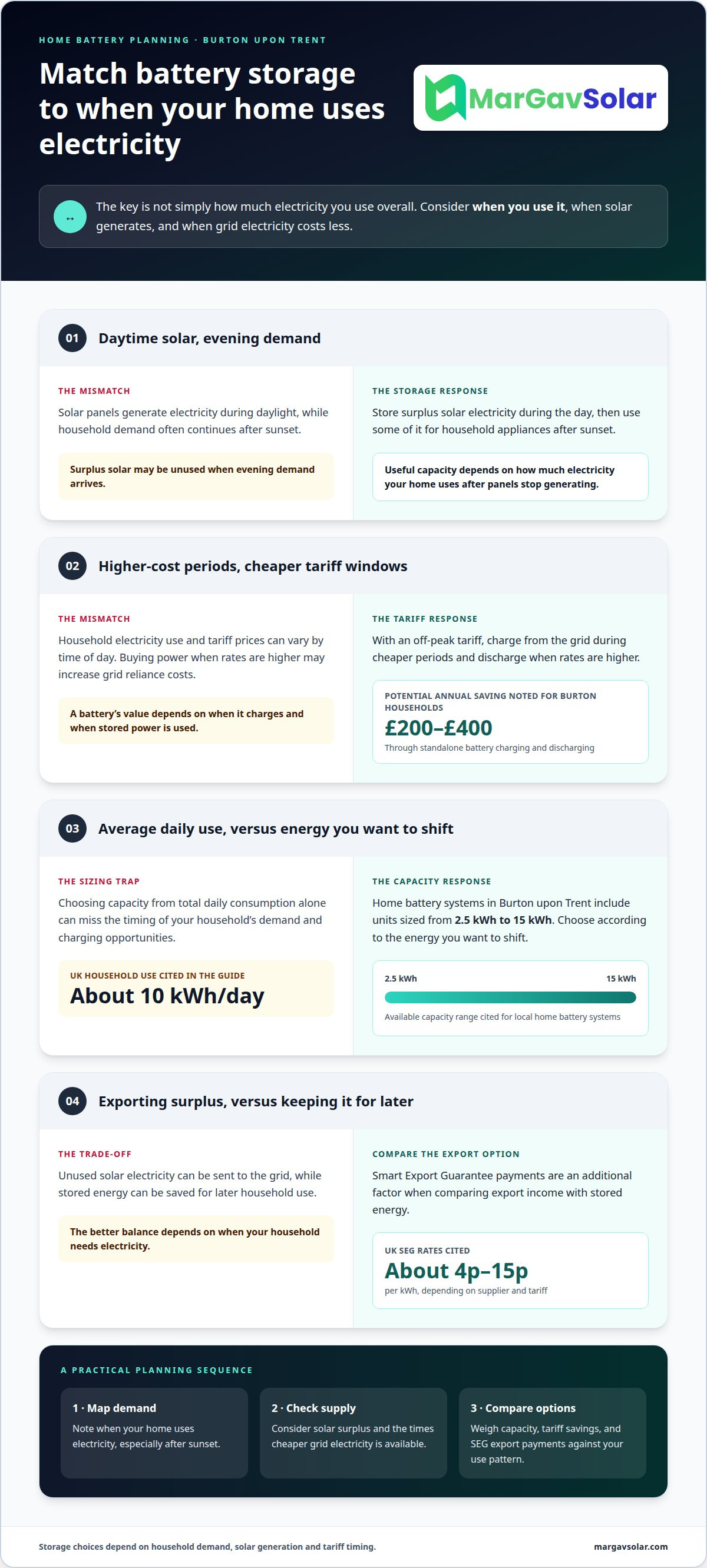
Battery storage works best when charging reflects household demand, solar generation and tariff rates. A UK household uses about 10 kWh of electricity per day, but the timing of that use helps determine a suitable capacity and operating pattern.
Map when the home uses energy, when solar panels generate it, and when cheaper grid electricity is available. If demand rises in the evening, a battery can store daytime solar generation for later. With an off-peak tariff, it can charge from the grid during cheaper periods and discharge when rates are higher. Burton households using this approach may save £200-£400 per year through standalone battery charging and discharging.
Home battery systems in Burton upon Trent include units sized from 2.5 kWh to 15 kWh. They can pair with solar panels or operate as standalone storage charged from the grid. Choose capacity according to the energy you want to shift, not simply average daily consumption.
Home energy controls can coordinate when stored electricity is used. Align charging with solar surplus or cheaper tariff periods, then reserve energy for later household demand. A battery can work alongside solar panels; a standalone unit instead responds to grid prices and household use.
Residential storage serves an individual home, unlike grid-scale projects that store energy for the wider electricity system. UK grid-scale storage had 12.9 GWh of operational capacity in 2025, a different scale and purpose from domestic storage.
Compare expected tariff savings with the battery’s use pattern, and consider Smart Export Guarantee payments for electricity sent to the grid. UK Smart Export Guarantee rates range from about 4p to 15p per kWh, depending on supplier and tariff. For home battery systems in Burton upon Trent, the balance between export income and stored energy depends on when the household uses electricity.
Home battery system comparisons
Compare systems by how well they suit your home, not by capacity alone. Check whether a battery can work with existing solar panels, connect to a new installation, or operate as a standalone unit. The right arrangement depends on your current equipment and whether you want to store solar generation or shift grid electricity use. With home battery systems in Burton upon Trent, property-specific needs matter more than a one-size-fits-all choice.
Next, consider how the battery will meet evening demand. Capacity indicates how much energy it can store, while output affects how much electricity it can supply at once. A home running several appliances at the same time may need a different setup from one that uses stored energy gradually. Compare these requirements with your household’s actual usage.
Battery chemistry is another comparison point. Lithium-ion batteries are the most common home type, with LFP and NMC among the chemistries used. LFP batteries typically achieve 4,000 to 6,000 charge cycles before capacity drops to 80%; compare expected use and warranty terms alongside that cycle information.
For an existing solar installation, adding storage may not require replacing the panels. The inverter arrangement matters: a compatible system can direct solar generation into the battery, while excess electricity may be exported. Compare how each option handles generation, household use and export, rather than focusing on one specification.
Warranty terms and expected service life should be assessed together. Most solar batteries are designed to last up to 15 years, while UK home battery manufacturer warranties typically run for 10 years. The warranty period isn’t the same as a promise that capacity remains unchanged throughout that time, so read its coverage and conditions carefully.
When comparing home battery systems in Burton upon Trent, list your solar equipment, evening electricity use, export needs and preferred charging pattern. Then assess storage capacity, output, chemistry, inverter compatibility and warranty as parts of one system. National standards do not make every home setup identical: household demand and existing equipment shape the practical choice.
Plan a battery upgrade around your solar equipment and household energy needs.
Options include adding a battery to existing solar panels, installing a system alongside new solar panels, or choosing a standalone unit. Lithium-ion systems are common and include LFP and NMC chemistries.
MarGav Solar: Residential Solar PV Systems
MarGav Solar helps homeowners plan solar generation, add battery storage and upgrade existing systems. Its residential solar PV and battery storage solutions may suit you if you want to use more of the electricity your home generates or store surplus for later. You can also consider an EV charger as part of the project, while solar panel maintenance and cleaning supports your existing panels.
Turn to MarGav Solar when weighing a new solar installation against adding storage to panels you already have. Sharing your household’s energy-use patterns and current solar setup helps shape a solution around your needs, not just battery capacity.
Contact MarGav Solar to discuss your home’s solar and battery storage needs.
Make your next energy decision with confidence
Start by deciding what you want a home energy system to do. You might prioritise using more of your own solar generation, allowing for future household changes, or bringing several energy needs into one plan. Setting that priority gives the project direction before equipment is selected.
If you’re considering home battery systems in Burton upon Trent, MarGav Solar can discuss how solar PV and battery storage may suit your property. EV chargers can also form part of a wider home energy plan. Start with a conversation about your current setup and what you want to achieve, rather than choosing equipment in isolation.
Bring your questions about how a proposed system would serve your home, and use the discussion to shape a practical next step. Contact MarGav Solar about battery storage to explore your options and move towards a setup that suits your household.
Frequently Asked Questions
What are the best home battery systems in the UK in 2026?
There isn’t one best system for every UK home in 2026; the best fit depends on your existing equipment and how you’ll use stored electricity. Compare whether a battery works with your inverter and solar setup, how its capacity matches your household’s demand, and what the warranty covers. A system that suits one property may not suit another with different solar equipment or energy habits.
How does a battery work with a time-of-use tariff?
A battery can charge when your tariff’s electricity rate is lower, then supply stored electricity during more expensive periods. For example, a household might schedule charging overnight and use that energy during its evening peak. The value depends on the difference between tariff rates and how much electricity your home can use from storage. Compare the tariff’s time windows with your usual demand.
Is now a good time to add a battery, or should I wait?
Adding a battery now may make sense if your home has surplus solar generation or a time-of-use tariff that lets you shift when you use electricity. Waiting may suit a household still planning a solar installation or unsure how much electricity it uses at different times. Base the decision on current energy patterns, planned equipment changes and the value of using stored power, rather than assumptions about future prices or technology.
Which local installers supply and fit home batteries in Burton upon Trent?
MarGav Solar focuses on Staffordshire and provides battery storage solutions with professional installation. For a home in Burton upon Trent, start by discussing your existing solar equipment, electrical setup and energy priorities. This helps establish whether a standalone battery or storage alongside solar is the better fit, and what the installation needs to account for.
How much can a home battery save on electricity bills in the UK?
Savings depend on how much stored electricity replaces power you would otherwise buy, as well as your tariff rates. Using stored solar energy after sunset may reduce grid purchases; a time-of-use tariff can also make charging during cheaper periods useful. Compare your likely charging and usage patterns with your tariff, rather than treating a general savings figure as a prediction for your home.
What battery capacity is suitable for a typical Burton upon Trent home?
A typical UK home battery is described as having 5 kWh to 15 kWh of capacity, but that range isn’t a recommendation for every Burton property. Choose capacity according to how much electricity you want to store and use later, plus the solar generation available to charge it. A household with limited surplus generation may need a different setup from one with greater daytime generation and evening demand.


