

If you’re searching for “how to choose the right EV charger for my car”, start by matching the charger to your vehicle’s onboard charging capability, your home’s electrical supply and your usual driving routine. The highest-powered home charger isn’t automatically the best fit.
Power ratings, cable types and smart features can make the choice feel complicated. Focus first on the details that determine compatibility and everyday usefulness: what your car can accept, how long it’s usually parked at home and where you can position the charger.
This guide explains how to check compatibility, compare charging speeds and assess features such as cable design and smart controls. It also covers installation factors, including your electrical supply and parking layout. MarGav Solar provides EV charging point consultancy and professional installation for homeowners in Staffordshire. Solar PV and battery storage can also be considered as part of a wider home energy plan.
Key Takeaways
- Choose a charger that suits your car’s onboard AC charging capability, home supply and parking routine, rather than relying on its headline power rating.
- Check your vehicle’s connector and charging limits before comparing compatible home chargers.
- Choose a tethered or untethered cable based on your parking position, storage preferences and daily routine.
- Compare smart controls, such as scheduling and usage monitoring, if the charger supports them and you expect to use them.
- Use a checklist to prepare for installation, and consider whether solar PV or battery storage fits your wider home energy plans.
Why the Right EV Charger for Your Car Is More Than a Power Rating
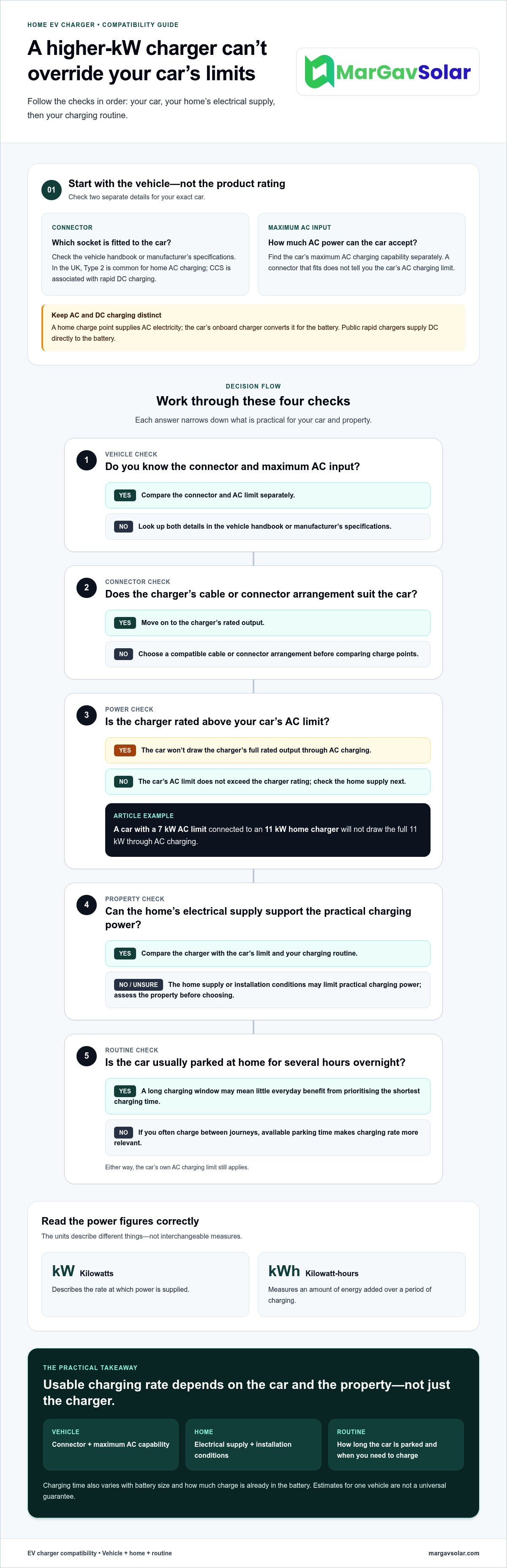
A suitable home EV charger brings together three things: what your car can accept, what your home’s electrical supply can support and how you park and charge. A higher power rating won’t necessarily make your car charge faster. The vehicle’s charging capability and the time it spends at home matter just as much.
For example, if your car is parked at home for several hours overnight, a charger matched to the vehicle and household supply may meet your needs. If you often need to charge between journeys, the available parking time becomes more important. Choose for your routine, not simply the largest number on a product specification.
What does a home EV charger actually do?
A dedicated home charge point supplies AC electricity to a parked vehicle. The car’s onboard charger converts that AC power into a form its battery can store. Public rapid chargers work differently: they supply DC power directly to the battery, so they serve a different charging purpose and aren’t interchangeable with a home AC point.
Charger ratings use kilowatts (kW) to describe the rate of power, while kilowatt-hours (kWh) measure an amount of energy. In simple terms, kW describes how quickly power is supplied, and kWh describes how much energy is added over a period of charging.
Which charging factors matter before comparing products?
Consider the car, home and routine together. Your vehicle’s onboard AC charging capability can limit the power it draws, even when the home charge point has a higher rating. The household electrical supply also affects what’s practical, and the connector must fit the vehicle or work with an appropriate cable arrangement.
Connector standards can be confusing because some systems combine AC and DC charging in one connector design. The Combined Charging System (CCS) standard is one example. Your car’s connector is a useful starting point, but it doesn’t tell you everything you need to know.
Your charging routine puts those technical details into context. If the car is parked on the drive overnight, the long charging window may mean there’s little everyday benefit in prioritising the shortest possible charging time. If you regularly need to top up between journeys, the time available may make charging rate more relevant. In either case, the car’s own charging limit still applies.
To decide how to choose the right EV charger for my car, consider the vehicle’s capabilities, home supply, connector and usual parking pattern together. Next, compare the vehicle and property with a charger’s rating, keeping those limits in mind.
Match EV Charger Power and Connector to Your Car
To compare home charge points, check four details: the car’s connector, its maximum AC charging capability, the home’s electrical supply and the charger’s rating. These factors work together. A connector that fits doesn’t indicate how quickly the car can charge, and a more powerful charge point can’t override the car’s limits.
How do I check my car's connector and AC charging limit?
Look in your vehicle handbook or the manufacturer’s specifications for two separate details: the charging connector and the maximum AC input. Don’t assume that one confirms the other. Plug-in hybrids and battery-electric cars can have different charging capabilities, so check information for your exact vehicle rather than relying on a general guide to its make.
Car connector: Identify the socket fitted to your vehicle and choose a compatible home charging cable or connector arrangement.
Onboard AC capability: Find the car’s maximum AC charging rate. This indicates how much power it can draw from a home charge point.
Home electrical supply: The property’s supply and installation conditions affect the practical charging power available.
Charger rating: Compare the charge point’s rated output with both the vehicle’s AC limit and the home’s capability.
In the UK, Type 2 is a common connector for AC charging at home. CCS is associated with rapid DC charging. Check the connector and AC charging limit separately: knowing that a vehicle can use a particular rapid-charging connector doesn’t establish its home AC capability. Confirm both details for your vehicle before comparing charge points.
Does a higher-kW home charger always charge faster?
No. The vehicle’s onboard AC charger can limit the power it accepts, even when the home charge point has a higher rating. For example, if a car’s AC limit is 7 kW and the home charger is rated at 11 kW, the car won’t draw the full 11 kW through AC charging. The home’s electrical capacity may impose another limit, so the usable rate depends on the car and property as well as the charger.
Charging time also varies with battery size and how much charge is already in the battery. An estimate for one vehicle shouldn’t be treated as a promise for another. Use specifications to compare compatibility and potential charging rate, not as a universal guarantee.
An assessment of the property can clarify its practical charging capability before you select a charge point. MarGav Solar provides EV charging point consultancy and professional installation, bringing the vehicle requirements and home setup into the decision. This is useful when you’re working out how to choose the right EV charger for my car and want to look beyond the headline kW figure.
Compare Home EV Charger Setups by Cable, Controls and Energy Use
Once you know your car’s connector and charging limits, compare how different charger setups fit your driveway and habits. A cable that’s easy to use every evening may matter more than a control you rarely need. Consider where the car parks, how you want to handle the cable and whether you’d like to manage charging times.
Should I choose a tethered or untethered EV charger?
A tethered unit has an attached cable, so you can plug in without taking a separate cable out of the car. That’s convenient if you use the same parking spot regularly, but you’ll need somewhere to put the cable when it’s not in use. An untethered unit uses a separate cable that you store and connect when needed. This gives you more flexibility over cable storage, but adds a step each time you charge.
Picture your usual parking position. Can the cable reach the vehicle’s charge port comfortably without stretching across a walkway or driveway? Match the cable arrangement to your vehicle and consider where you’ll store it between charges.
Are smart controls or solar integration useful for my home?
Scheduling can help you set charging around your household routine or a preferred electricity tariff, if the charger supports that function. Usage monitoring may help you understand charging patterns where available. These controls are most useful when they fit the way you charge. They needn’t take priority over basic compatibility, a practical cable setup or a suitable installation.
If your home has solar PV or battery storage, consider how a compatible charger could fit into the wider energy system. Solar integration depends on the equipment and setup, so don’t treat it as a guaranteed bill saving. MarGav Solar’s EV charging points guide provides more context on home charging and these energy considerations.
Tethered cable: Suits a regular parking position and makes plugging in straightforward. Check that the cable can reach and consider where it will sit when not in use.
Untethered cable: Suits people who prefer to store their cable separately or want flexibility over when they connect it. Allow for the extra handling and storage.
Scheduling: Useful if you want charging to follow a preferred routine or tariff, provided the charger supports it. It may be less important if you’re happy to plug in without setting a schedule.
Usage monitoring: Can help you review charging activity where supported. Treat it as an extra, not a substitute for a compatible charger and suitable installation.
Solar or battery integration: Relevant if your home has these systems and the charging equipment is compatible. The benefit depends on the full setup, so don’t assume a particular saving.
A practical way to decide how to choose the right EV charger for my car is to rank your priorities: compatibility and cable reach first, then the controls you’ll use, followed by energy integration if it applies to your home. MarGav Solar provides consultancy and professional installation for EV charging points, alongside solar PV and battery storage solutions for a joined-up home energy plan. Explore home EV charging support as you compare your options.
Use This EV Charger Checklist Before You Choose
Before comparing specific charge points, work through your car, parking arrangement and home setup. This helps narrow your options to chargers that fit your needs, rather than features that look impressive but may not improve everyday charging.
- Record your car’s limits. Use the vehicle handbook or manufacturer specifications to note its connector and maximum AC charging capability. These details help identify compatible home charging options.
- Assess where you park. Consider the usual parking position, the distance to a possible charger location and how you’ll manage or store the cable. If more than one vehicle may need regular charging, include both in your planning.
- Review the home supply. The existing electrical supply and proposed charger location affect what’s practical. Don’t assume the property can support a particular charger rating without an assessment.
- Prioritise useful features. Decide whether a tethered or untethered cable suits your parking routine, then consider controls such as scheduling if you’ll use them. Treat optional extras as secondary to compatibility and a workable setup.
- Plan the installation. Think about the charger position, cable route and relevant home energy equipment, such as solar PV or battery storage. A clear plan connects your choice to how you use the property.
What should I check about my vehicle and parking?
Keep your car’s connector and maximum AC capability together in your notes, but check them separately. Then consider your usual parking position: where could the charger go, and can the cable reach the vehicle comfortably? Note whether the car’s position changes or another vehicle also needs regular access. This helps you choose for everyday use, not just an ideal parking scenario.
The highest-rated charger won’t automatically deliver the fastest charge. If the car’s onboard AC system accepts less power than the charge point can provide, the car’s limit constrains the rate. The home’s electrical capacity and installation conditions also affect the practical choice. A site assessment considers the existing supply and proposed charger location instead of assuming one rating suits every property.
What should I consider about the home's electrical setup?
MarGav Solar provides consultancy and professional installation for energy systems, helping homeowners consider the vehicle, property and charge point together. For Staffordshire homeowners planning solar alongside charging, solar panel installation can be part of the wider home energy plan. Solar PV or battery storage may be relevant, but neither should be treated as a guaranteed charging saving.
Use your checklist to make the decision specific to your household: compatible with the car, practical for the parking space and appropriate for the home’s supply. Discuss your EV charger installation with MarGav Solar to turn those factors into an installation plan.
Choose an EV Charger with MarGav Solar's Home Energy Support
Choosing a home EV charger comes down to a practical match: your car’s charging capability, your household electrical supply, a cable setup that suits your parking space and any controls you’ll use. Consider the whole home setup instead of treating the charger as an isolated purchase or assuming the highest rating is automatically best.
When does an integrated home energy assessment help?
If your home already has solar PV or you’re planning it, consider EV charging alongside it to understand how the different parts of your household energy setup relate. Battery storage may also be relevant to your plans. The value lies in weighing up your priorities together, not assuming integration will guarantee a particular bill reduction, charging speed or installation outcome.
For example, a household planning solar may want to consider the future charger location and charging routine as part of its wider energy decisions. Another household may simply need a good fit for its vehicle and parking arrangement. Both are sensible starting points. Base your charger choice on the car, the property and your household’s plans, then consider whether solar PV or storage has a role.
What can Staffordshire homeowners expect from MarGav Solar?
MarGav Solar provides consultancy and professional installation for EV charging points, bringing vehicle requirements and the home setup into the decision. With over 20 years of experience in energy systems, the company also offers residential solar PV and battery storage for homeowners whose wider plans include them. This supports a joined-up conversation without assuming every home needs the same equipment.
Before discussing your project, gather your vehicle’s connector and AC charging information, note where you usually park and think about whether you’d value a tethered cable, scheduling or other supported controls. These details provide a useful starting point. A suitable recommendation depends on your household and property, so there’s no need to choose extra features simply because they’re available.
In Staffordshire, homeowners can use MarGav Solar’s consultancy to consider EV charging alongside the electrical supply, installation location and any existing or planned solar PV. Battery storage can also be part of the conversation when it fits the wider home energy plan. The aim is to make an informed choice based on how you use your car and home, without promising a particular saving or charging result.
If you’re still considering how to choose the right EV charger for my car, bring together the vehicle’s limits, your parking and cable preferences, and the features that matter to your routine. Explore MarGav Solar's home energy solutions for EV charging consultancy and professional installation.
Take the Next Step Towards Home Charging
Before settling on a charger, prepare a short brief: note your vehicle’s charging details, where it usually parks, how you expect to charge and any plans for your home’s energy setup. This gives you a practical starting point for planning an installation and keeps the decision focused on what works for your household.
If you’re wondering how to choose the right EV charger for my car, you don’t have to compare product ratings in isolation. MarGav Solar offers consultancy and professional installation for EV charging points, drawing on more than 20 years of industry experience. Its work across EV charging, solar PV and battery storage can also put a charger choice in the context of your wider home energy plans.
Use your notes to plan the next step. Explore MarGav Solar's home energy solutions and discuss a home charging setup suited to your car and property.
Frequently Asked Questions
Can I use the same home EV charger for different electric cars?
Often, one home charge point can serve different compatible vehicles, but the cars may charge at different rates. Check each vehicle’s connector and maximum AC charging capability in its handbook or official specifications. If two drivers share the charger, consider whose car needs charging first and whether the cable can reach each vehicle’s usual parking position. This helps you plan for how your household actually uses the charger.
Is it safe to charge my EV overnight at home?
Home charging is intended for a vehicle that’s parked and connected, but safe use depends on suitable equipment and a correctly designed installation. Follow the vehicle and charger instructions, and don’t use damaged cables or improvised extension arrangements. Keep charging equipment in its intended condition and use it as directed. If you notice damage or the equipment signals a fault, stop using it and arrange for the setup to be assessed.
Can I charge a plug-in hybrid with a home EV charger?
Many plug-in hybrids can use a home charge point, but connector type and maximum AC input vary by model. Check the handbook or manufacturer specifications for your exact vehicle before choosing equipment. A plug-in hybrid’s battery may be smaller than that of a battery-electric car, so its charging needs and duration can differ. If your household has both types of vehicle, compare each car’s requirements separately.
Do I need an internet connection for a home EV charger to work?
Internet access is generally associated with connected functions rather than the basic physical match between the car and charge point. Depending on the charger, features such as remote control, scheduling or usage monitoring may rely on connectivity. If you expect to use these functions, check the chosen unit’s instructions for its network requirements and what happens if your connection is unavailable. Don’t assume all chargers offer the same controls.
What happens if my EV charger has a higher power rating than my car can accept?
The car’s onboard charging equipment generally limits how much AC power it can take, so a higher-rated charge point won’t necessarily make it charge faster. Your home’s available electrical supply can also affect the usable power. When considering how to choose the right EV charger for my car, compare the vehicle’s limit with the property’s assessed capability and any other vehicles you may charge at home.
Can a home EV charger use electricity from solar panels?
That depends on how the charge point, solar PV system and any battery storage are configured to work together. Surplus solar electricity won’t necessarily flow to a vehicle automatically, so include the equipment’s supported operating modes in your plans. For Staffordshire homeowners, considering EV charging alongside existing or planned solar PV can help clarify priorities without assuming a particular saving or charging outcome.


