

If your solar panels are generating electricity, why is there still a charge on your electricity bill? It’s a fair question, especially when import, export and generation figures can look as though they describe the same energy. Understanding my electricity bill with solar starts with separating three things: electricity you buy from the grid, electricity your panels produce, and any surplus sent back to the grid.
Even when your panels are working, you may still use grid electricity at night or when generation is low. Your bill can also include a daily standing charge, while export payments may appear separately rather than as a credit on the same statement. A bill after installation isn’t automatically a sign that something is wrong, but it’s worth knowing what each figure means.
This guide explains how to read the main sections of a solar household bill, compare meter readings and billing dates, and understand where export payments may appear. You’ll also learn what to check if charges seem unexpectedly high, and when to speak to your electricity supplier or investigate your system’s performance.
Key Takeaways
- Understanding my electricity bill with solar starts with checking which figures relate to grid imports, solar generation and exported energy.
- Supplier bills can use different labels, and generation data may appear in your inverter or monitoring records rather than on the bill.
- Compare billing dates with import, export and generation readings for the same period before drawing conclusions.
- A high bill alone doesn’t prove your solar system has failed. Changes in household use, generation or billing may also explain it.
- Use your checks to decide whether to query a charge with your supplier or investigate your system’s performance.
Understanding my electricity bill with solar: why charges can remain
A bill can still arrive when your solar panels are working normally. Panels reduce the electricity you need to buy only when they are generating and that electricity meets household demand. At other times, your home may draw power from the grid, and your supplier may still charge a daily standing charge. Understanding my electricity bill with solar means separating these charges from the energy your system produces.
A household electricity bill records the grid electricity charged by your supplier, along with any credits or payments handled under your account’s billing arrangements. It may not show every part of your solar energy use. Your bill, meter readings and system monitoring can each record different figures, so identify what each one measures before comparing them.
Why solar panels do not automatically remove every bill charge
Your home uses electricity at different times throughout the day. If appliances are running while the panels aren’t producing enough to meet demand, the shortfall comes from the grid. This can happen in the evening, overnight or during periods of lower generation. A battery can store some surplus generation for later use, but it doesn’t change the distinction between energy produced, used and imported.
Standing charges are daily account charges and may remain even when you import very little electricity. They’re separate from charges based on the amount of grid electricity used. Depending on your supplier and account, export payments may be credited on a bill or handled separately. UK export arrangements have changed over time. The overview of solar power in the United Kingdom provides context on the Feed-in Tariff and Smart Export Guarantee.
The three energy flows behind a solar bill
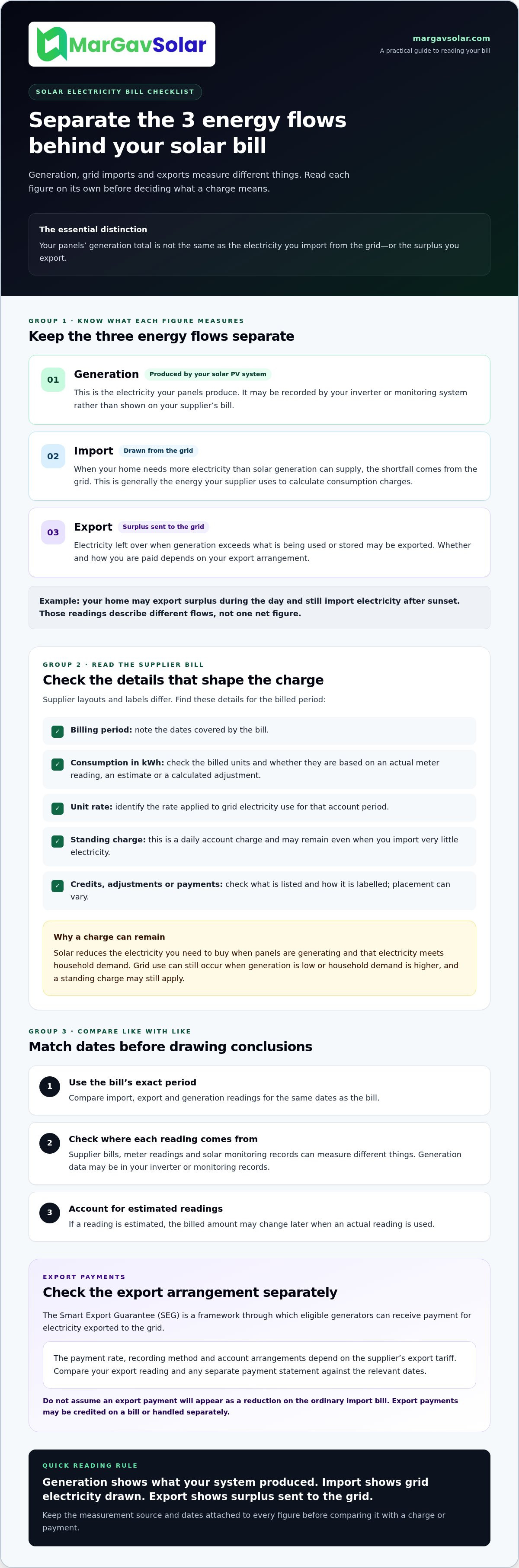
Keep these three measurements separate when reading your figures:
- Generation: the electricity produced by your solar PV system. It may be recorded by the inverter or monitoring system rather than shown on your supplier’s bill.
- Import: electricity drawn from the grid when your home needs more than its solar generation can supply. This is generally the energy your supplier uses to calculate consumption charges.
- Export: surplus electricity sent from your home to the grid when generation exceeds what’s being used or stored. Whether and how you’re paid for it depends on your export arrangement.
Grid electricity you use is imported energy; electricity your panels produce is solar generation, and the figures are not interchangeable. For example, panels may generate electricity during the day while the household is out. Some power may later be used at home, some may be stored if a battery is fitted, and any remaining surplus may be exported. Meanwhile, the home could still import electricity after sunset.
Generation totals alone don’t tell you what you owe or what you might receive for exports. Treat each figure as a separate part of the account, then compare its dates and measurement source. The next sections explain how to find those details on bills and system records.
How solar generation, grid imports, and export payments appear on a bill
Your supplier’s bill usually focuses on electricity bought from the grid, not everything your solar system produces. Labels and layouts differ, so look for the billing period, consumption in kilowatt-hours (kWh), unit rate, standing charge and any account credits. Your solar generation may instead appear in inverter or monitoring records, while export details may be on a separate statement.
This distinction is central to understanding my electricity bill with solar. The Energy Saving Trust’s guide to solar panel benefits explains how generating electricity at home can affect energy use. Your bill still depends on what you import and how your supplier handles exports.
Which electricity bill figures matter when you have solar?
Start with the billed units and the dates they cover. Check whether consumption is based on actual meter readings or estimates, then note the unit rate and standing charge for that account period. Credits, adjustments or payments may also appear, but their labels and placement vary. If a reading is estimated, the billed amount may change later when an actual reading is used.
Keep the billing period in view as you read each figure. A generation total from your solar monitoring app won’t explain a supplier charge unless it covers the same dates as the bill. Check whether the bill’s consumption figure is an actual reading, an estimate or a calculated adjustment. This helps you avoid treating a mismatch between different periods as evidence of a billing or system problem.
How exported electricity and the Smart Export Guarantee relate
The Smart Export Guarantee (SEG) is a framework through which eligible generators can receive payment for electricity exported to the grid. The payment rate, recording method and account arrangements depend on the supplier’s export tariff. Compare your export reading and any separate payment statement against the relevant dates. Don’t assume an export payment will appear as a reduction on the ordinary import bill.
Imported electricity is charged as energy drawn from the grid, while exported electricity is recorded and paid under a separate export arrangement. A home might import power in the evening and export surplus during the day, so the two readings describe different flows, not a single net figure. If you have a battery, surplus electricity may be stored for later household use rather than exported at that time. Storage changes how energy is used, but import and export records remain distinct.
For a useful comparison, note the bill’s start and end dates, the meter readings used for import, and any export readings or payment-period dates. Then compare these with generation records for the same period. If the supplier statement and export statement don’t line up, first check whether they cover identical dates and whether the readings are actual or estimated.
If you’re considering how household generation relates to electricity use, a professionally designed residential solar PV system can take household patterns into account. MarGav Solar also provides battery storage and solar maintenance, which can be relevant when reviewing how a system fits your home.
How to compare your solar bill with meter and system readings
A useful bill check is a like-for-like comparison, not a quick glance at one total. Your supplier’s statement, electricity meter and solar monitoring may describe different energy flows or cover different dates. Before deciding that a charge or generation figure looks wrong, line up the period and source for each reading. This routine makes understanding my electricity bill with solar more practical and helps you keep useful records for your next statement.
Match your electricity bill to the correct dates
Find the bill’s start and end dates first. Use those dates as the boundary for every comparison, and note whether the supplier used actual readings or estimates. Monitoring records may be shown by day or month, so totals for a different period can’t be compared directly with the bill.
Work through these four checks in order:
- Billing dates: Record the statement’s opening and closing dates. Check that the meter and system records cover the same interval, rather than a calendar month or a different billing cycle.
- Import readings: Find the meter readings used to calculate electricity drawn from the grid. Note whether they’re actual or estimated, and compare them with available meter records for the same dates.
- Export readings: Review the export figures for that period, if your meter or export account records them. Keep this separate from import, as they represent different directions of electricity flow.
- System generation: Check the solar monitoring total for the matching dates. Record the figure and its source, such as inverter monitoring, so you can make the same comparison next time.
Understand differences between meter and inverter data
An inverter’s monitoring data generally describes electricity generated by the solar PV system. On its own, it doesn’t show how much the home imported from the grid or how much electricity the household used. Those figures come from meter readings or other household monitoring. Depending on the records available, you may not have one display that captures generation, import, export and total consumption together.
Estimated readings can differ from actual readings without proving that the meter or bill is faulty. An estimate is used when an actual reading isn’t available for the statement; a later actual reading may result in an adjustment. Mark estimated entries clearly in your notes, then compare them with the next bill or reading instead of treating the difference as an immediate error.
Keep a short log with each bill’s dates, import and export readings, whether they’re actual or estimated, and the system’s generation total. Add the date you took any manual readings. This creates a consistent record for spotting changes over time and makes it easier to explain a mismatch to your supplier. MarGav Solar’s residential solar PV work includes considering how a system relates to household energy use.
What to check when your electricity bill seems unexpectedly high
A higher-than-expected bill doesn’t, by itself, prove your solar system has failed. The statement may cover a longer period, include an estimated reading or adjustment, or reflect a change in how much electricity your household used. Solar generation can also vary with the season and conditions. When understanding my electricity bill with solar, first check the bill and readings before drawing conclusions about system performance.
Check billing, meter readings, and your electricity tariff
Compare the billed import units with the meter readings for the bill’s exact start and end dates. Check whether the readings are actual or estimated, and look for adjustments or credits that could affect the amount due. Then review the import unit rate, standing charge and any export terms shown on your account. Supplier arrangements differ, so use your own current tariff information rather than assuming a particular rate or payment method.
Separate a possible billing query from a change in energy use. More time at home, new appliances or greater use of existing equipment can increase electricity consumption. If the billed import appears higher than expected, note the dates and readings, then compare them with your meter records. A mismatch is worth querying with your supplier, but first check that both sets of figures cover the same period and use comparable readings.
When a bill pattern may warrant a solar system check
Compare the system’s generation with its own records from a similar period, allowing for seasonal differences. A winter total shouldn’t be judged against a brighter summer period as though conditions were identical. If monitoring has stopped updating, that may indicate a reporting issue rather than prove the panels have stopped generating. Check whether the system is showing recent data before deciding what the figures mean.
Solar panel maintenance can help investigate system condition when generation records raise concerns. Keep the dates, meter readings and monitoring figures together so you can describe the pattern clearly. MarGav Solar’s solar panel maintenance service can support an assessment of your system.
Use this checklist to decide what to follow up:
- Ask your supplier about the bill if billed import units don’t match actual readings for the same dates, or an estimate or account adjustment is unclear.
- Review your tariff details if import charges or export credits differ from the terms shown on your account.
- Investigate system performance if generation is persistently unlike the system’s own comparable records, or monitoring remains out of date.
Keep the question focused: billing and tariff concerns belong with your electricity supplier, while a sustained generation concern calls for a closer look at the solar system. If your generation records point to a performance issue, MarGav Solar’s solar panel maintenance service is a relevant next step.
Make sense of your solar electricity bill and plan your next step
A repeatable check turns a confusing statement into useful information. Read the bill, match its dates to your records, check the relevant readings, then write down any questions. Over time, this routine can help you distinguish a billing issue from a change in household energy use or solar generation. Understanding my electricity bill with solar becomes easier when you keep those explanations separate instead of judging the system by the amount due alone.
A simple monthly routine for checking a solar bill
Keep each statement and make a brief record of its billing period, meter-reading status and any adjustments. Where matching records are available, note import, export and solar generation separately. Don’t combine figures from different dates or treat generation as though it were the amount of electricity used in the home.
It can also help to note changes in household routines. New appliances, more time at home or a change in when you use electricity may affect how much you import. A short note beside that month’s readings gives you context when reviewing a later bill, without assuming every change is caused by the solar system.
- Save the statement: Record its start and end dates, and whether readings are actual or estimated.
- Keep energy flows distinct: Compare import, export and generation only across matching periods.
- Note household changes: Record shifts in routines or electricity use that could help explain a different import total.
- List questions as they arise: Include the bill line or reading you’re querying, rather than relying on memory.
How solar expertise can help interpret household energy needs
A billing query and a system performance concern call for different follow-up. Ask your electricity supplier about charges, readings, tariff terms or account credits that don’t match your statement or records. If billing details appear consistent but solar generation looks unusual against comparable historical data, check whether monitoring has stopped reporting and whether the system may need attention.
MarGav Solar supports homeowners with residential solar PV systems, battery storage and solar panel maintenance. With more than 20 years of industry experience, the company provides support from consultation through installation and longer-term maintenance. Reviewing how electricity is used at home can help make a discussion about solar PV or battery storage relevant to your household, without assuming a particular bill outcome.
Your bills and reading notes provide a clearer starting point for considering your household’s energy needs. Staffordshire homeowners can explore MarGav Solar’s residential solar PV, battery storage and system support in the context of their home.
Turn clearer bill reading into a confident next step
Understanding my electricity bill with solar can do more than explain a charge. It can help you see how your household uses energy and what questions to consider before changing your routine or reviewing your system. Keep your bill records as a reference, then use what they reveal to guide your next decision.
If you’re considering solar or want to explore how your current setup relates to your home’s energy needs, MarGav Solar brings more than 20 years of industry experience to residential solar PV installation and maintenance. Support from initial consultation through installation and longer-term maintenance can help you consider your options in the context of your household, without assuming a particular bill reduction.
For homeowners in Staffordshire, explore residential solar solutions with MarGav Solar to discuss solar PV, battery storage or ongoing system support. Your bill records and a clearer understanding of your energy use provide a practical starting point for that conversation.
Frequently Asked Questions
Why do I still have an electricity bill if I have solar panels?
Solar panels generate electricity when sunlight is available, but your home may still need grid power when demand is higher than generation. A bill can also include standing charges and other account items. For example, cooking or heating after sunset may increase grid imports even if the panels generated electricity earlier. Before suspecting a fault, check the statement period, import readings and tariff details against your account records.
Does my electricity bill show how much solar energy my panels generate?
Not always. Supplier bills often focus on electricity imported from the grid, while generation may be recorded by an inverter or monitoring app. Export readings or payment statements can be separate, depending on your meter and supplier arrangement. If your bill covers part of a month but your app displays a full calendar month, compare a matching date range before drawing conclusions about how much your system produced.
How can I tell if my solar panels are reducing my electricity bill?
Compare import readings across bills for similar periods, while considering changes in household routines and seasonal generation. For understanding my electricity bill with solar, it also helps to review generation and export records separately, where available. A new appliance or more daytime use can change imports. One statement alone may not show the system’s overall effect, especially if billing periods or tariff terms have changed.
What is the Smart Export Guarantee on an electricity bill?
The Smart Export Guarantee is a UK framework under which participating licensed electricity suppliers offer payments for eligible electricity exported to the grid. The supplier’s arrangement determines how exports are recorded and how payments are documented. You might see a separate export statement or account entry rather than a credit on the standard bill. Check your current agreement and supplier documents for the terms that apply to your account.
Can I get paid for solar electricity I export to the grid?
Some households can receive payment for exported electricity through an arrangement such as a Smart Export Guarantee tariff, subject to eligibility and supplier terms. Don’t assume exported units automatically reduce charges for imported electricity. Check the export agreement, the readings used for the payment period and any separate payment record. If a payment seems missing, first confirm that the statement covers the same dates as your export data.
What should I do if my solar electricity bill looks wrong?
Check the bill’s dates, import readings, estimated-reading status and tariff details, then compare them with your meter records. Note the specific line or reading that seems inconsistent and raise billing or meter questions with your electricity supplier. If the account figures appear correct but generation data looks unusual, check whether monitoring is reporting and review comparable periods. Staffordshire homeowners can use this information to explain a potential system performance issue when arranging solar panel maintenance.


