

What’s the best way to charge your electric vehicle using solar power? The answer to how to integrate EV charger with solar depends on how much electricity your system generates, when your car is at home and how you want to use any surplus. It’s natural to wonder how solar power reaches the car, or whether you need a home battery to make the setup work.
In practice, solar electricity supplies your home first. When your car is plugged in, it can use the solar power available after other household demand is taken into account. If your car is usually away during the sunniest hours, charging directly from daytime generation may not fit your routine. A battery can store surplus electricity for later, but it’s optional, not a prerequisite for combining solar and EV charging.
This guide explains the main integration options and their trade-offs, what to consider about generation, charging schedules and storage, and what information to gather before planning a system. MarGav Solar supports Staffordshire homeowners with residential solar, battery storage and EV charging, bringing more than 20 years of industry experience to projects planned around the whole home.
Key Takeaways
- Understand how solar generation can flow through your home’s electrical system to charge your EV, and why timing matters.
- To plan how to integrate EV charger with solar, start by noting your driving routine and when the car is usually parked at home.
- Compare direct solar charging, battery storage and grid support to see which approach best suits your household’s needs.
- Gather details about your existing panels, inverter, battery, parking spot and potential cable route before a system assessment.
- Consider solar PV, battery storage and EV charging as parts of one home energy plan, with MarGav Solar supporting Staffordshire homeowners from consultation through installation and maintenance.
How solar panels and an EV charger work together at home
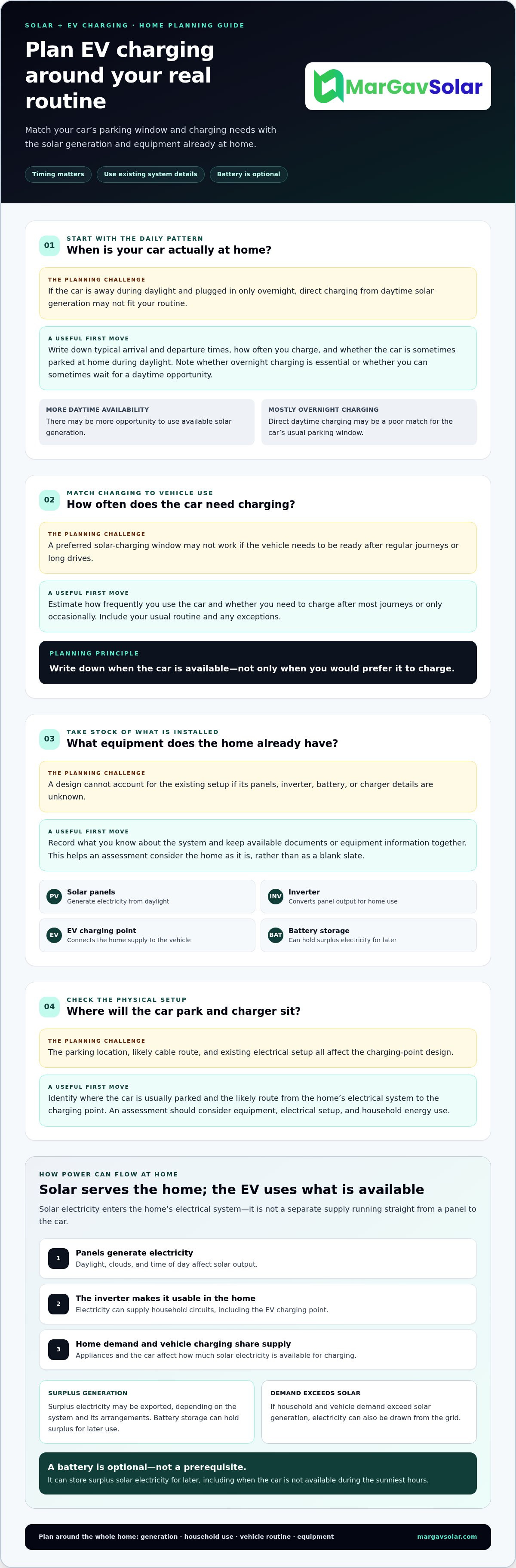
Integrating a home EV charger with solar PV means coordinating the electricity your roof generates with household demand and your car’s charging needs. It isn’t a separate supply running straight from a panel to the vehicle. Solar generation enters your home’s electrical system, where it can supply household appliances and, when the car is connected, contribute to charging.
In short, solar-assisted EV charging means charging a plugged-in car with some or all of the solar electricity available at home. A standalone charger charges the car without being planned around on-site solar generation. The difference is how the home’s energy sources work together, not simply whether a charger is installed.
In a typical solar PV setup, panels generate electricity and an inverter converts it into a form the home can use. From there, electricity can supply household circuits, including an EV charging point. Both vehicle demand and solar output change during the day: clouds, daylight and other household use affect how much solar electricity is available at any given moment. For an overview of charging equipment and infrastructure, see Electric vehicle charging.
What happens to solar electricity when the car is plugged in?
Solar electricity used by appliances or the car is consumed on site. If the home generates more than it uses, surplus electricity may be exported, depending on the system and its arrangements. If household and vehicle demand exceed solar generation, electricity can also be drawn from the grid.
For example, if the car is charging while the oven and other appliances are running, those loads share the home’s available supply. The amount of solar generation contributing to vehicle charging can therefore vary. Plugging in the car does not guarantee a fixed solar contribution.
Which parts of a home energy system are involved?
Planning how to integrate EV charger with solar means considering the components as one system. Each has a different role, and a battery is an option rather than a requirement. Your existing equipment and household routine help determine which arrangement makes sense.
- Solar panels generate electricity from daylight.
- An inverter converts the panels’ output for use in the home.
- An EV charging point connects the home’s electrical supply to the vehicle for charging.
- Battery storage can hold surplus solar electricity for use later, rather than sending it straight to the vehicle or exporting it.
Practical details matter too. When the car is parked, when the home uses electricity and how the existing system is configured all affect how the components work together. MarGav Solar’s EV Charging Points in Staffordshire homeowner’s guide offers a related perspective on home charging. An integrated project plan can consider solar generation, storage and charging as complementary parts of the home energy system.
How to plan solar-powered EV charging around your home
A useful plan starts with your household, not a particular charger or battery. To explore how to integrate EV charger with solar, map when you drive, when the car is at home and what your existing energy system can support. Work through these steps before making design decisions.
- Record your driving and charging routine. Note typical arrival and departure times, how often you charge, and whether your car is sometimes parked at home during daylight. Regular overnight charging creates a different pattern from flexible daytime charging, so include your usual routine and any exceptions.
- Estimate your real charging needs. Consider how frequently you use the car and whether you need to charge after most journeys or only occasionally. A household with regular long drives may prioritise having the car ready when needed. A car that stays parked at home during part of the day may have more opportunity to charge while solar generation is available.
- Gather details of your current equipment. Record what you know about your solar panels, inverter, battery storage and any existing EV charger. Keep available system documents or equipment information together. These details help an assessment account for the setup already in place rather than treating the home as a blank slate.
- Plan the charging location and electrical assessment. Identify where the car is usually parked and the likely route from the home’s electrical system to the charging point. A design assessment should consider the existing electrical setup, equipment and household energy use, then identify compatibility and design considerations.
Start with your driving pattern and charging window
Compare your typical return-home time with the daylight hours when your solar panels may be generating. If the car is away during the day and only plugged in overnight, direct daytime charging may not fit your routine. If it’s often at home during daylight, there may be more opportunity to use available generation. Your vehicle use and household schedule determine the practical charging window.
Write down when the car is available, not just when you’d prefer it to charge. Also note whether overnight charging is usually essential or whether you can sometimes wait for a daytime opportunity. This gives the system plan a realistic starting point.
Assess the existing solar and electrical system
List the panel and inverter details, any battery storage, and the make or type of an existing charger if you have one. An assessment brings these components together with your charging routine and the home’s electrical setup. For background before reviewing your own system, MarGav Solar’s solar panel installation guide can help explain the role of residential PV.
Bring the information you’ve collected into one project plan. MarGav Solar can consider residential solar PV, battery storage and EV charging together, with support from consultation through installation and long-term maintenance. Explore MarGav Solar’s home energy solutions as you consider the next steps for your home.
Direct solar charging, battery storage or grid support: compare the options
There isn’t one best arrangement for every home. The choice depends on whether your car is available while solar panels are generating, how much household electricity is being used at the same time, and whether you want to store surplus for later. Use this comparison to decide what to explore in a system plan.
| Option | How it works | Useful circumstances | Main trade-off |
|---|---|---|---|
| Direct solar use | Available solar electricity supplies the home, including the EV charging point while the car is plugged in. | The car is often at home during periods of solar generation, and charging can fit around that window. | Daytime generation may not line up with parking or charging needs, and household use also draws on available solar electricity. |
| Battery-supported charging | A home battery stores some generated electricity for use later, which may include EV charging. | The car is usually parked or charged after solar generation has fallen. | Storage adds another part to consider in the system plan, and a battery shifts when stored energy is available; it doesn’t create energy. |
| Solar with grid support | Solar contributes when available, while electricity can also be drawn from the grid when household and vehicle demand is greater than solar output. | You need flexibility to charge when the car is home, even if that time doesn’t match solar generation. | Some charging may use grid electricity, so the vehicle’s energy won’t necessarily all come from the panels. |
When direct solar charging may fit your routine
Direct use may suit a household where a car is regularly parked at home during daylight and charging can be scheduled around other electricity use. For instance, someone working from home may have more opportunity to connect the car while panels are generating than someone who returns home after dark.
That timing won’t necessarily line up every day. In the UK, available generation changes with daylight and weather, while journeys and household demand vary too. Direct solar can contribute to charging when conditions and timing align, but it shouldn’t be treated as a promise that panels will provide all the energy a vehicle needs.
When battery storage or grid support may help
A battery can make some previously generated solar electricity available after it was produced, which may help if the car is usually parked in the evening. It shifts energy through time rather than generating extra energy, and the amount available depends on what was stored and what else the home uses.
Grid support offers another kind of flexibility: the home can draw electricity when solar output isn’t enough for household and vehicle demand. A system plan can consider this alongside storage rather than assuming a battery is essential. For a deeper look at what storage does in a home energy system, consult a solar battery storage guide. Ultimately, the right solar EV charging setup depends on when your car is available, when your home generates and uses electricity, and how much flexibility you need. Planning how to integrate EV charger with solar means weighing those timings and needs together.
What to check before integrating an EV charger with solar
A little preparation makes a professional system assessment more useful. Before deciding how to integrate EV charger with solar at your property, gather what you know about the existing equipment and think through how you park and charge. Compatibility and electrical requirements depend on the individual home, so use this checklist as a starting point, not a substitute for an assessment.
Information to gather before a system assessment
Collect any available system paperwork, equipment details and notes about your routine. You don’t need to interpret technical specifications yourself. A clear list of what’s installed, where the car is parked and when you need it can help shape a practical discussion.
- Solar and inverter: Note any information you have about the panels and inverter, including documents from the original installation or later work.
- Battery and charging equipment: Record whether battery storage or an EV charger is already installed, with any details you can find about the equipment.
- Charging habits: Write down how often you charge, typical arrival and departure times, and whether the car is sometimes at home during daylight.
- Parking and cable route: Identify the usual parking position and the likely route between it and the home’s electrical equipment. Include practical obstacles such as a side passage, gate or detached garage.
These details connect the energy system to everyday use. A charger location that looks convenient on paper, for example, may not suit where the vehicle is usually parked. A long or awkward cable route may also affect installation planning. Mention any likely changes to parking or household routines.
How installation planning connects the system components
Consultation should bring together the property, existing solar and electrical equipment, charging location and vehicle use. A design assessment can identify compatibility questions and the electrical requirements relevant to your home. This helps ensure the plan considers the charging point alongside the wider system rather than treating each component in isolation.
Installation details and applicable electrical documentation depend on the work and property. Don’t assume that one arrangement or certificate applies to every home. Project planning should establish the relevant requirements and documentation for the proposed work. The wider solar installation process also involves understanding the property and the system being planned, not just choosing equipment.
For Staffordshire homeowners, local project planning can take account of the home’s layout, existing system and practical charging needs. MarGav Solar’s consultation, installation and long-term maintenance support can bring solar PV, battery storage and EV charging into one considered plan, informed by more than 20 years of industry experience.
Once you’ve assembled your notes, plan your home energy system with MarGav Solar around the equipment, parking setup and charging routine you’ve recorded.
Plan an integrated solar and EV charging system with MarGav Solar
Bringing solar panels and EV charging together is a home energy planning decision, not simply a matter of adding equipment. A clear sequence helps you move from general research to a setup shaped around your property and routine:
- Understand your demand. Note how you use the car, how often it needs charging and when it’s usually at home.
- Assess the existing system. Gather details about your solar PV, inverter, battery storage and electrical setup.
- Compare configurations. Consider direct use of available solar, optional battery storage and grid support against your charging priorities.
- Plan the installation. Bring the equipment, parking location, cable route and household needs into one project plan.
This order keeps the practical question at the centre: how to integrate EV charger with solar in a way that makes sense for your home, rather than assuming one configuration suits everyone. An assessment can then consider what’s already in place and what you want the system to do.
What an integrated project can consider
A joined-up plan can consider residential solar PV, an EV charging point and battery storage as complementary options. Solar generation may contribute to home and vehicle use; a battery may store some surplus for later. Whether storage belongs in the design depends on your property, existing equipment and when you need to charge. No particular combination guarantees a specific level of solar contribution or performance.
That’s why it helps to discuss the system as a whole. A homeowner whose car is usually away during the day, for example, may have different priorities from someone who can charge while the vehicle is parked at home. The right plan accounts for those patterns alongside the property and its existing equipment. MarGav Solar provides residential solar PV, battery storage and EV charging points, with consultation, installation and long-term maintenance support.
Take the next step for your Staffordshire home
For a useful first conversation, bring together any available system information and a short account of your vehicle use. Note your usual parking position, charging times and priorities, such as whether you want to make use of daytime generation or need flexibility to charge at other times. You don’t need to settle every technical decision in advance; these details help frame the project.
MarGav Solar supports Staffordshire homeowners from initial consultation through installation and ongoing maintenance, backed by more than 20 years of industry experience. A professional assessment can consider the home, existing system and charging requirements together to inform the installation plan. If you’re ready to discuss your home energy project, Discuss your solar and EV charging project.
Turn your charging plans into a home energy design
Turn what you’ve learned about your routine into a clear brief for your home. Note when the car is available, what equipment is already installed and what you want your charging setup to prioritise. That gives a project discussion a practical starting point without assuming every household needs the same combination of solar, storage and grid electricity.
Working out how to integrate EV charger with solar is ultimately about matching the system design to your property and everyday needs. MarGav Solar helps Staffordshire homeowners consider solar PV, battery storage and EV charging as part of a joined-up home energy project, with support from consultation through installation and long-term maintenance.
When you’re ready to explore the options for your home, discuss your solar and EV charging project. A thoughtful plan starts with choices that fit the way you live and drive.
Frequently Asked Questions
Can I use my existing solar panels to charge an electric car?
In many cases, an existing solar PV system can contribute electricity to EV charging, but the setup needs to be assessed alongside the charger and your home’s electrical system. Gather any panel and inverter information you have, along with details of the car and charging point. An older system or a recent inverter replacement, for example, may affect what needs consideration. A property-specific assessment can clarify the practical options for your home.
Do I need a home battery to charge an EV with solar panels?
No, a home battery isn’t essential. Your car may use solar electricity that’s available while it’s plugged in, and the home can draw from the grid when generation doesn’t meet demand. A battery is worth considering if you want to use some stored solar electricity at a different time, such as later in the day. Whether that suits you depends on your routine, existing equipment and project priorities.
Can solar panels charge an electric car at night?
Solar panels don’t generate electricity at night, so they can’t provide fresh solar power to a car then. Night-time charging may still use solar energy stored earlier in a home battery, if the system includes suitable storage and energy is available. Otherwise, the home can draw electricity from the grid. If you usually plug in after returning from work, include that pattern when planning how to integrate EV charger with solar.
Can an EV charger use solar power and grid electricity together?
Yes, a home can use available solar generation and draw grid electricity when household and vehicle demand exceeds it. The precise way the sources are coordinated depends on the equipment and system design. If household appliances are using electricity while the car charges, for instance, the solar contribution available to the vehicle can change. A system assessment can help establish how the existing setup and proposed charger should work together.
Will my solar panels charge my EV during a power cut?
Usually, a standard grid-connected solar system stops supplying power during a grid outage for safety reasons. Solar panels alone therefore shouldn’t be assumed to keep an EV charging through a power cut. Some systems may be designed with backup capability, but operation depends on the installed equipment and configuration. If backup power matters to you, raise it as a specific requirement when discussing your home energy plans in Staffordshire.
Can I add an EV charger to an existing solar panel system?
Often, an EV charging point can be considered as an addition to an existing solar setup. The appropriate design depends on the property, electrical arrangement and installed equipment, so don’t assume every charger will work identically with every system. Keep your solar and inverter documents handy and note where you park. MarGav Solar can consider existing residential solar PV alongside EV charging as part of a home project.
How many solar panels are needed to charge an electric car?
There isn’t one panel count that suits every EV or household. The estimate depends on the vehicle’s energy use, how far you drive, the solar system’s generation and how much electricity the home uses for other needs. A car covering a longer daily commute will have different charging demand from one used occasionally. A project assessment can use your driving pattern and property details to inform system planning.


