
In 2026, a successful solar installation in Staffordshire is less about finding the lowest price and more about securing a partner who understands the new, quality-focused MCS standards. You've likely felt the frustration of comparing conflicting technical quotes while wondering if a company will actually be around to support your warranty in a decade. Learning how to choose a solar installer in Staffordshire shouldn't feel like a gamble with your home's safety.
It's understandable to feel cautious when the UK market is shifting so rapidly. With the 0% VAT rate on solar and battery storage set to expire on March 31, 2027, the pressure to get it right the first time is high. You want a system that doesn't just sit on your roof but actively maximizes your returns through the latest Smart Export Guarantee (SEG) rates, which can now reach up to 32p per kWh for those with the right hardware and tariffs.
This guide provides a clear framework to help you master the art of vetting local companies. We'll show you how to verify essential UK certifications, compare quotes with confidence, and ensure your installation is both high-yield and fully compliant with local planning rules. By the end, you'll have the tools to choose a local partner who can deliver a safe, warrantied system for your home.
Key Takeaways
- Differentiate between local specialists and national sales aggregators to ensure your system design fits Staffordshire’s unique geography.
- Verify mandatory MCS and electrical certifications like NICEIC or NAPIT to guarantee your eligibility for the Smart Export Guarantee (SEG).
- Identify the hidden risks in low-cost quotes by learning how to compare "Tier 1" components against generic, lower-quality alternatives.
- Discover the essential steps for how to choose a solar installer in Staffordshire, including how to use Companies House and local references to verify reliability.
- Understand the advantage of choosing a local partner for faster maintenance response times and specific knowledge of regional weather patterns.
Understanding the Staffordshire Solar Landscape in 2026
Choosing the right partner starts with understanding who is actually doing the work. In the current Staffordshire market, you'll encounter two types of businesses: local installers and national sales aggregators. National companies often use aggressive marketing to capture leads before subcontracting the installation to the lowest bidder. This often results in a "one size fits all" approach that ignores local nuances. A dedicated local installer lives and works in the area, meaning their reputation depends on the long term performance of your system. When researching how to choose a solar installer in Staffordshire, prioritize companies with a physical presence between the Potteries and the southern reaches of the county.
Staffordshire’s diverse geography directly impacts system design. The exposed, elevated areas near the Peak District fringe require different mounting considerations than the sheltered urban rows of Stoke-on-Trent or the leafy suburbs of Stafford. Local experts account for shading from landmarks like Cannock Chase and design arrays that withstand regional weather patterns. This localized knowledge is a key part of the broader growth of Solar power in the United Kingdom, where residential adoption is increasingly driven by regional expertise rather than national trends. While large scale solar farms face local opposition in the "Solar Land Grab" debates, rooftop residential PV remains a highly supported way for Staffordshire residents to secure energy independence.
Local Grid Constraints and G98/G99 Applications
Every solar installation must be coordinated with the Distribution Network Operator (DNO). In Staffordshire, this is National Grid Electricity Distribution. They manage the infrastructure that carries electricity to your home. If you're installing a standard system under 3.68kW, your installer usually follows the G98 process, which is a simple "fit and inform" notification. However, as battery storage solutions and larger arrays become the 2026 standard, most homeowners now require a G99 application. This is a prior-approval process where the grid operator confirms the local cables can handle your system's export. A professional installer handles all this paperwork for you. They'll ensure your system is legally connected before you try to claim export payments.
Staffordshire Planning Permissions and Conservation Areas
Most residential solar projects fall under "permitted development," meaning they don't need formal planning permission. There are strict rules to follow: panels shouldn't protrude more than 20cm from the roof slope and must be kept away from the roof edge. Things get more complex in Staffordshire's many conservation areas, such as parts of Lichfield or historic villages in the Moorlands. If you live in a listed building, you'll almost certainly need Listed Building Consent. A local expert identifies these hurdles during the initial site survey. They know which district councils are more stringent and can advise on low profile mounting or specific panel aesthetics that are more likely to be approved in sensitive zones.
Essential Credentials and Accreditations to Verify
Credentials are the first line of defense against poor workmanship. In the UK solar industry, certain badges are non-negotiable for both safety and financial eligibility. When learning how to choose a solar installer in Staffordshire, you'll find that the Microgeneration Certification Scheme (MCS) is the most critical. As of 2026, the MCS has transitioned into a more quality-focused scheme that serves as the sole gateway for government clean-heat programs. Without an MCS certificate, you're also ineligible for the Smart Export Guarantee (SEG). Since some energy suppliers now offer export rates up to 32.17p per kWh for homeowners with batteries, missing out on this certification could cost you hundreds of pounds in lost income every year.
The Energy Saving Trust guide to solar panels emphasizes that finding a certified installer is the only way to ensure your investment is protected. Beyond MCS, look for manufacturer-specific statuses. Companies that have achieved "Elite" or "Advanced" status with brands like GivEnergy or SolarEdge have undergone additional training directly from the hardware makers. These statuses often unlock extended hardware warranties that generic installers simply can't offer. If you're looking for a partner with these high-level credentials, you can browse our residential solar PV systems to see the standards we maintain.
The Importance of NICEIC Certification
While MCS covers the solar technology, NICEIC certification focuses on the electrical integrity of your home. Solar arrays involve high-voltage DC and AC electricity, making rigorous safety audits essential. An NICEIC-registered installer has their work inspected regularly to ensure it meets BS 7671 standards. This is particularly vital for battery storage solutions and EV charging points, which require complex wiring into your existing consumer unit. You can verify any firm's status by checking their name on the official NICEIC or NAPIT online portals. Don't take a verbal "yes" as proof; always check the live database.
HIES and RECC: Your Financial Safety Net
Consumer protection bodies like HIES (Home Insulation & Energy Systems) or RECC (Renewable Energy Consumer Code) provide a layer of security that many homeowners overlook. These organizations ensure that your deposit is protected and that you receive an Insurance Backed Guarantee (IBG). If an installer goes out of business, the IBG ensures your system's warranty remains valid for the long term. They also provide free mediation services if a dispute arises regarding performance or installation quality. When deciding how to choose a solar installer in Staffordshire, always ask to see their membership number for one of these schemes. It's the difference between a risky gamble and a secure, warrantied home upgrade.
Evaluating Solar Quotes: Beyond the Bottom Line
When you're figuring out how to choose a solar installer in Staffordshire, the temptation to pick the lowest bid is strong. However, a low headline price often hides compromises in areas you can't see from the ground. Cheap mounting systems made of thin galvanized steel can corrode over time, especially in the damp, windy conditions typical of the Staffordshire Moorlands. In contrast, premium quotes include stainless steel or high grade aluminum rails that won't fail during a winter storm. Similarly, look for "Tier 1" panels. These aren't just brands; they're products from manufacturers with the financial stability to honor a 25 year warranty. Generic panels might look identical, but their power output often degrades much faster, leaving you with a sub-optimal system long before it has paid for itself.
The difference between a "desktop quote" and a physical site survey is another major red flag. Many national companies rely solely on satellite imagery to estimate your roof size. This process misses crucial details like the structural integrity of your rafters, the exact location of vent pipes, or the age of your consumer unit. A reputable local installer will always perform a physical inspection. They'll check if your electrical system needs a modern upgrade to handle the load, ensuring you don't face unexpected costs on the day of the installation. If a company won't visit your home before asking for a deposit, they aren't the right partner for a high yield, safe installation.
Battery Storage and Inverter Synergy
Your inverter is the hardest working component of your system, converting DC sun power into usable AC electricity. Evaluating solar battery storage options in your proposal is about more than just capacity. It's about how the battery and inverter talk to each other. Choosing a GivEnergy certified installer is a smart move in 2026 because it grants you access to a seamless cloud monitoring ecosystem. This allows you to track energy flow in real time and automate your battery to charge from the grid when prices are low. If your current system is aging, inverter upgrades can often unlock these smart features without needing to replace every panel on your roof.
Performance Estimates and ROI Calculations
Be wary of installers who provide overly optimistic generation claims. A professional ROI calculation must account for the specific pitch and orientation of your Staffordshire home. Shading is the biggest "solar killer." Whether it's a chimney stack in Stoke or a row of mature oaks near Cannock Chase, even partial shade can significantly drop a string system's output. Your quote should include a shading analysis and explain how the Smart Export Guarantee (SEG) affects your payback. With 2026 export rates varying from 15p to over 32p per kWh depending on your tariff, a realistic estimate helps you understand exactly when your system will start turning a profit.
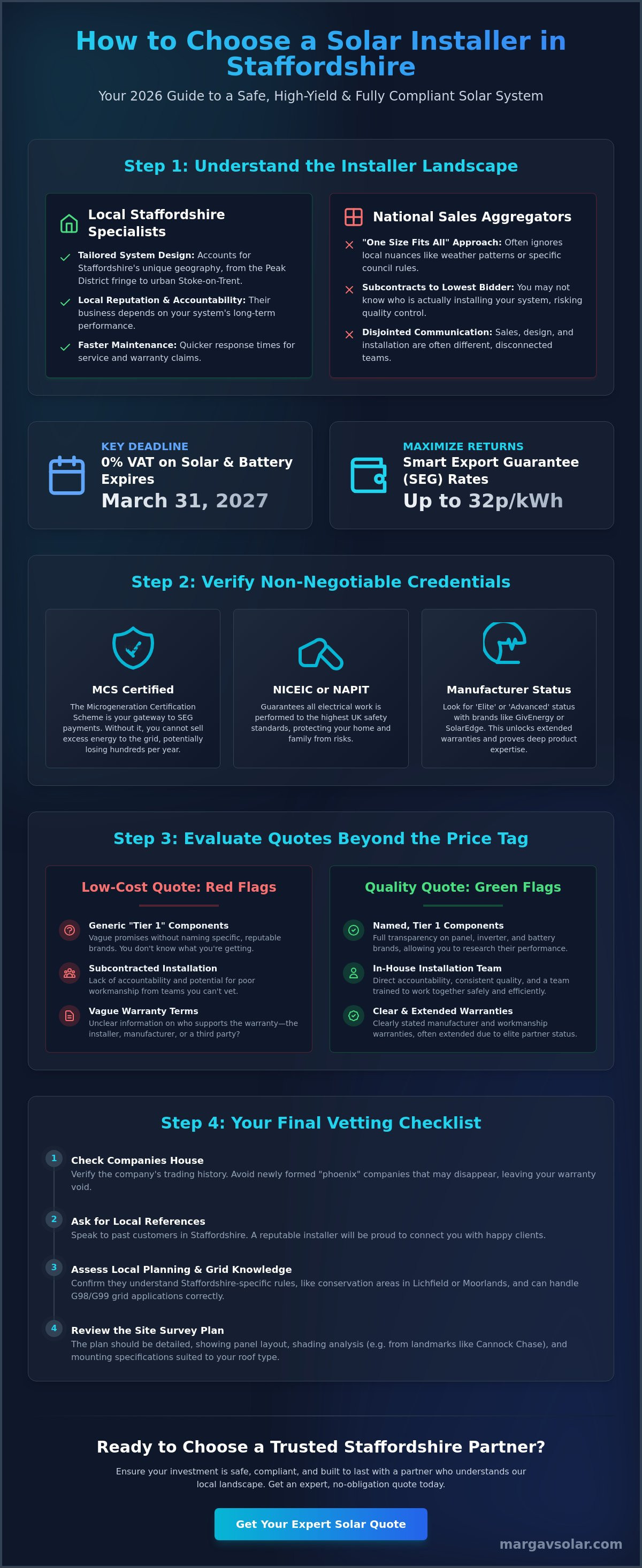
Step-by-Step: Vetting Your Staffordshire Solar Company
Once you've narrowed down a shortlist of candidates, it's time to move beyond their website testimonials. Start by researching the company’s history and financial stability via Companies House. In the volatile 2026 energy market, you want a firm that has been trading steadily rather than a phoenix company that recently rebranded to escape past liabilities. A stable company is far more likely to be around to honor your long term warranties. When considering how to choose a solar installer in Staffordshire, don't be afraid to ask for local references. A reputable installer should be able to point you toward completed projects in towns like Stafford, Leek, or Lichfield. Seeing a physical installation and speaking with a fellow homeowner provides a level of clarity that no brochure can match.
The quality of your initial consultation often predicts the quality of the installation. If the "expert" who visits your home is more interested in closing a deal than discussing your energy usage, they're likely a salesperson rather than a technician. A professional consultation should involve a deep dive into your electricity bills and your future plans, such as adding a battery or an EV charger. This ensures the final fixed-price contract is comprehensive. It should cover everything from scaffolding and bird proofing to DNO applications and final certification. If you're ready to speak with a technical expert rather than a salesperson, you can book a survey for our residential solar PV systems today.
The Site Survey: What a Professional Looks For
A professional site survey is a technical audit, not a sales pitch. The surveyor must check the structural integrity of your roof rafters to ensure they can handle the additional weight of the panels and mounting system. They also need to measure the capacity of your existing electrical consumer unit. If your fuse box is outdated, it might require an upgrade to safely integrate a new PV system or battery. Finally, they should identify the best cable routes. A good installer works to minimize aesthetic disruption, hiding cables behind downpipes or within loft spaces whenever possible.
Post-Installation Support and Maintenance
Installation day isn't the end of your journey. You need to know what happens if a fault occurs or if your generation drops unexpectedly. Ask about solar panel maintenance packages that include regular cleaning and health checks to keep your system performing at its peak. In 2026, most high quality systems offer remote monitoring via apps like GivEnergy Cloud. This allows both you and your installer to track performance in real time. Before signing a contract, clarify the specific response time for technical repairs. Knowing exactly who to call and how quickly they'll arrive provides essential peace of mind for your investment.
Why Local Expertise Matters for Staffordshire Homeowners
Choosing a local expert is about more than just proximity; it's about long term accountability. While national aggregators might offer slick marketing, they often struggle with the logistics of post-installation support. If your system requires a minor adjustment or a warranty call-out, a national firm might wait until they have several jobs in the West Midlands before sending a van. A local specialist is usually just a short drive away, providing significantly faster response times. This "boots on the ground" advantage is a primary reason why homeowners researching how to choose a solar installer in Staffordshire eventually settle on a regional partner.
Local knowledge also extends to the physical environment. Staffordshire isn't a monolith. The exposed, wind-swept elevations near the Peak District fringe require different mounting considerations than a sheltered suburban street in Cannock. A local installer understands these micro-climates and selects hardware designed to endure regional weather patterns. Beyond technical specs, choosing a local firm keeps your investment within the Staffordshire economy. It supports local renewable energy jobs and builds a relationship with a team that will still be operating in your community ten or twenty years from now.
Integrating EV Charging into Your Solar System
As we move deeper into 2026, many homeowners are looking to pair their PV arrays with dedicated EV charging points. A local expert can design these systems to work in perfect harmony. The most critical factor here is load balancing. Your installer ensures that your car charger doesn't trip your home's main fuse when the kettle and oven are running at the same time. By using a single point of contact for your solar, battery, and EV tech, you avoid the "finger-pointing" that often happens when multiple contractors are involved in a single energy ecosystem.
MarGav Solar: Your Trusted Staffordshire Partner
With over 20 years of expertise in solar panel installation, MarGav Solar understands the unique needs of Staffordshire homeowners. We don't believe in high-pressure sales or generic "desktop" estimates. Our commitment to the community is built on fixed-price contracts and comprehensive end-to-end maintenance. We handle everything from the initial site survey to the final DNO notification, ensuring your journey to energy independence is smooth and transparent. Ready to take the next step? Book your Staffordshire site survey today and let's design a system that works for your home and your future.
Securing Your Staffordshire Energy Future
Transitioning to renewable energy is one of the most significant investments you'll make for your home. By prioritizing MCS and NICEIC certifications, you ensure your system is eligible for the highest Smart Export Guarantee rates while guaranteeing the highest safety standards. Local knowledge is your greatest asset. A partner who understands the specific planning rules in Lichfield or the weather patterns of the Moorlands provides a level of security that national firms simply can't match.
Mastering the process of how to choose a solar installer in Staffordshire ensures your home remains resilient as energy prices and regulations evolve. At MarGav Solar, we bring over 20 years of renewable energy expertise to every project. Our team of NICEIC and MCS certified installers are specialists in GivEnergy battery storage and seamless EV charging integration. We're here to help you navigate the technical details and deliver a high-yield system that lasts for decades.
Ready to take the next step toward energy independence? Book Your Expert Site Survey in Staffordshire today. Let's build a cleaner, more efficient future for your home together.
Frequently Asked Questions
Do I need planning permission for solar panels in Staffordshire?
In most cases, you don't need planning permission because residential solar is considered "permitted development." However, you must check with your local council if you live in a conservation area or a listed building. Restrictions apply if the panels protrude more than 20cm from the roof or are installed on a wall facing a highway within a designated conservation zone.
How long does a typical solar installation take in Staffordshire?
The actual on-site installation usually takes between one and two days for a standard residential system. This timeframe includes erecting scaffolding, mounting the roof brackets, and completing the electrical wiring for the inverter and battery storage. You should allow extra time for the initial technical survey and the DNO approval process, which must happen before the physical work begins.
What is MCS certification and why is it mandatory for Staffordshire homes?
MCS is the primary UK quality standard for renewable energy products and installers. It's mandatory if you want to sell your surplus electricity back to the grid through the Smart Export Guarantee (SEG). Choosing an MCS-certified partner is a core part of learning how to choose a solar installer in Staffordshire, as it ensures the hardware meets strict performance and safety benchmarks.
Can I install solar panels on a listed building in Staffordshire?
You can install solar panels on a listed building, but you must obtain Listed Building Consent from your local district or borough council first. This process involves demonstrating that the installation won't harm the building's character or historic significance. A local expert can often suggest low-profile or black-frame panels that are more likely to be accepted by Staffordshire planning officers.
Should I choose a local Staffordshire installer or a national company?
A local installer is almost always the better choice because they provide faster response times and have "boots on the ground" for future maintenance. When you're deciding how to choose a solar installer in Staffordshire, remember that national companies often subcontract the work to third parties. A local firm depends on its regional reputation and understands the specific electrical grid constraints managed by National Grid Electricity Distribution.
What happens if my solar installer goes out of business?
Your warranty remains protected if your installer was a member of a consumer protection scheme like HIES or RECC. These organizations provide Insurance Backed Guarantees (IBGs) that cover your system for up to ten years even if the original firm ceases trading. Always verify that your chosen contractor issues a valid IBG certificate once the installation is complete and the final payment is made.
How much can I save on my energy bills with solar in Staffordshire?
A typical 4kW solar system can save a household approximately £735 per year on energy bills as of May 2026. Additionally, you can earn roughly £360 annually through Smart Export Guarantee payments by selling excess power back to the grid. These figures vary based on your specific energy usage patterns and whether you've included a battery to maximize your self-consumption.
Do Staffordshire solar installers handle the DNO application process?
Professional installers handle all the necessary applications to the Distribution Network Operator (DNO) on your behalf. This is a legal requirement to ensure the local grid can safely handle the electricity your system generates. Your installer will manage the G98 notification for smaller systems or the G99 application for larger arrays and battery storage solutions before the installation starts.


