

Could charging an electric car with solar bring your running costs close to zero? Only when the car uses electricity generated at home, either directly or after storage. Charging after sunset or when solar generation is low may still rely on the grid. The cost to run an electric car with solar depends on more than your panels’ total output: it also depends on when the car is home, how much electricity your household uses and how you charge.
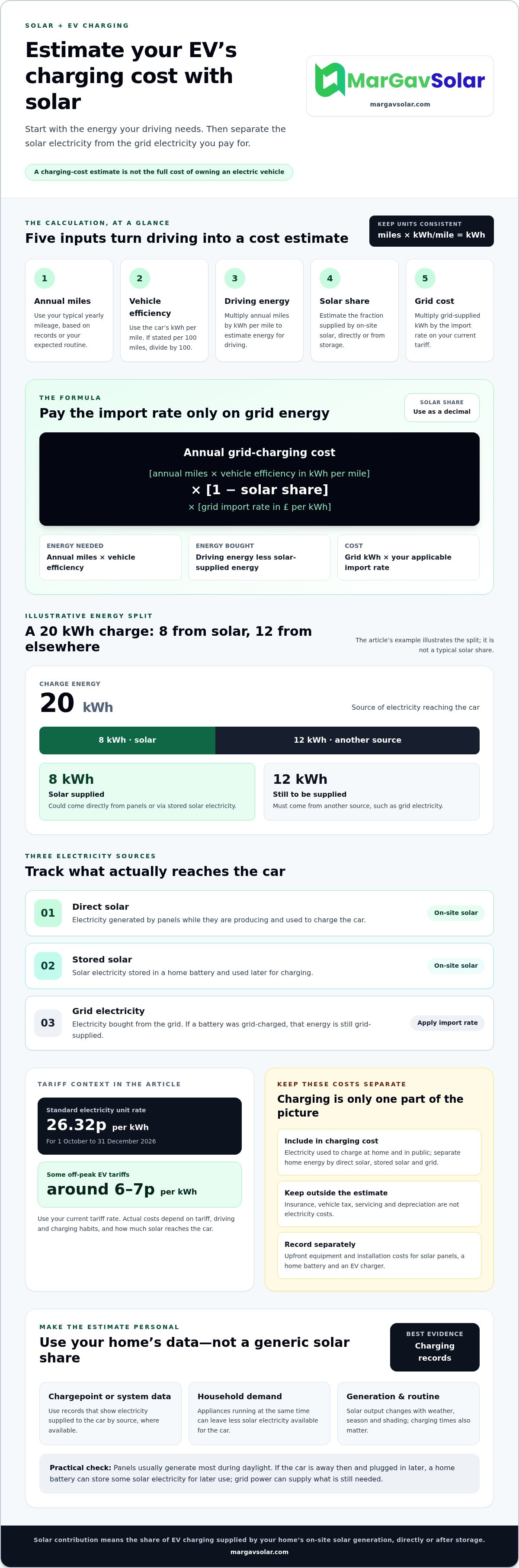
It’s easy to see why the figures can be confusing. In the UK, the standard electricity unit rate is 26.32p per kWh for the period from 1 October to 31 December 2026, while some off-peak EV tariffs are around 6-7p per kWh. Your actual costs depend on your tariff, driving and charging habits, and how much solar power reaches the car.
This guide explains how to estimate charging costs using your energy use, compare direct solar with battery storage and grid charging, and identify practical ways to use more of your home’s solar generation. MarGav Solar installs solar panels, battery storage and EV chargers, helping property owners in Staffordshire plan these elements together.
Key Takeaways
- Estimate the cost to run an electric car with solar using your annual mileage, your car’s efficiency and the share of charging supplied by solar.
- Compare direct solar, battery storage, home grid charging and public charging by when each can provide electricity for your car.
- Review your charging schedule, household energy use and solar generation to find practical opportunities to use more solar power.
- Assess your electricity tariff alongside your solar use, rather than assuming the lowest unit rate will always suit your routine best.
- MarGav Solar’s process brings property assessment, a tailored energy plan, professional installation and after-care together for solar and EV charging.
What does it cost to run an electric car with solar?
Here, “running cost” means the electricity used to drive, not the full cost of owning an electric vehicle. An electric car uses energy stored in its battery, and the cost of replenishing that energy depends on its source. Solar can reduce the amount you buy from the grid, but charging at home does not automatically mean charging for free.
Separate three sources when estimating your costs: electricity used directly from solar panels while they’re generating, solar electricity stored in a home battery and used later, and electricity bought from the grid. If a home battery is charged from the grid, that energy remains grid-supplied, even if it is used to charge the car later.
Solar contribution is the share of your EV’s charging electricity supplied by your home’s on-site solar generation, either directly or after storage. This distinction separates simply having solar panels from the amount of solar power that actually reaches the car. The share varies by home and routine, so there is no single figure that applies to every UK household.
Which costs belong in an EV charging estimate?
Count the electricity used to charge the vehicle, then separate home charging from public charging. Home electricity may come from direct solar, stored solar or the grid. Public charging is bought through a charging provider. Keep insurance, vehicle tax, servicing and depreciation outside this calculation: they are not electricity costs and do not fall simply because you charge with solar.
Also keep recurring charging costs separate from the upfront cost of equipment and installation. Solar panels, a home battery and an EV charger are parts of your home energy setup, not per-charge costs. When comparing options, record equipment and installation separately rather than treating them as the cost of driving each mile.
Why solar does not cover every charge
Solar panels usually generate most during daylight. But your car may be parked at work or out driving then, and plugged in at home later. If it is available to charge during sunny hours, some generated electricity may go straight to it. Otherwise, a home battery can store some solar electricity for later use, while grid power can supply what is still needed.
Generation also changes with weather, season and shading. Household demand matters: appliances running at the same time can leave less solar power available for the car. For example, if a charge needs 20 kWh and 8 kWh comes from solar, directly or via storage, the remaining 12 kWh must come from another source, such as the grid. This is an illustration, not a typical solar share. Your result depends on generation, household use and charging times.
How to calculate your electric car charging cost with solar
A useful estimate starts with the energy your driving requires, then separates the electricity supplied by solar from the electricity you import. Keep the units consistent: if your car’s efficiency is stated in kilowatt-hours per mile (kWh/mile), use miles for distance and kWh for energy. Check whether the vehicle figure reflects real-world driving or a test value, and use your own charging data where possible.
Estimate annual electricity use for driving
Follow these five steps to build a repeatable estimate:
- Estimate annual mileage: use your typical miles driven in a year, based on records or your expected routine.
- Find vehicle efficiency: note the car’s stated energy consumption in kWh per mile. If it is given per 100 miles, divide that figure by 100.
- Calculate energy for driving: multiply annual miles by kWh per mile. This estimates the energy required for driving before you split it by source.
- Estimate the solar share: use measured charging data or a property-specific estimate to find what fraction of charging electricity comes from your on-site solar generation, directly or via a battery.
- Calculate grid use and cost: subtract solar-supplied energy from total charging energy, then multiply the remaining grid kWh by your applicable import unit rate.
Formula: annual grid-charging cost = [annual miles × vehicle efficiency in kWh per mile] × [1 − solar share as a decimal] × [grid import rate in £ per kWh]. The inputs are annual mileage, vehicle efficiency, solar share and electricity import rate. Use the rate on your current tariff, not a general estimate.
Illustrative example: Enter your own verified mileage, efficiency, solar contribution and tariff in the formula. If your meter or charging records show how much grid electricity the car used, multiply those grid-supplied kWh by the rate on your bill. This gives a personalised estimate without relying on a generic household or tariff assumption.
Account for solar use and grid electricity
Estimate solar contribution using data that reflects your home and charging routine. If your system or chargepoint records electricity supplied to the car by source, use those records. Otherwise, compare charging periods with solar generation carefully, since household appliances may also use the electricity being generated. A property-specific assessment can help bring these factors together.
Apply your import rate only to electricity bought from the grid. If you export surplus solar, treat any export payment separately from the EV charging calculation; exported units are not electricity used by the car. Battery losses may also matter. Use energy delivered to the vehicle where available, or account separately for losses if your figures measure energy entering storage instead. For context, Cost of running an electric car with solar in the UK offers a related comparison, but your own inputs determine your result.
MarGav Solar can assess solar generation and EV charging together as part of a property-specific solar and EV charging plan.
Solar-only, solar with a battery, or grid charging: what changes?
The main difference between these options is when and where electricity is available. Direct solar can power a car while panels are generating. A home battery can shift some solar energy to a later time, and grid or public charging supplies electricity when on-site generation is unavailable or inconvenient. None guarantees that every charge comes from the same source.
Use this comparison to identify which options suit your routine. The best-fit charging option depends on timing, energy use and the property, not on a universal ranking of which setup costs least.
| Option | When it can supply energy | What affects its contribution |
|---|---|---|
| Direct solar | While the panels are generating and the vehicle is connected at home. | Daylight availability, household demand and whether the car is parked at home. |
| Solar with a battery | Solar electricity can be stored and used to charge the car later, subject to the system’s design and performance. | How much energy is generated, used around the home, stored and needed for charging. |
| Grid-only home charging | When the vehicle is plugged in and the home draws electricity from the grid. | Your charging schedule and the import tariff that applies at that time. |
| Public charging | At a public chargepoint when you’re away from home or can’t charge there. | Where you travel, which chargepoints are available and their prices. |
Charging directly from solar
Direct charging uses available solar generation while the car is connected. But the panels also supply the home, so appliances and other household demand may use some of that electricity first. If the car is away during the brighter parts of the day and returns in the evening, it may use less direct solar. Generation can also vary with weather, season and shading.
Your home’s total solar output is not the same as the amount available for its EV. Base your estimate on the generation and household use that coincide with charging, rather than assuming all surplus or all panel output goes into the car.
When battery storage may change the calculation
A home battery can store some generated electricity for use after solar production falls. This may help if your car is usually home later in the day. A battery does not create extra solar energy, and the amount useful for charging depends on system design, household demand, storage performance and your charging schedule. Consider these factors together when comparing a battery with direct solar or grid charging.
For a closer look at how storage fits into a home energy setup, explore this solar battery storage guide. To understand the cost to run an electric car with solar, compare the energy delivered to the vehicle from each source across your own charging routine, rather than assuming one option covers every charge.
How to make solar-powered EV charging work for your routine
Make your charging plan fit how you use your car and home. Start by noting when the vehicle is usually parked, when you need it ready to drive, and which household appliances run during those periods. This helps show whether daytime charging could use available solar, or whether your routine is more likely to need stored energy or grid electricity.
Match charging times to solar generation
If your car is at home during daylight, plugging it in while your panels are generating may create more opportunity for direct solar charging. If it is away during the day, that opportunity may be limited. Review generation and charging records across representative periods, including different seasons, rather than relying on one sunny day or assuming one schedule will suit every journey.
Use the data to test realistic routines. Compare a typical weekday when the car is away with a day when it is parked at home. Note the solar generation, household use and charging energy in each case. If you need to charge before an early departure, being ready for the journey may matter more than waiting for a sunny window. A suitable routine can make better use of solar without guaranteeing that solar will meet every charging need.
Use a property-specific energy plan
Solar output depends on the home, including roof orientation, shading and local conditions. Household demand and charging times also affect how much generation can go to the EV. For Staffordshire homeowners, a property-specific generation estimate is more useful than a UK-wide assumption because it can account for the home and its likely energy use. Explore solar panel installation in Staffordshire for more context on planning around a property.
Consider the solar panels, battery storage and EV charger as parts of one energy setup. A battery may help shift some generated electricity to a later charging time, while direct solar use depends on the car being at home as generation is available. The right balance depends on household demand and driving schedule, so avoid judging the options on equipment alone. A tailored assessment can bring those factors together.
Assess your electricity tariff alongside solar use, not in isolation. A lower-priced import period may be useful when you need grid charging, but it does not show how much solar electricity the vehicle could use at home. Compare the tariff’s relevant charging times with your routine and the home’s generation. For practical home chargepoint context, see the EV charging points guide for Staffordshire.
MarGav Solar offers a free, no-obligation consultation to help plan solar generation and EV charging around your property.
Plan solar and EV charging with MarGav Solar
A solar and EV setup works best when the plan reflects both the property and the way you use energy. MarGav Solar installs residential solar panels, battery storage and EV chargers through a process that starts with a consultation and property assessment. You’ll receive a quotation and a tailored energy plan, followed by professional installation and after-care and support.
This joined-up approach helps you consider solar generation alongside household electricity demand and your car-charging routine. Rather than treating panels, a battery and a charger as separate decisions, you can explore how they may fit together at your home. The aim is a property-specific plan, not a promised charging cost or guaranteed saving.
What a tailored solar and charging assessment considers
The assessment considers your property and expected energy use. Roof suitability and shading can affect solar generation; household demand and the times your EV is at home influence how much generated electricity may be available for charging. Your plan can also consider whether battery storage is relevant for using some solar electricity at a different time.
Useful details to bring to the discussion include your typical driving pattern, when the car is usually parked at home, and any information you have about current household electricity use. These help connect the property’s potential generation with real charging habits. The resulting energy plan is tailored to your requirements, without assuming every charge will be solar-powered or assigning a fixed outcome to the system.
From assessment to installation
After the initial consultation, MarGav Solar assesses the property and prepares a quotation. The tailored plan sets out the proposed approach for solar panels, battery storage and EV charger installation as relevant to the home. Once the plan is agreed, professional installation is followed by after-care and support.
Considering the components together gives you a clearer basis for assessing the cost to run an electric car with solar. Your charging costs still depend on how much electricity the vehicle uses and how much of that energy comes from solar rather than the grid. The assessment relates those factors to your property and routine; it does not promise a particular level of solar generation or savings.
Take the next step with a free consultation
If you’re at an early planning stage, MarGav Solar’s free quick-scan can help you explore your home’s solar potential. It is free to use and carries no commitment, but it is not a guaranteed forecast of EV charging savings. A free, no-obligation consultation and property assessment can help shape a plan around your home and charging needs.
Explore solar, battery and EV charging solutions to see how a property-specific setup can bring these elements together.
Make your next charging decision with confidence
Your estimate is a starting point, not a fixed promise. If your driving routine or household energy use changes, revisit the figures using what you actually charge and how much electricity your home supplies. This helps you make decisions about solar, storage or charging habits based on your needs rather than assumptions about a typical household.
MarGav Solar helps UK property owners consider solar generation and EV charging together. The free quick-scan offers an initial guide with no commitment required. For a more tailored discussion, a free consultation can help relate your property, charging routine and energy requirements.
With a clearer picture of the cost to run an electric car with solar, you can compare your options using your own energy use and charging habits. Book a free, no-obligation consultation with MarGav Solar to discuss a solar and EV charging plan for your property in Staffordshire.
Frequently Asked Questions
Is it free to charge an electric car with solar panels?
Not necessarily. Electricity generated at home may not add a per-unit charge to your bill when it powers the car directly, but the panels and any battery have upfront costs, and solar may not cover every charge. You may still import electricity, especially when generation is low. To estimate your cost, separate solar-supplied energy from grid-supplied energy and apply your tariff rate only to imported units.
How many solar panels are needed to charge an electric car?
There is no single panel count that suits every driver. Start with your annual mileage and the car’s energy use to estimate yearly charging demand, then compare it with a property-specific estimate of solar generation. The result depends on the home, household electricity use and how often the car can charge while solar is available. In Staffordshire, a property assessment can help produce a more relevant estimate than a UK-wide assumption.
Can I charge my electric car with solar power on a cloudy day?
Yes. Solar panels can still generate electricity in cloudy conditions, although output may be lower than on a bright day and varies with the weather. If the car is charging at home, it may use some available generation, while the grid supplies any shortfall. Compare your system’s generation records with charging data across different weather and seasonal conditions, rather than relying on one day’s output.
Do I need a home battery to charge an electric car with solar?
No. You can charge directly from solar when the car is at home and generation is available. A battery can store some generated electricity for later, which may suit a household whose car is usually plugged in after daylight hours. Whether storage is useful depends on the home’s energy demand, solar generation and charging routine. Compare those factors before deciding whether a battery belongs in your setup.
Can I earn money by exporting solar electricity instead of charging my car?
Potentially, if your export arrangement pays for electricity sent to the grid. The amount and terms depend on your supplier and export tariff, so check the current details that apply to your home. Compare the value of exporting surplus electricity with the value of using it to reduce grid imports for EV charging. The better option can vary with your tariff, charging schedule and how much surplus generation you have.
Does solar charging work if my electric car is usually parked away from home during the day?
It can, but being away during daylight limits the chance to charge directly from solar at home. You could use a home battery to store some daytime generation for later, if that fits your energy needs and system, or charge from the grid when you return. Consider how often the car is home during daylight and whether you need a full charge on particular days before choosing a routine.
How do I compare the cost of solar charging with an EV electricity tariff?
Compare the tariff’s relevant import rates with the electricity your car could use directly from solar or from stored solar. Apply the tariff rate only to grid-supplied charging, and use current rates and terms for your specific plan. If exporting is an option, include the payment you’d forgo by using that electricity in the car. This gives a more useful comparison than looking at a tariff’s headline rate alone.


