
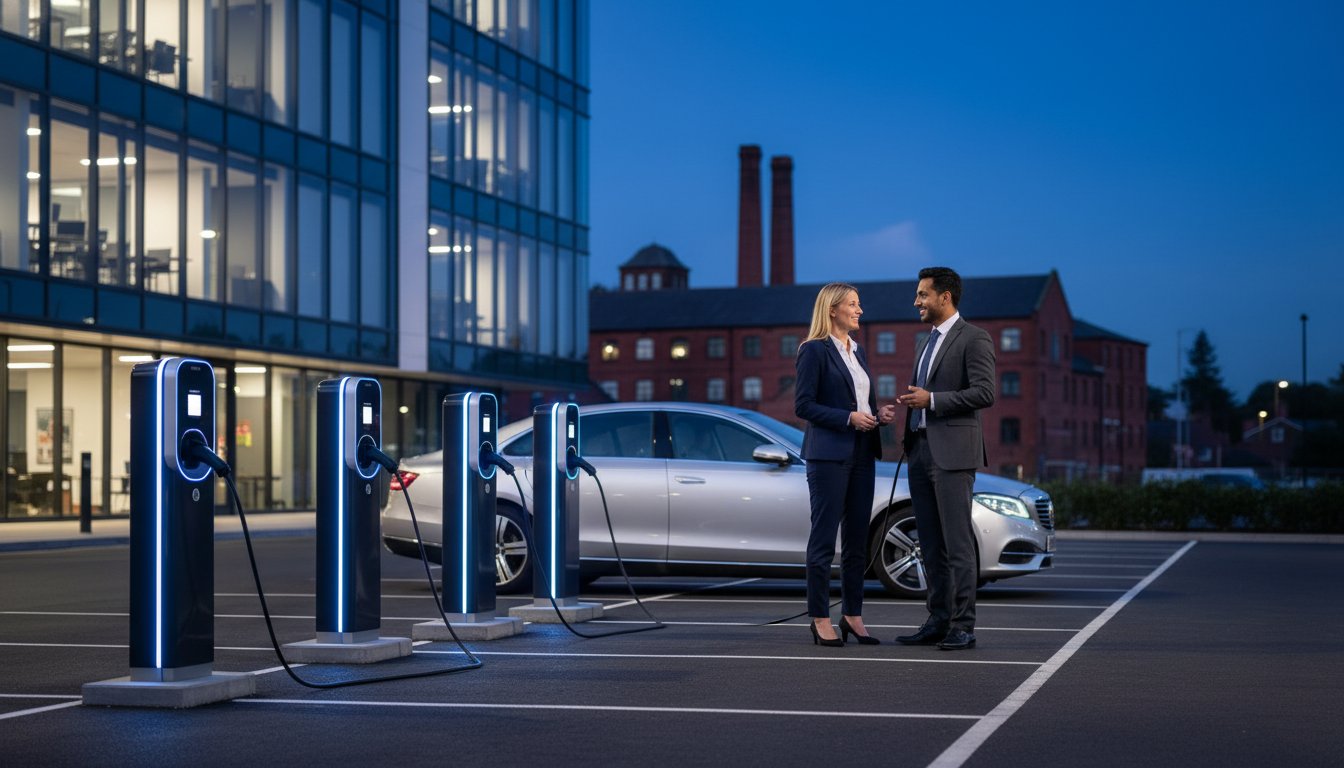
Installing commercial EV charging stations in Burton upon Trent has officially crossed the line from a modern luxury to a core business utility. You're likely aware that your customers and employees now expect reliable power for their vehicles, yet concerns about Staffordshire's local grid capacity and the recent overhaul of government grants can make any business owner hesitant. It's difficult to stay confident when the Workplace Charging Scheme rules have shifted and the fear of choosing the wrong charger speed looms over your investment.
We understand that you want to lower your carbon footprint while attracting high-value EV-driving customers to your door. This 2026 guide will show you how to transform your Burton-based business into a sustainable hub with professional commercial EV charging installation and strategic infrastructure planning. We'll break down the latest Staffordshire developments, including the increased £500 per socket grant and the mandatory smart charging regulations, to ensure your business remains competitive and compliant for the long term.
Key Takeaways
- Learn why transitioning to electric vehicle infrastructure is now a core business utility as the UK moves toward 2030 and 2035 zero-emission mandates.
- Discover how to select the ideal infrastructure for commercial EV charging stations in Burton upon Trent by matching charger speeds to your visitors' typical dwell times.
- Explore how integrating battery storage and solar PV systems can significantly lower operational costs and protect your business from peak energy rates.
- Get clarity on the 2026 Workplace Charging Scheme (WCS) updates, including how to secure the increased £500 per socket grant for your installation.
- Understand the importance of professional site audits and DNO applications to ensure your local electrical capacity can handle long-term demand.
Why Burton Businesses are Investing in Commercial EV Charging Stations
Burton upon Trent is evolving. While the town is famous for its industrial heritage, the local business community is now looking toward a cleaner future. The move toward installing commercial EV charging stations Burton upon Trent is driven by a mix of government pressure and clear economic benefits. With the UK's ban on new petrol and diesel car sales set for 2030, the transition isn't optional; it's a matter of when, not if. Local firms that act now are positioning themselves as leaders in a rapidly changing market. To support this shift in your fleet operations, you can discover Fleetmaxx Solutions and their range of EV charge cards.
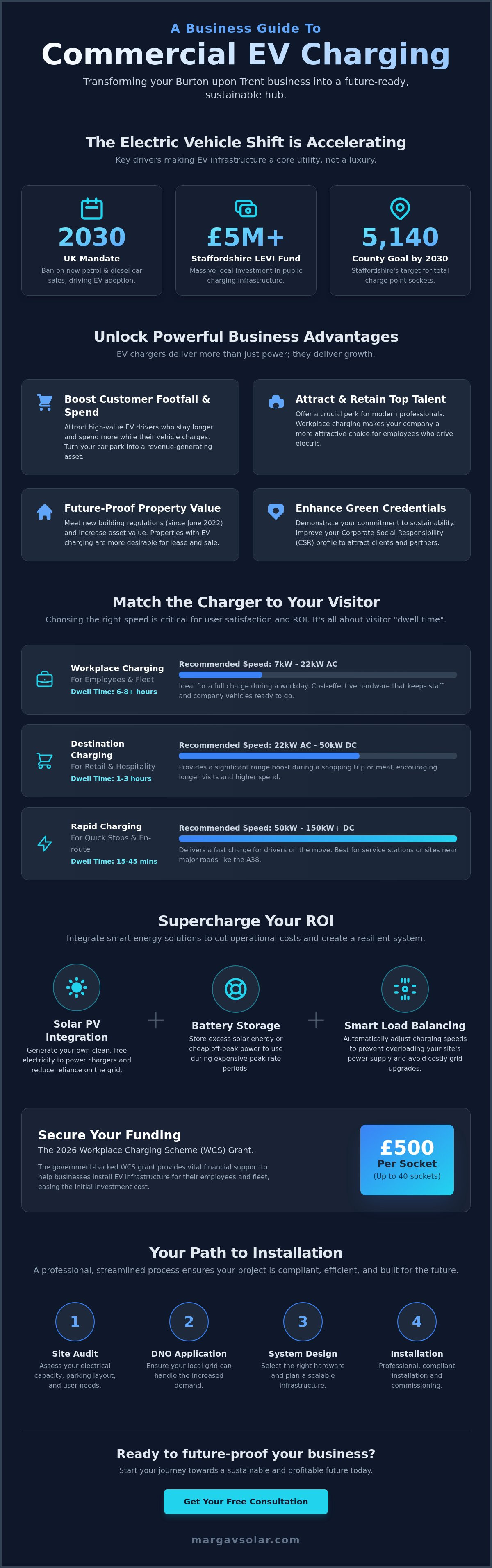
Staffordshire is already preparing for this massive shift. The County Council has been allocated more than £5 million from the Local Electric Vehicle Infrastructure (LEVI) fund to develop charging points on public land and community hubs. This investment supports the county's goal of reaching 5,140 charge point sockets by 2030. For local businesses, this means the infrastructure around you is changing fast. Staying ahead of these mandates isn't just about avoiding future headaches. It's about enhancing your corporate social responsibility (CSR) profile. Modern clients and partners want to work with brands that take sustainability seriously. Offering charging facilities also helps you attract and keep the best talent. Many high-value professionals have already made the switch to electric, and they'll choose an employer who makes their daily commute easier.
Boosting Customer Footfall and Dwell Time
Retailers and hospitality businesses in Burton are finding that an electric vehicle charging station acts as a powerful draw for new customers. This is especially true for sites located near the busy A38 corridor. When drivers stop to charge, they don't just wait in their vehicles. They become destination shoppers. There's a direct correlation between charging availability and increased customer spend. While the car draws power, the driver spends money on food, drinks, or retail goods. By providing this utility, you're turning a standard car park into a revenue-generating hub that encourages longer visits.
Future-Proofing Commercial Property Value
If you own or manage commercial property, EV infrastructure is no longer a "nice to have" feature. Since June 2022, Building Regulations (Approved Document S) have required new non-residential buildings with more than 10 parking spaces to include at least one charger and cable routes for 20% of the remaining spaces. This shift in law means that older properties without charging points risk becoming less desirable. Landlords who invest in commercial EV charging stations Burton upon Trent now will see higher lease attractiveness and increased asset value. It's a simple way to ensure your property remains a competitive choice for future tenants who will undoubtedly require these facilities as standard.
Selecting the Right Charging Infrastructure for Your Site
Choosing the right hardware for commercial EV charging stations Burton upon Trent depends entirely on your business model. You shouldn't just install the fastest unit available without considering how your visitors use your site. It's about matching energy delivery to your visitors' habits. Selecting the wrong speed can lead to wasted capital or, conversely, frustrated customers who can't get a meaningful charge during their stay. High-quality infrastructure helps attract and retain tenants/customers by providing a service that fits their lifestyle.
Scalability is another vital factor. Many businesses start with two chargers but find they need twenty within a few years. Planning your electrical capacity and cable ducting now saves massive "groundworks" costs later. Modern systems also include smart charging features like load balancing. This technology monitors your building's total power usage. If your machinery or air conditioning is running at full tilt, the chargers will temporarily throttle back to prevent blowing a fuse. It's a sophisticated way to manage demand without expensive grid upgrades.
Workplace Charging: Best for Employees
For employees, 7kW to 22kW AC chargers are the "sweet spot." Since staff usually remain on-site for an eight-hour shift, these units provide a full charge without the high cost of rapid hardware. You can manage access through RFID cards or dedicated mobile apps to ensure only authorised personnel use the power. For Burton-based delivery businesses, these units are perfect for overnight fleet charging. If you're ready to modernize your premises, selecting the right EV charging points is the first step toward a more efficient operation.
Public-Facing Rapid Charging: Best for Retail and Hospitality
Retail parks and hotels benefit most from 50kW+ DC rapid chargers. These units are designed for quick turnover, adding significant range in the time it takes to have a coffee or finish a food shop. In these public settings, tethered cables are generally preferred. They're permanently attached to the unit, making the process much easier for customers. Always consider the physical layout; ensure there's enough space for all visitors to navigate the charging bay safely, regardless of their vehicle's charging port location.
Maximising ROI: Solar Integration and Energy Management
Installing commercial EV charging stations Burton upon Trent is a smart move, but the real financial gains happen when you pair them with renewable energy. If you rely solely on the grid, you're at the mercy of fluctuating business electricity rates. By generating your own power, you turn your car park into a self-sustaining asset. This approach doesn't just lower your carbon footprint; it significantly accelerates your return on investment. You can even generate revenue by setting specific tariffs for public or guest use, effectively turning your charging bays into a secondary income stream that pays for itself over time.
Smart energy management is the glue that holds this system together. It protects your local grid connection by ensuring your building's total power draw never exceeds its limit. Without this, you might face heavy fines or be forced into expensive infrastructure upgrades. Integrating your charging network with your existing energy profile allows for a much more balanced and profitable operation.
This level of technical integration is a growing trend in the commercial sector worldwide. To see how similar turnkey, small-scale energy solutions are being implemented for businesses elsewhere, you can discover SolarPorts Development.
Reducing Operational Costs with Solar PV
The business case for solar panel installation on warehouse or office roofs is stronger than ever. Instead of buying every kilowatt from a supplier, you can charge your fleet or employee vehicles with energy generated directly on-site. When calculating the payback period for these integrated systems, businesses must account for the offset energy costs and the available government grants for EV chargers. As of April 2026, the Workplace Charging Scheme (WCS) provides up to £500 per socket, which helps lower the initial capital barrier for this green transition.
The Role of Battery Storage in Commercial Charging
Rapid chargers demand a lot of power in a very short window. This sudden spike can often exceed a building's electrical capacity. This is where solar battery storage becomes essential. Think of it as a reservoir. It slowly fills up when demand is low or the sun is shining, then releases that energy instantly when a vehicle plugs in. This "buffer charging" strategy protects your business from peak demand charges. It ensures that your commercial EV charging stations Burton upon Trent remain fully operational even when the local grid is under heavy pressure. It's a clever way to bypass the need for costly new transformers while maintaining a high-speed service for your visitors.
The Installation Process for Burton upon Trent Businesses
Setting up commercial EV charging stations Burton upon Trent requires more than just mounting hardware on a wall. It's a structured engineering project that begins with a deep dive into your building's electrical heart. A professional site audit is the first step. We look at your existing distribution board and total power load to see how many chargers your current system can safely support. This phase prevents future blowouts and ensures your business stays operational while vehicles are drawing power.
Once the technical foundation is clear, we help you navigate the financial support available. As of June 2026, the Workplace Charging Scheme (WCS) grant has been extended to March 2027, providing up to £500 per charging socket. This can cover up to 75% of your installation costs for up to 40 sockets. After the paperwork is secured, the physical work begins. This includes groundworks for cable ducting, installing the physical pedestals, and final commissioning. We don't just leave you with a manual; we provide staff training to ensure your team knows how to manage the software and assist customers.
Navigating Staffordshire Grid Constraints
The East Midlands grid can be complex. In some parts of Burton, power availability is limited, creating "red zones" where the grid is near capacity. We liaise directly with the District Network Operator (DNO) to secure the necessary permissions for your install. If your site has restricted capacity, we don't just give up. We look at smart load management or battery integration to bypass these local bottlenecks. Our team manages the entire DNO application process, so you don't have to deal with the technical bureaucracy of the energy networks.
Compliance and Safety Standards
Safety is paramount for public-access units. Every installation must meet the IET Wiring Regulations (BS 7671) and the Smart Charge Point Regulations 2021. This ensures your chargers are secure, reliable, and capable of managing grid demand. We prioritize NICEIC certification for all commercial projects to guarantee the highest workmanship standards. High-use equipment also needs a plan for the future. Regular maintenance and cleaning will keep your hardware looking professional and functioning perfectly for years to come. If you're ready to begin your site audit, speak with our team about professional EV charging points today.
Choosing MarGav Solar for Your Commercial EV Project
Partnering with a local specialist is the most effective way to ensure your investment in commercial EV charging stations Burton upon Trent yields long-term results. We bring over 20 years of expertise in Staffordshire’s renewable energy sector to every project. This isn't just about bolting a charger to a wall. It’s about understanding the specific grid limitations of the East Midlands and the unique needs of businesses in the heart of the region. We provide an end-to-end service. This means we handle everything from the initial District Network Operator (DNO) applications to long-term maintenance and software management. You won't have to juggle multiple contractors or chase energy providers.
Our bespoke designs set us apart. We don't believe in one-size-fits-all solutions. Instead, we integrate your charging infrastructure with existing or new solar PV and battery systems. This holistic approach ensures your site operates at peak efficiency, as we've explored in earlier sections regarding ROI and energy management. Being based locally means we offer rapid response times that national providers simply can't match. If you have a technical question or need a site visit, we're right here in the region ready to help.
Fixed-Price Contracts and Transparent Planning
Transparency is the foundation of our client relationships. We offer fixed-price installation contracts to eliminate the fear of hidden costs or "unforeseen" electrical issues. Our process begins with a comprehensive site survey. We identify the most cost-effective cable routes and infrastructure placements before any work starts. This careful planning allows us to provide detailed project timelines. You can plan your operations around the installation, ensuring that business disruption is kept to an absolute minimum. We believe you should know exactly what to expect from day one.
Expertise in High-Efficiency Hardware
We only install premium, durable hardware designed for the rigours of commercial environments. Reliability is crucial when your reputation is on the line. For advanced monitoring and control, we offer integration with the GivEnergy Cloud. This platform allows you to track energy usage, manage user access, and monitor system health in real-time. Our commitment doesn't end when the power is switched on. We provide robust equipment warranties and ongoing support to ensure your charging hub remains a reliable asset for years to come. By choosing high-efficiency hardware, you're investing in a system that will grow alongside the local EV market through 2030 and beyond.
Future-Proof Your Burton Business Today
The transition to electric transport is no longer a distant goal. It's a current reality for businesses across Staffordshire. By installing commercial EV charging stations Burton upon Trent, you aren't just meeting government mandates. You're building a destination that attracts high-value customers and supports a modern workforce. Integrating these systems with solar PV and battery storage ensures your infrastructure remains profitable and resilient against rising energy costs.
Success in this transition requires a partner who understands the local landscape. Our team brings 20+ years of industry experience and the technical precision of NICEIC certified installers to every project. As Staffordshire local specialists, we navigate the specific grid requirements of the East Midlands to deliver a seamless, end-to-end service. Don't leave your infrastructure to chance. Request a Commercial EV Site Audit from MarGav Solar and start your journey toward a sustainable, energy-independent future today.
Frequently Asked Questions
Can I get a grant for commercial EV charging stations in Burton?
Yes, your business can access the Workplace Charging Scheme (WCS) to help with installation costs. As of April 1, 2026, this grant provides £500 per charging socket for up to 40 sockets across your business sites. This voucher-based system covers up to 75% of the total purchase and installation costs, helping Burton upon Trent firms reduce the initial capital required for sustainable infrastructure.
Do I need planning permission for EV chargers at my business premises?
Most commercial installations fall under permitted development rights and don't require formal planning permission. However, you must follow specific size and height limits for wall-mounted or pedestal units. If your business is located in a conservation area or a listed building within Staffordshire, you should consult the local planning office before starting any physical groundworks to ensure compliance with local heritage protections.
How many EV charging points should my business install?
You should base your decision on current staff demand while planning for the UK's 2030 and 2035 zero-emission mandates. Since June 2022, Building Regulations require new non-residential buildings with more than 10 parking spaces to have at least one charger and cable routes for 20% of the remaining spaces. A sensible strategy is to install for today's needs but lay the ducting for future capacity to avoid expensive future excavations.
Can I charge customers for using my EV charging stations?
Yes, you're permitted to set your own tariffs and generate a secondary revenue stream from your commercial EV charging stations Burton upon Trent. If you provide public-facing chargers with a power output of 8kW or more, you must follow the Public Charge Point Regulations. These rules mandate clear pricing in pence per kilowatt-hour, a customer helpline, and the provision of contactless payment options for all users.
What is the Workplace Charging Scheme (WCS)?
The WCS is a government-funded initiative managed by the Office for Zero Emission Vehicles (OZEV) to support businesses in the transition to electric transport. The scheme has been extended for a final year until March 31, 2027. It's designed to make workplace charging more accessible for employees and fleet vehicles, though it's important to note that the SME Infrastructure Grant was discontinued on March 31, 2026.
How long does a commercial EV charger installation take?
The physical installation usually takes between one and three days, but the entire process from audit to commissioning can take several weeks. This timeline depends heavily on the response time from the District Network Operator (DNO) regarding your power capacity application. Once we've secured the necessary electrical permissions and completed the groundworks, the final mounting and testing of the chargers are completed quickly to minimise business disruption.
Will installing EV chargers affect my business electricity bill?
Your electricity consumption will increase, but you can manage this impact through smart charging technology. All new workplace chargers must comply with the Smart Charge Point Regulations, allowing you to schedule charging during off-peak periods when rates are lower. In Staffordshire, where business electricity rates can range from 12p to 18p per kWh depending on your contract, this smart management is essential for keeping operational costs predictable.
Can I integrate my existing solar panels with new EV chargers?
Yes, integrating existing solar PV systems with your new charging points is a highly effective way to lower your operational costs. Using "free" energy generated on-site reduces your reliance on the grid and protects your business from fluctuating energy prices. If your solar production is high during the day when vehicles aren't plugged in, adding battery storage can hold that energy until it's needed for overnight fleet charging.


