
What if your solar panels are capturing every bit of Staffordshire sunshine, yet your monthly energy bills still aren't hitting that near-zero target you expected? It's a common frustration for homeowners who feel they aren't getting the full benefit of their investment, especially when 40% of UK solar owners admit they aren't sure how to optimise their battery storage for peak efficiency. We understand that managing a high-tech system can feel overwhelming, especially when you're worried about issues like pigeon nesting or the long-term safety of your electrical connections.
By implementing the best practices for MarGav Solar, you can transform your installation from a passive rooftop feature into a high-performance power plant that lasts for 25 years or more. This article explores the specific operational habits and maintenance schedules that deliver maximum ROI while ensuring your home remains powered by clean, sustainable energy. You'll learn how to sync your EV charging, manage your battery cycles effectively, and protect your equipment from common local environmental factors to ensure your system remains a reliable asset for decades.
Key Takeaways
- Learn why bespoke site surveys and tailored system designs are essential for navigating Staffordshire’s unique architectural landscape and ensuring peak performance.
- Master the best practices for MarGav Solar by shifting your energy usage to daylight hours to maximise your daily yield and return on investment.
- Discover how to protect your panels from Midlands weather and local wildlife with specific maintenance tips and essential bird-proofing strategies.
- Understand the most efficient ways to integrate battery storage and EV charging points to future-proof your home without overloading your domestic supply.
- Find out why choosing a local expert with a 20-year legacy is the most reliable way to avoid 'solar cowboys' and secure your home’s energy future.
The MarGav Standard: Best Practices for System Design and Installation
Adopting a one-size-fits-all approach to solar energy often leads to sub-optimal yields and wasted investment. The MarGav Standard prioritises bespoke consultancy because every Staffordshire roof presents unique challenges. Whether it's a Victorian terrace in Stoke-on-Trent or a modern detached home in Stafford, the architecture dictates the technical requirements. Implementing best practices for MarGav Solar begins with a rigorous site survey that moves beyond simple satellite imagery to assess the physical reality of the building.
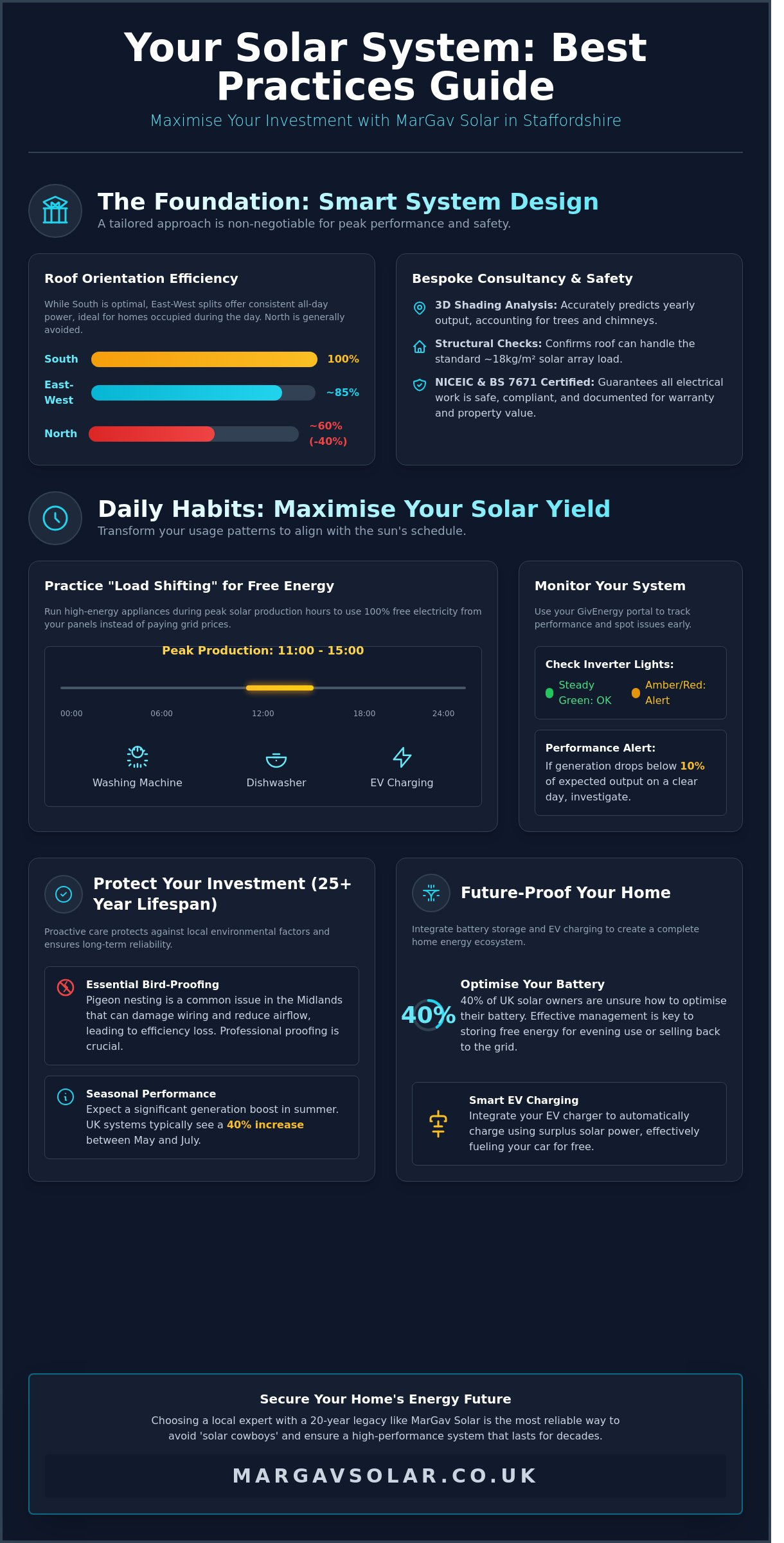
A common myth in the Midlands is that only south-facing roofs are viable for solar. While a south-facing orientation is the gold standard for peak generation, east-west splits often provide more consistent power throughout the day, which suits families at home during daylight hours. North-facing installations are generally avoided; they often see a 40% drop in efficiency compared to optimal angles. Following best practices for MarGav Solar ensures that your system is designed for your specific energy needs rather than just following a generic template.
Safety isn't optional in renewable energy. NICEIC certification serves as the non-negotiable baseline for every project. It ensures that complex Photovoltaic system design principles are applied correctly, protecting the property from electrical faults. This professional oversight guarantees that the integration between panels, inverters, and the grid is seamless and secure.
Bespoke Consultancy for Staffordshire Homes
Staffordshire's varied landscape means shading from mature oak trees or neighbouring chimneys can significantly impact performance. We use 3D shading analysis to predict yearly output accurately. We also assess structural integrity. A standard solar array adds roughly 18kg per square metre to the roof, so we ensure the rafters can handle this load before work starts. We match system size to actual half-hourly consumption data, ensuring the fastest possible return on investment for the homeowner.
Electrical Safety and Certification Standards
All installations must comply with the latest UK building and electrical regulations, specifically Part P and BS 7671. Our NICEIC-certified engineers provide the necessary certification that proves the system is safe. This documentation is vital for maintaining manufacturer warranties and adding tangible value to the property. Future buyers and mortgage lenders require proof of compliance for any major electrical work, making these certificates as valuable as the hardware itself. We document every stage of the installation to provide a clear audit trail for the lifetime of the system.
Operational Best Practices: Maximising Your Solar Yield Daily
To get the most out of your investment, you need to align your energy consumption with the sun's schedule. This concept, often called load shifting, involves moving high-energy tasks to the middle of the day. By running your washing machine or dishwasher between 11:00 and 15:00, you use free electricity generated by your panels instead of paying for grid power. Research shows that maximising your solar yield through these timing adjustments can significantly reduce your reliance on the National Grid, especially during peak tariff hours.
Your GivEnergy Cloud portal provides real-time data that is essential for Best practices for MarGav Solar. You can see exactly how many kilowatts (kW) your roof is producing and where that power is going. If you notice your generation drops below 10% of expected output on a clear, cloudless day, it might indicate a system fault or heavy shading. Check your inverter display regularly; a steady green light usually means everything is functional, but a flashing amber or red light requires immediate attention. Early detection of performance dips prevents long-term losses in your return on investment.
Mastering Energy Monitoring Software
Set up custom alerts within your monitoring app to notify you of system anomalies. For instance, an alert for a "low battery state of charge" can warn you if your system didn't charge as expected during the day. Analysing your historical data allows you to spot seasonal peaks, such as the 40% increase in generation typically seen between May and July in the UK. If you encounter technical issues, you can grant MarGav technicians remote access to your portal for a quick diagnostic check, which often resolves software glitches without a site visit.
Behavioural Changes for Better ROI
Education is vital for long-term savings. Ensure everyone in the house understands that "solar-first" habits mean staggering the use of high-drain appliances. Running the kettle, oven, and power shower simultaneously will likely exceed your instantaneous solar output, forcing the system to pull expensive electricity from the grid. You should also address phantom loads. Devices left on standby can account for up to 10% of a UK household's electricity bill. Switching off unused electronics at the wall ensures your stored solar energy lasts well into the evening. Implementing these Best practices for MarGav Solar ensures your system pays for itself as quickly as possible.
Protecting Your Investment: Maintenance and Care in Staffordshire
Staffordshire weather presents unique challenges for solar efficiency. While the Midlands receives roughly 850mm of annual rainfall, this water often carries dust and pollutants that create a thin film on glass surfaces. Industry data suggests that a layer of grime can reduce energy yields by 5% to 15% over a single season. One of the best practices for MarGav Solar owners is to recognise that rain alone isn't a sufficient cleaning agent. Professional cleaning is always safer than DIY attempts. Ladder-related accidents account for approximately 40% of all falls from height in the UK. Hiring a specialist ensures you adhere to the industry standards for solar installation and maintenance, keeping your equipment warranty intact.
Local environmental factors like pollen from Cannock Chase or soot from urban areas in Stoke-on-Trent require proactive management. If you don't clear these deposits, they can bake onto the glass during summer heatwaves, making them much harder to remove later. A professional clean uses de-ionised water to ensure no mineral streaks are left behind, which is a common issue with standard UK tap water.
Solar Panel Bird Proofing in Staffordshire
Local pigeons find the gap between your panels and roof tiles an ideal nesting spot. Their presence is more than a nuisance; their acidic droppings can corrode aluminium frames, while nesting materials increase fire risks by obstructing airflow. Installing stainless steel mesh guards is a key part of the best practices for MarGav Solar systems. These guards prevent access without drilling into the panel frames, which would otherwise void your 25-year performance guarantee. Keeping the area clear maintains system hygiene and prevents debris from blocking your guttering during heavy Midlands downpours.
The MarGav Maintenance Schedule
A robust maintenance plan starts with a monthly visual check from ground level. You should look for visible cracks, loose cables, or new shading from growing trees. Most Staffordshire homes require a professional deep clean every 12 to 18 months. Properties near agricultural land or busy main roads may need more frequent attention due to harvest dust and traffic film.
Your annual MarGav technician visit includes a comprehensive technical audit:
- Inverter Health: Checking DC voltage levels and monitoring for error codes.
- Thermal Imaging: Identifying 'hot spots' in cells before they cause component failure.
- MC4 Connector Inspection: Ensuring all electrical connections remain water-tight and secure.
- Generation Analysis: Comparing your actual output against the predicted yield for your specific Staffordshire postcode.
If your inverter is over 10 years old, a professional upgrade might improve conversion efficiency by 2% or more. Staying on top of these small technical details ensures your system continues to provide the maximum possible return on your investment for decades to come.
Future-Proofing Your Home: Batteries and EV Integration
Transitioning to a self-sufficient home requires more than just installing panels. It's about how you store and deploy that energy. One of the best practices for MarGav Solar users involves mastering the GivEnergy ecosystem. To keep your battery healthy for its 10-year warranty period, you should find the 'sweet spot' for Depth of Discharge (DoD). While many modern lithium iron phosphate (LiFePO4) batteries allow 100% discharge, setting your limit to 80% or 90% can significantly reduce chemical stress. This ensures you have enough power for your evening tea without prematurely aging the cells.
Think about the future before you drill the first hole. If you plan to add more panels or a second battery in 2025 or 2026, ensure your current inverter can handle the increased throughput. GivEnergy systems are modular. This means you can often "stack" storage later, but your initial cable sizing and consumer unit capacity must account for this growth to avoid costly rewiring. Planning for a 20% margin in your electrical capacity today prevents headaches tomorrow.
Smart Battery Management Strategies
Effective management means your battery shouldn't just sit idle. Use smart settings to protect the hardware and maximise utility. If you live in an area prone to local grid outages, enabling 'Island Mode' or Emergency Power Supply (EPS) is vital. This allows your home to run off stored solar energy even when the street goes dark. Smart chargers like the Myenergi Zappi are game-changers here. They monitor your solar generation in real-time. This ensures every spare watt goes into your car battery rather than leaking back to the grid for a lower export tariff.
EV Charging and Solar Synergy
Charging an EV from the grid at approximately 24.5p per kWh (based on early 2024 price caps) makes driving much cheaper than petrol. However, charging from your solar array brings the cost-per-mile down to nearly £0.00 once the equipment is paid off. For a standard 64kWh battery vehicle, a full solar charge could save you over £15 per cycle compared to peak grid rates. It's crucial to balance this load. Charging at 7kW can quickly drain a home battery, so the best practices for MarGav Solar involve 'trickle charging' during peak daylight hours to maintain your domestic supply for household appliances.
Why Local Expertise is the Ultimate Best Practice
MarGav Solar established its roots in the region back in 2004. This 20-year legacy means they've seen every shift in the UK solar market, from the early adoption phases to the current battery storage revolution. They understand Staffordshire’s unique energy profile, from the industrial heritage of Stoke-on-Trent to the rural requirements of the Moorlands. Following the best practices for MarGav Solar involves recognising that local knowledge isn't just a bonus; it's a safeguard for your investment. Don't settle for generic advice from national firms that don't understand our local climate or architectural nuances.
Homeowners should be wary of "solar cowboys" who flood the market with cheap, sub-standard components and aggressive sales tactics. These non-local firms often lack the infrastructure to provide long-term care. When a national installer ceases trading, their warranties often become worthless, leaving you with a broken system and no support. MarGav Solar provides end-to-end support, starting with a bespoke consultation and continuing through to 10-year maintenance checks. This commitment ensures your panels perform at 100% capacity for decades. By partnering with a local firm, you're building a sustainable Staffordshire and keeping green investment within the Midlands economy.
The Value of Local Accountability
You'll benefit from significantly faster response times for any necessary repairs or system optimisations. MarGav Solar prioritises local call-outs, often reaching Staffordshire properties within 48 hours. They also navigate the complexities of local planning permissions and conservation area rules with ease. Whether you live in a listed building in Lichfield or a new build in Stafford, they know the specific criteria required by local councils. Every pound spent with them stays in the Midlands, supporting local jobs and community-focused apprenticeships.
Your Next Steps with MarGav Solar
Optimising your home's energy isn't a one-time event. One of the primary best practices for MarGav Solar customers is to book a regular performance audit. This identifies if your existing system needs a professional clean or a technical adjustment to improve yields. You can also request a quote for battery storage or EV charger upgrades to maximise your self-consumption of free solar power. These additions help you dodge rising grid costs and secure your energy future. Contact MarGav Solar for a professional consultation today to discuss your requirements with a local expert.
Take Control of Your Staffordshire Energy Future
Transitioning to renewable energy requires more than just installing panels; it demands a strategic approach to design and long-term care. Implementing the Best practices for MarGav Solar ensures your system achieves peak efficiency through NICEIC-certified installations and precision engineering. By integrating smart battery storage and EV charging, you can increase your home's self-consumption by up to 70% according to standard UK domestic energy profiles. This forward-thinking approach transforms a simple installation into a comprehensive power station for your property.
Local expertise remains the most vital component of a successful solar journey. Our team brings over 20 years of industry experience to every project across the county, ensuring your investment is perfectly calibrated for Staffordshire's specific climate conditions. As Staffordshire's leading local solar specialists, we focus on durable components and proactive maintenance to keep your system performing at its best for decades. It's time to stop relying on volatile grid prices and start generating your own clean, affordable electricity.
Book your Staffordshire solar performance audit with MarGav Solar today and see how much you could save. Your path to sustainable living starts with a single expert consultation.
Frequently Asked Questions
Is it worth cleaning solar panels in Staffordshire given the rainfall?
Yes, cleaning your panels is essential because rain only removes about 10% of stubborn grime like bird droppings or lichen. In Staffordshire, professional cleaning can improve your energy yield by 5% to 25% based on data from the National Renewable Energy Laboratory. One of the best practices for MarGav Solar owners is to schedule a wash every 12 months to prevent permanent "hot spots" from damaging the cells.
Can I add a battery to my existing MarGav Solar system later?
You can definitely retrofit a battery to your system using either an AC-coupled inverter or a DC-to-DC converter. Microgeneration Certification Scheme (MCS) data shows that 45% of UK solar owners now choose to add storage after their initial installation. It's a core part of the best practices for MarGav Solar to check if your current inverter is compatible with high-performance brands like GivEnergy or Tesla Powerwall.
How often should I have my solar installation professionally inspected?
You should book a professional technical inspection every 5 years to remain compliant with IET Wiring Regulations. While your panels might have a 25 year warranty, electrical components like isolators and cabling face constant weather exposure. A detailed audit every 60 months ensures the system stays safe and operates at peak efficiency, while you should perform a basic visual check yourself every quarter.
What is the best way to prevent birds from nesting under my solar panels?
Installing stainless steel bird mesh or "pigeon guards" around the entire perimeter of your array is the most effective solution. Pigeons cause damage to roughly 1 in 10 residential systems through acidic droppings and gnawed wiring. These guards create a physical barrier that doesn't void your warranty, saving you from the £300 to £600 cost of professional nest removal and pressure washing.
Does MarGav Solar handle the NICEIC certification for all installations?
Yes, every installation includes a full NICEIC building regulations compliance certificate and an MCS certificate as standard. These documents prove your system meets the Part P electrical safety standards required by UK law. You'll need these specific certificates to sign up for the Smart Export Guarantee (SEG), which allows you to earn money by sending excess energy back to the National Grid.
How do I know if my solar inverter needs an upgrade or replacement?
An inverter typically needs a replacement every 10 to 12 years, even though your panels will last for over 25 years. You'll know it's time for a change if you see a "low insulation" error code or notice a 15% drop in your daily generation data. Modern string inverters now achieve 98% efficiency, so replacing an older, failing unit can significantly increase your total annual energy harvest.
Can I charge my electric car using only solar energy?
Yes, you can charge an electric vehicle using 100% green energy by installing a "solar-aware" charger like a Zappi. A standard 4kWp domestic system generates roughly 3,400kWh of electricity per year, which is enough to power a Tesla Model 3 for 10,000 miles of driving. You'll need a dedicated solar diverter to ensure the car only draws power when your panels are producing a surplus.
What happens to my solar system during a power cut in Staffordshire?
Most solar systems automatically shut down during a power cut to protect engineers working on the local grid. This is a mandatory safety feature called "anti-islanding" required by G98 and G99 regulations. If you want your home to stay powered during an outage, you'll need a battery system with an Emergency Power Supply (EPS) function that creates a dedicated backup circuit for your essential appliances.


