

The average electricity bill savings with solar UK households see aren’t captured by one headline figure. The same panels can deliver different value depending on when you use electricity, how much you export and the rates on your import and export tariffs.
It’s natural to want a simple estimate before deciding whether solar is worthwhile. Electricity you use as it’s generated can reduce the amount you buy from the grid, while surplus power may earn an export payment. These benefits aren’t necessarily equal, and savings can vary with household habits, system generation and the season.
This guide explains the main factors behind solar bill savings and shows how to estimate your likely benefit using your own electricity use and tariff information. You’ll also see how a battery could change the balance by storing surplus generation for later use, and what to compare in solar-only and solar-plus-battery scenarios. If you’re in Staffordshire, a household-specific assessment can make national estimates more relevant to your home.
Key Takeaways
- Understand what “savings” include: electricity you don’t need to buy from the grid and any export income, less relevant ongoing costs. Solar may reduce bills without eliminating them.
- Use the average electricity bill savings with solar UK as a starting point, not a promise. Your usage and tariff details shape the estimate.
- Compare solar-only with solar plus a battery using the same household assumptions to see whether storing surplus power could suit your routine.
- Gather recent bills, annual consumption, import tariff details and export terms. Estimate avoided grid purchases separately from export income.
- For a Staffordshire assessment, bring your usage and tariff information so roof suitability and system options can be considered for your home.
What does average electricity bill savings with solar in the UK really mean?
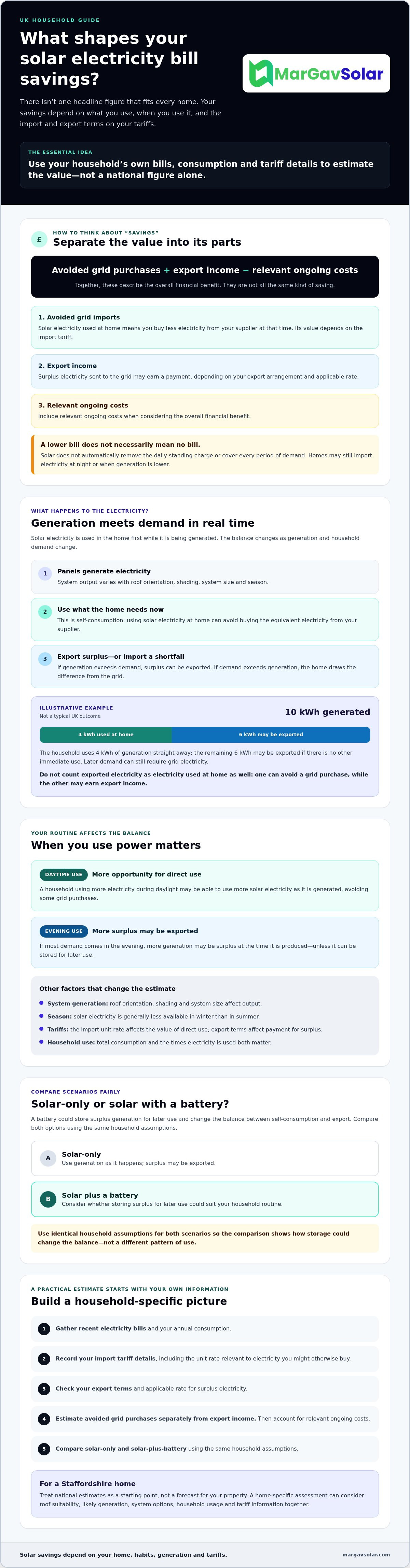
Solar savings aren’t simply the amount of electricity your panels generate. They come from the grid electricity you no longer need to buy, plus any income from exporting surplus power, minus relevant ongoing costs. The balance depends on your household’s usage, system performance and tariffs, so a single figure for the average electricity bill savings with solar UK can be misleading unless you know the assumptions behind it.
Most homes will still have an electricity bill. Solar can reduce the amount of electricity imported from the grid, but it doesn’t automatically remove the daily standing charge or cover every period of demand. At night or during lower-generation periods, you may still use grid electricity. The UK’s solar mix and history provide useful context in this overview of Solar power in the United Kingdom, but national context can’t predict the result for an individual home.
Why solar savings differ from one UK home to another
Annual electricity use matters, but timing matters too. A household using more power during daylight hours may be able to use more solar electricity as it’s generated, avoiding some grid purchases. If most demand comes in the evening, more surplus may be exported unless the household has a way to store it.
Generation also varies with roof orientation, shading and system size. Output changes across the seasons, with less solar electricity generally available in winter than in summer. Staffordshire customers should treat national estimates as a starting point, not a forecast for their property. A home-specific assessment can consider the roof, likely generation and household usage together.
What counts as a saving on an electricity bill?
Keep the two main benefits separate when estimating value:
- Avoided grid imports: electricity generated and used at home means you need to buy less electricity from a supplier at that time.
- Export income: surplus electricity sent to the grid may earn payment, depending on the household’s export arrangement and applicable rate.
Don’t count exported electricity as electricity used at home as well. They’re different outcomes: a unit consumed on-site can reduce grid imports, while a unit exported may earn payment under the applicable arrangement. Include any relevant ongoing costs when assessing the overall financial benefit.
In short: solar bill savings are the value of avoided grid electricity plus export income, less relevant ongoing costs. They don’t necessarily mean your electricity bill disappears.
How solar panels reduce grid imports and change your electricity bill
Solar electricity is used in the home first when it’s being generated. If your panels produce more than your household needs at that moment, the surplus can be exported to the grid. If they produce less, you draw the difference from your electricity supplier. Solar can therefore reduce grid imports without supplying every unit your home needs throughout the day.
The part of your generation used in the property is called self-consumption. Using that electricity can avoid buying the equivalent amount from your supplier, while exported electricity may earn a payment under your export arrangement. For a wider look at household solar, the government announcement on plug-in solar provides separate context on small-scale solar technology.
Self-consumption, grid imports, and exported electricity
Illustrative example, not a typical UK outcome: suppose a system generates 10 kWh during a period, and the household uses 4 kWh of that generation straight away. Those 4 kWh are self-consumed. The remaining 6 kWh may be exported if there’s no other immediate use for them. Later, if household demand exceeds generation, the home imports electricity from the grid.
Exported power earns according to the export arrangement, while self-consumed power is valued by the grid electricity purchase it avoids. The two amounts shouldn’t be treated as interchangeable. The value of direct use depends on the import tariff, while export income depends on the applicable export terms.
How tariffs and standing charges affect savings
Your import unit rate affects the value of each unit used directly. The higher the rate you would otherwise pay, the more that unit of self-consumption can reduce usage charges. For reference, The Energy Shop reported an Ofgem Price Cap average electricity unit rate of 26.32p per kWh and a daily standing charge of 54.83p for 1 October to 31 December 2026. These are reference figures for standard variable tariffs, not a prediction of every household’s bill or tariff.
Standing charges are separate from the cost of each unit imported, so solar generation doesn’t automatically remove them. Export payments also follow separate terms and may not match your import rate. Under the Smart Export Guarantee (SEG), eligible households can receive payment for electricity exported to the grid. Check the supplier’s current tariff terms and any conditions before estimating income.
Generation changes with the season, weather, roof orientation and shading. Household demand also affects how much power can be used as it’s produced. To see how these factors may apply to your home, explore residential solar PV options and consider a property-specific assessment.
Solar-only or solar with a battery: which could save more?
A battery changes when you can use solar electricity, not how much sunlight your roof receives. To compare fairly, keep household electricity demand, solar generation and import and export tariff assumptions the same. Then consider how much daytime surplus could be stored and used later instead of exported. The Energy Saving Trust solar panel guide offers impartial background on solar panels and the Smart Export Guarantee.
In a solar-only setup, electricity not used as it’s generated may be exported. Adding a battery can store some surplus for later, such as during evening use, subject to the system’s design and usable capacity. Storage doesn’t automatically improve the financial result: weigh the value of using stored electricity against the export income you might otherwise have received and the battery’s cost.
| Consideration | Solar-only | Solar with a battery |
|---|---|---|
| Daytime demand | Direct use can reduce grid imports while panels are generating. | Direct use remains possible; surplus may also be stored. |
| Evening use | Electricity may need to come from the grid when solar generation is low. | Stored solar power may serve some later demand, depending on the system. |
| Exports | More unused daytime generation may be available to export. | Some surplus may be stored instead, potentially reducing exports. |
| What to assess | Daytime routines, roof and system design, and export terms. | All solar-only factors, plus evening demand, battery capacity and cost. |
When solar-only may fit a household’s usage
Solar-only may suit households that can use a meaningful share of generation during daylight. Flexible routines, running appliances when panels are producing, or charging an electric vehicle at home during the day can increase direct use. These are scenarios, not forecasts: actual results depend on when generation and demand coincide. If daytime use is limited, compare the likely export value with the potential benefit a battery might add.
When battery storage may be worth assessing
A battery may be worth assessing if the home regularly uses electricity in the evening and has surplus solar generation earlier in the day. Its performance depends on the selected system, including usable capacity and configuration. It won’t necessarily cover all evening demand. For more background, MarGav Solar’s Solar Battery Storage in Staffordshire: The Complete 2026 Homeowner’s Guide explores the option in more detail. The average electricity bill savings with solar UK households achieve will still depend on their own usage, generation and tariffs, so compare both setups using the same assumptions before deciding.
How to estimate your potential solar electricity bill savings
A useful estimate starts with your household’s actual electricity use, not a headline average. The phrase average electricity bill savings with solar UK can be a helpful starting point, but your result depends on how much solar power your home can use, your tariff and the export terms available to you.
The information to collect before comparing estimates
Gather recent electricity bills and note the dates they cover, your annual consumption if shown, and your import tariff’s unit rate and standing charge. Also record when people are usually home, major daytime electricity loads, and whether you expect to add an EV or battery. Roof direction, shading and any known property constraints are useful details for a professional assessment.
A step-by-step estimate
- Set your baseline. Use bills covering a full year where possible, so seasonal changes in use are represented. Note your annual consumption and current tariff details.
- Review the proposed system’s generation estimate. Ask what assumptions are made about the roof, shading, system design and seasonal output. Treat this as an estimate, not a guarantee.
- Estimate avoided imports. Identify the forecast solar electricity you’ll use in the property, then apply your import unit rate to those units. Don’t apply the rate to all generation if some will be exported.
- Estimate export income separately. Multiply expected exported units by the rate in your applicable export arrangement. Check its terms rather than assuming it matches your import tariff.
- Review the overall picture. Add avoided import costs and export income, then account for relevant ongoing costs. Keep the standing charge separate, as generating electricity doesn’t automatically remove it.
This split helps prevent double counting: each unit is either used in the home or exported, not both. Actual outcomes can differ as weather, household routines and system performance change.
How to compare solar savings estimates fairly
Compare estimates using the same annual electricity use, import tariff, export rate and assumptions about self-consumption. Check whether each figure means avoided grid purchases alone, export income alone, or both. If a battery is included, ask how its operation changes expected imports and exports.
Assessment checklist: recent bills and billing dates; annual consumption; import tariff and standing charge; export terms; occupancy and daytime loads; EV or battery plans; roof direction, shading and known constraints.
For more on what to expect from the process, see MarGav Solar’s Solar Panel Installation in Staffordshire: A Comprehensive Guide. To discuss how your household’s information could inform a property-specific solar assessment, enquire about a Staffordshire solar assessment.
Turn your solar savings estimate into a Staffordshire home assessment
Your estimate is most useful when it’s based on your home, not just a national average. Before discussing options, gather recent electricity bills, annual usage, import tariff and export terms, plus a note of when your household uses the most electricity. Include any plans for an electric vehicle or battery, and details you know about roof direction, shading or property constraints.
This information gives an installer a clearer starting point for considering roof suitability, likely generation, household demand and possible system options. It also helps explain why published figures for the average electricity bill savings with solar UK may not match your circumstances. A property-specific assessment can refine the assumptions, but any estimate remains dependent on system design and how you use electricity.
Questions to ask before choosing a solar installation
Ask how the proposal accounts for your household’s usage patterns, expected solar generation and the share of electricity assumed to be used at home rather than exported. Check which export terms the estimate uses, and whether its savings figure includes avoided grid purchases, export income, or both. These details make comparisons more meaningful.
Compare proposals on a like-for-like basis, including their system assumptions and options. Ask the installer to explain what installation work is included and which electrical certification, maintenance and warranty details apply to the proposed system. Don’t assume these terms are identical between providers. Request clear answers in writing so you can assess what’s actually being offered.
What MarGav Solar can help assess
MarGav Solar provides residential solar PV consultancy and professional installation in Staffordshire, with more than 20 years of industry experience. A discussion can consider your household’s usage alongside your property and solar options. Battery storage can also be assessed against your daytime surplus and evening demand, rather than treated as an automatic requirement.
For practical information about caring for a system after installation, see MarGav Solar’s Solar Panel Maintenance in Staffordshire: The Complete 2026 Homeowner’s Guide. MarGav Solar also provides solar panel maintenance and cleaning, alongside residential solar PV and battery storage solutions.
Have your bills and household notes ready, then discuss what may suit your Staffordshire property. A conversation can help clarify the assumptions behind a potential system and the questions worth resolving before you make a decision.
Take the next step towards a solar plan that fits your home
The average electricity bill savings with solar UK households may see depends on more than panel output. Your daytime use, import tariff, export arrangement and roof conditions all shape the result. A battery may help shift surplus electricity to later, but it’s an option to assess against your household’s needs, not an automatic requirement.
Use your bills and usage patterns as the starting point for a home-specific estimate. Comparing how much electricity you could use directly, export or store gives you a more useful basis for weighing system options than relying on a single national figure.
For Staffordshire households, MarGav Solar offers residential solar PV consultation and professional installation, with battery storage available to assess as part of the options. The team brings more than 20 years of industry experience and supports customers from consultation through installation and long-term maintenance.
Discuss a solar assessment for your home with MarGav Solar and take a considered next step. With the right information, you can explore what may suit your property with confidence.
Frequently Asked Questions
How much can solar panels reduce an average UK electricity bill?
There’s no single saving that applies to every UK home. The Guardian’s 2026 reporting cites an estimate of around £900 a year for a typical 4kW solar system, but that figure depends on household use, system assumptions and tariffs. Your own result may differ based on how much electricity you use while panels are generating, how much you export, and your applicable import and export rates.
Can solar panels eliminate my electricity bill in the UK?
Usually, solar panels reduce electricity bought from the grid rather than making every bill disappear. Your home may still import electricity when panels aren’t generating enough to meet demand, such as at night. A supplier’s standing charge may also remain even if solar covers much of your use. Check your bill and tariff terms to distinguish ongoing charges from the cost of imported units.
Do solar panels save more money if I use electricity during the day?
Often, daytime use can increase the amount of solar electricity you use directly, reducing the units you need to buy from your supplier. Appliances or home EV charging scheduled during solar generation may help, depending on your routine and system output. The benefit still depends on your import tariff and how much electricity the panels generate at that time. Compare usage across the day, not only your annual total.
Does adding a battery increase solar electricity bill savings?
Not automatically. A battery can store some surplus solar electricity for later use, which may suit a household with daytime generation and regular evening demand. But stored electricity needs to be weighed against potential export income and the battery’s cost. Performance also depends on the chosen system and its usable capacity. Compare solar-only and solar-plus-battery estimates using the same household demand, generation and tariff assumptions.
How is solar electricity bill saving calculated?
Estimate the value of solar electricity used at home by multiplying those units by the import rate you would otherwise pay. Separately estimate export income by multiplying exported units by the rate in your export arrangement. Add the two figures, then account for relevant ongoing costs. Don’t count the same electricity as both self-consumed and exported. Treat the result as an estimate, since real generation and household use can vary.
Does the Smart Export Guarantee pay for all electricity my solar panels generate?
No. The Smart Export Guarantee (SEG) relates to eligible electricity exported to the grid, not every unit your panels generate. Electricity used in your home reduces grid imports instead; it isn’t exported. Payment depends on your export arrangement and its terms, so check the applicable rate and conditions with your supplier. Keep expected export income separate from estimated savings on electricity you use directly.
Are solar electricity bill savings the same across Staffordshire and the rest of the UK?
No. Solar generation can vary by location, roof direction, shading, system design and seasonal conditions, while household use and tariffs also affect savings. Staffordshire homes shouldn’t assume national estimates predict their own results. A property-specific assessment can consider the roof and household’s electricity use together. MarGav Solar serves Staffordshire, where a local consultation can help evaluate residential solar PV options without promising a fixed saving.


