

The biggest battery isn’t automatically the best way to save. For many UK homes, adding battery storage is estimated to save an extra £300-£700 per year; the benefit of upgrading to a larger solar battery depends on how much surplus solar electricity you can store and use later. Matching capacity to your home’s generation and energy use is key.
It’s reasonable to expect a larger battery to store more solar power for evening use, but it only helps if your system can charge it and your household can use that stored energy. This guide explains how to estimate potential savings, compare solar generation with household electricity use, and assess a suitable capacity for a retrofit.
You’ll also learn how seasonal generation, changing energy habits and your existing inverter affect the decision. The aim is to judge whether a bigger battery suits your home’s actual energy pattern, rather than choosing capacity on size alone.
Key Takeaways
- Compare daytime solar surplus with the electricity your household uses later to see whether extra storage could be useful.
- For retrofit systems, 5-7 kWh is a typical battery size for small to average UK households, while higher-usage homes may need 8-10+ kWh.
- Solar-only systems typically achieve 35-40% self-consumption; systems with a battery typically reach 60-80%.
- An AC-coupled battery can often be added while retaining a standard solar inverter, though an old or battery-incompatible inverter may affect the setup.
- Allow for seasonal differences: lower winter solar generation can mean a battery doesn’t fully charge every day.
AC-coupled batteries and separate battery inverters
An AC-coupled battery connects to your home’s alternating-current electricity system rather than directly to the solar panels. A separate battery inverter manages charging and discharging, which can make this arrangement suitable for an existing solar system.
Matching Batteries with Existing Inverters
A hybrid inverter manages solar panels and battery storage, while a standard solar inverter usually handles the panels alone. With an AC-coupled battery, a separate battery inverter can often work alongside a standard solar inverter, allowing the existing unit to stay in place. Compatibility matters because the battery and inverter must communicate and operate within their supported electrical limits.
Before choosing equipment, identify the make and model of the existing inverter and battery, if fitted. Compare their supported configurations with those of the proposed battery system. An old, unsupported or battery-incompatible inverter may need an upgrade, or a standalone battery system may be more suitable. This assessment also helps establish whether the solar panels can continue operating as before.
Adding a Battery or Replacing the Existing Unit
Adding a second battery increases storage while keeping the existing unit, provided both batteries support the same system configuration. Replacing the existing battery with a larger one may be more suitable if the current unit is incompatible, ageing or unable to expand. The key question is whether the inverter and battery controls can manage the combined capacity.
For an existing solar system, an AC-coupled battery can often be added without replacing a standard solar inverter. A hybrid inverter offers another option, but an older unit may need replacement if it cannot support battery operation. Compare compatibility, usable capacity and the system’s charging arrangement before choosing between them.
Does an upgrade affect export payments? If your solar system receives Feed-in Tariff payments, get permission from your FIT provider before upgrading its inverter, including to a larger-capacity model. A battery upgrade can change how much solar electricity is exported, so consider its effect on export payments and any Smart Export Guarantee arrangement.
What UK requirements apply? Battery and inverter work must meet applicable electrical and grid-connection requirements. Whether the change needs DNO notification or approval depends on the equipment and how the system connects to the grid.
Can you install it yourself? Battery and inverter installation involves electrical connections and system configuration. Use a qualified electrician to complete the work safely and ensure the equipment operates as designed.
How long does installation take? The work involves assessing the existing system, confirming compatibility, fitting and connecting the battery or inverter, then testing the system. The time required depends on the equipment and the changes needed to the existing setup.
What risks should you consider? Incompatible batteries and inverters may not operate together, while incorrect electrical work can create safety risks. Poorly matched equipment can also limit charging, discharging or the use of stored energy.
For qualifying solar and battery installations in the UK, the VAT rate is 0%, according to HM Revenue & Customs. For systems receiving Feed-in Tariff payments, the scheme ended in 2019, but existing payment arrangements can continue under their terms. An inverter replacement may affect those payments, so provider permission matters before work begins.
Assessing solar generation and household energy use
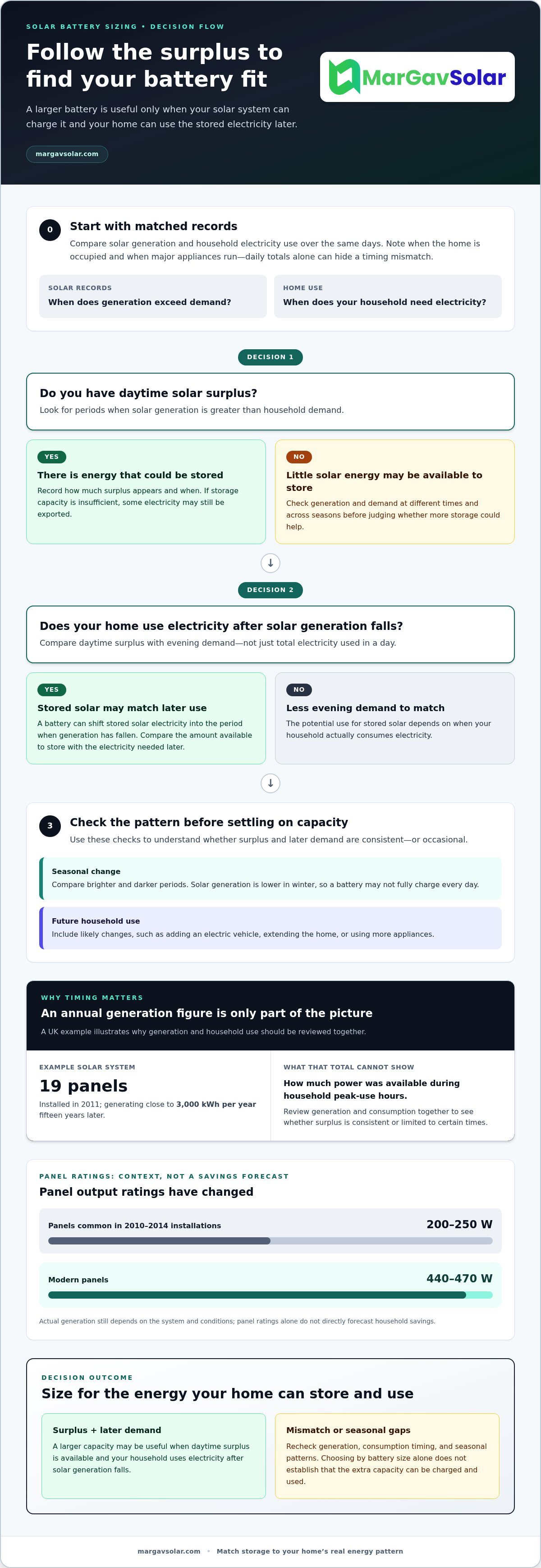
Battery sizing starts with two patterns: how much electricity your solar panels generate, and when your home uses power. UK homeowners benefit most from storage when daytime generation exceeds demand, leaving electricity available for evening use instead of exporting it.
Start with your solar system’s generation records and household electricity data. Compare generation with consumption over the same days, then note when the home is occupied and major appliances run. A daily total alone can hide a mismatch: two homes may use the same amount overall, but one may consume most of its electricity during sunny hours while the other needs more after sunset.
Consider an example from the UK: a 19-panel solar PV system installed in 2011 was generating close to 3,000 kWh per year fifteen years later. That annual figure helps describe generation, but it doesn’t show how much power was available during each household’s peak-use hours. Reviewing generation and consumption together reveals whether surplus is consistent or appears only at certain times.
Use these comparisons to understand your household’s pattern before estimating savings:
- Daytime surplus: Identify periods when solar generation exceeds household demand. That excess could charge storage, while insufficient capacity may leave some electricity exported.
- Evening demand: Look at electricity used after solar generation falls. A battery can shift stored solar energy into this period.
- Seasonal change: Compare brighter and darker periods. Solar generation is lower in winter, so a battery may not fully charge every day.
- Future use: Include likely changes, such as adding an electric vehicle, extending the home or using more appliances.
Panel ratings offer context, not a direct forecast of household savings. Modern panels can produce 440-470 W per panel, compared with 200-250 W panels common in installations from 2010-2014. Actual generation still depends on the system and conditions at the property. A hybrid setup can coordinate solar generation and battery storage, but the useful capacity depends on surplus electricity and when the household needs it.
Estimate savings by considering how much surplus could be stored and how much imported electricity it could replace later. A battery that regularly holds unused solar energy for evening demand has more opportunity to reduce energy bills than one that rarely charges fully or stores more than the home can use. Reviewing household data alongside solar generation can make this comparison clearer; residential solar system options are relevant when assessing how generation and storage work together.
Choosing battery capacity based on household usage
A suitable battery capacity reflects how much electricity your home needs after solar generation falls, not simply the size of the solar array. For a UK retrofit, typical guidance places small to average households around 5-7 kWh, while higher-usage homes may suit 8-10+ kWh.
Use your household’s daily pattern to decide which capacity range makes sense. Identify evening demand, regular overnight use and the amount of solar electricity left over during the day. A battery can only store surplus generation, so a larger unit may sit partly unused if the panels rarely produce enough excess electricity to charge it.
Think about the days when storage matters most. A household that uses more electricity after sunset may benefit from greater capacity than one that runs appliances during sunny hours. But winter generation is lower, and a battery may not fully charge every day. Base the size on a realistic pattern across the year, rather than assuming summer output is available year-round.
- Small to average household: A 5-7 kWh retrofit battery is a typical starting range. Compare its capacity with evening electricity use and the solar surplus available for charging.
- Higher-usage household: An 8-10+ kWh battery may fit homes with greater demand, such as after adding an electric vehicle or increasing appliance use.
- Export pattern: Regular daytime exports indicate that some solar generation is unused at home. A battery can store some of this electricity for later, subject to its capacity and charging conditions.
- Tariff pattern: Smart tariffs can let households charge a battery cheaply overnight. This may affect the value of extra capacity, because stored grid electricity and stored solar serve different roles.
Consider a home where daytime solar already covers much of its electricity use, but evening demand remains high. The deciding questions are whether the system exports enough surplus to fill the extra capacity and whether the home can use that stored electricity later. If charging regularly falls short, adding capacity may not increase useful storage.
Also compare battery capacity with its ability to deliver electricity. The kWh figure describes stored energy, while the inverter and battery output limits affect how much power can run at once. Greater capacity won’t necessarily meet every simultaneous demand if the system’s output is constrained.
Before choosing, compare the household’s usage profile, solar export and tariff together. A 5-7 kWh unit may suit one home, while an 8-10+ kWh system may fit another. The best match is the capacity that can be charged and then used against the home’s actual electricity needs.
Estimated self-consumption with and without a battery
Self-consumption is the share of solar electricity your home uses instead of exporting it. Solar-only systems typically achieve 35-40% self-consumption, while UK solar systems with battery storage typically reach 60-80%. These estimates show how storing surplus can shift solar electricity into later household use.
Without a battery, solar panels generate electricity during daylight, and the home uses what it needs at that time. Any surplus may be exported to the grid. After generation falls, the household draws electricity from the grid, even if it exported surplus earlier. A battery changes this timing by storing some excess electricity for later use.
To estimate self-consumption, compare solar generation with the electricity used directly in the home, then divide the directly used solar electricity by total solar generation. Battery storage can increase the amount used on site, but its effect depends on available surplus, battery capacity and household demand after generation falls. A larger battery can store surplus solar electricity for later use, but it cannot increase the amount generated by the panels.
- Solar-only baseline: Use the typical 35-40% range as a reference, then consider how much daytime generation your household uses directly.
- Battery scenario: Compare that baseline with the typical 60-80% range for UK solar systems with a battery.
- Useful stored energy: Focus on surplus that can charge the battery and household demand that can use the stored electricity later.
These ranges describe typical system outcomes, not a guaranteed result for every installation. For example, a home with substantial daytime use may consume more solar electricity directly before adding a battery. Another home with greater evening demand may have more opportunity to use stored generation. The same capacity can therefore produce different self-consumption results in different homes.
Replacing an existing battery with a bigger model does not automatically move a system from 60% toward 80%. The extra capacity matters only when solar generation can charge it and the household can use that stored energy. A hybrid inverter can coordinate solar generation and battery charging, but system compatibility and operating limits also affect how much energy is shifted.
For a practical estimate, compare solar generation and household consumption data over the same periods. Separate direct daytime use, exported surplus and electricity drawn after solar generation falls. Then assess whether added capacity could store more surplus for later use. This gives a clearer picture of potential self-consumption than battery size alone.
Can I add a larger battery to my existing solar panel system in the UK?
Yes. In most UK homes, a solar battery can be retrofitted without replacing the existing panels. For homeowners upgrading to a larger solar battery, the installation route depends on the current inverter, battery compatibility and how the system connects to the home’s electrical supply.
A hybrid inverter combines solar and battery management in one unit. A hybrid inverter can be one option for adding a battery to an existing solar system. However, a standard solar inverter can often remain in place when an AC-coupled battery or separate battery inverter is installed.
The panels don’t automatically need replacing just because you want more storage. An AC-coupled battery connects through the home’s electrical system, allowing it to work alongside a standard solar inverter. The battery inverter manages charging and discharging, while the original inverter continues to handle solar generation.
Start by identifying the existing inverter’s make and model, then establish whether it supports the proposed battery arrangement. An old, unsupported or battery-incompatible inverter may need upgrading. A standalone battery system may also be an option when the existing inverter cannot support the planned setup.
- Hybrid inverter: Check whether the installed unit can manage the planned battery and solar panels together.
- Standard inverter: Consider AC coupling or a separate battery inverter, which can often avoid replacing a functioning solar inverter.
- Ageing or unsupported inverter: Include an inverter upgrade or standalone battery configuration in the system assessment.
- Battery compatibility: Match the battery and inverter controls so charging, discharging and system operation work together.
Feed-in Tariff arrangements need separate consideration. If your solar system receives FIT payments, get permission from your FIT provider before upgrading its inverter, including to a larger-capacity model. A battery can store electricity that might otherwise be exported, so consider how the proposed setup affects export payments and your existing arrangement.
For example, a homeowner with working panels and a standard inverter may be able to retain the panels and add an AC-coupled battery. If the inverter is unsupported or incompatible, the design may instead include an inverter upgrade. Before upgrading to a larger solar battery, assess the equipment already installed, not just the battery capacity.
Planning a retrofit means bringing the existing solar equipment and the proposed battery into one compatible system. Plan your home battery upgrade around your current panels, inverter and energy use.
MarGav Solar: Residential Solar PV Systems
MarGav Solar can help homeowners assess solar generation, household energy use and battery requirements for a retrofit. Its Battery Storage Solutions store surplus solar electricity for later use, while Residential Solar PV Systems support households planning a new or updated solar setup.
This is a useful next step if your existing inverter, solar panels or usage patterns make battery capacity difficult to assess. Understanding these factors helps shape a suitable system rather than choosing a larger battery by capacity alone. MarGav Solar also offers EV Charging Points for households factoring vehicle charging into their electricity needs.
Contact MarGav Solar to discuss your home’s solar and battery requirements.
Plan for the way your home will use energy
Think of upgrading to a larger solar battery as part of a longer-term home energy plan, not an isolated equipment choice. Household routines can shift as work patterns change, appliances are added or vehicle charging becomes part of daily life. A considered decision should suit your current habits while allowing for changes you expect.
Before moving ahead, clarify what matters most: which periods you want stored power to cover, how your energy needs may evolve, and whether you prioritise greater self-use, backup capability or both. Clear priorities make it easier to compare system options and avoid choosing capacity simply because it is larger.
MarGav Solar can help you consider battery storage alongside your residential solar plans and EV charging needs. Contact MarGav Solar for battery advice to discuss a setup that suits your home. With your priorities in focus, you can take the next step with confidence.
Frequently Asked Questions
How Much Can a Retrofit Battery Save You?
A retrofit battery is estimated to add £300-£700 in annual savings for many UK homes. The benefit comes from using stored solar electricity later instead of buying as much from the grid. Your household’s daytime surplus, evening demand and export tariff shape the result. For a clearer estimate, compare the electricity you import after solar generation falls with the surplus your panels export during the day.
WHY ARE SO MANY SOLAR OWNERS ASKING THIS QUESTION RIGHT NOW?
Homeowners are considering how to get more value from solar generation and adapt storage to changing energy habits. An electric vehicle, home extension or increased appliance use can raise electricity needs. Smart tariffs also let households charge batteries cheaply overnight, adding another consideration beyond storing daytime solar. For Staffordshire households, the practical question is whether current generation and usage patterns leave enough opportunity to make added storage useful.
What Size Battery Do You Actually Need?
Typical UK retrofit guidance puts small to average households at 5-7 kWh, and higher-usage homes at 8-10+ kWh. Treat those as starting ranges, not a decision based on household size alone. A household with an EV or greater evening demand could consider the higher range, while a home with limited solar surplus might not use that extra capacity fully. Compare electricity use with generation across the day.
How do I check compatibility between a new solar battery, inverter and existing system?
Check the inverter and battery make and model against the battery system’s supported configuration. A hybrid inverter handles solar and battery operation together; a standard solar inverter can often remain with an AC-coupled battery and separate battery inverter. The battery and inverter must work together for charging and discharging. An old, unsupported or incompatible inverter may require an upgrade or a standalone battery arrangement.
What does it cost to upgrade to a larger home battery in the UK, including installation?
The price depends on the system and is provided after a quote request. Cost factors include the battery selected, whether the existing inverter can be retained, and the electrical work needed to connect and configure the system. Replacing an incompatible inverter can change the scope compared with adding an AC-coupled battery. MarGav Solar’s Battery Storage Solutions support home storage upgrades, and the cost varies by installation in Staffordshire.
How much extra usable capacity do larger solar batteries provide, and how should I size one?
The extra usable capacity is the difference between the usable capacity of your current battery and that of the proposed replacement or addition. The product’s stated usable capacity matters more than comparing headline sizes alone. If your existing battery fills while surplus solar continues to be exported, added capacity could capture more. If it rarely fills, a larger unit may add little useful stored energy for your household.
How long does it take for a larger solar battery to pay for itself in the UK?
Estimate simple payback by dividing the quoted installed cost by the annual net savings from the upgrade. Estimate savings from grid electricity avoided, then account for export income lost when surplus solar is stored instead. Smart-tariff charging can also affect the calculation if cheaper overnight electricity replaces some grid imports. A payback estimate therefore needs both a project quote and an energy-use comparison, not battery capacity alone.


