

Showing my business is green with solar starts with generating renewable electricity on site and recording how much the business uses. Each kilowatt-hour generated by the panels means the business needs one kilowatt-hour less from its energy supplier.
Showing my business is green with solar means more than installing panels: it means making practical progress visible. Customers, staff and business partners may want evidence that a sustainability claim reflects real action.
This article explains how solar contributes to sustainability, which records can demonstrate progress towards Net Zero, and how to communicate results clearly. It also covers what affects a commercial installation and how panels, battery storage and EV charging can fit into a wider energy plan.
Key Takeaways
- Track solar generation and the electricity your business uses to show the practical contribution your system makes to reducing reliance on grid power.
- Under the Smart Export Guarantee, UK businesses with solar systems under 5 megawatts can sell excess energy back to the grid, according to Ofgem.
- Make sustainability claims specific and evidence-based, using records that support what you say about your business’s environmental progress.
- Use clear reporting to show how solar fits into your progress towards Net Zero, and explain the limits of what your figures demonstrate.
- Consider how solar panels, battery storage and EV charging can support a broader business sustainability plan.
Solar's contribution to sustainability and carbon reduction
Solar panels generate renewable electricity at the business site, reducing the amount needed from an energy supplier. The carbon benefit depends on how much power the system generates and how closely that generation matches business consumption.
Reducing Business Carbon Emissions
Each kilowatt-hour generated by a business’s solar panels means one kilowatt-hour less is needed from its energy supplier. This can reduce reliance on grid electricity and support carbon-reduction work, but the result depends on actual generation and use. Compare meter readings with solar-generation records for the same reporting period to understand the change.
Solar power contributes to the UK’s progress towards net zero emissions by 2050. A business can make its own contribution visible by recording generation, on-site use and electricity exported. Under the Smart Export Guarantee, UK businesses with solar systems under 5 megawatts can sell excess energy back to the grid, according to Ofgem.
Demonstrating Environmental Credentials
Installing solar panels is a tangible investment in renewable energy. To support green credentials, keep records of system generation and explain how the electricity is used. Separate on-site consumption from exported power, and don’t describe exported electricity as energy consumed by the business.
These records can support sustainability updates for customers, staff and business partners. Explain the system’s contribution rather than presenting the installation alone as proof of a smaller carbon footprint. Solar generation varies with daylight, weather and site conditions, so reporting actual performance gives readers a more useful picture.
When comparing solar panels with renewable electricity tariffs and power purchase agreements, consider what each arrangement supplies and how it affects on-site use. Solar generates power at the property, while tariffs and PPAs set terms for supplied electricity. Compare contract terms with generation and consumption records.
Planning permission and building regulations for commercial solar installations differ across England, Scotland, Wales and Northern Ireland. Requirements depend on the site, building and proposed installation, so assess planning and building-control considerations for the specific property before work begins.
Business grants, tax relief and incentives depend on the scheme, location and eligibility rules. Compare each opportunity’s current terms with project costs and expected energy use, rather than assuming every business or installation qualifies.
Solar’s limits matter when making marketing claims: generation changes with daylight and weather, and panels may not cover all business consumption. Distinguish renewable electricity generated on site from total energy use, and support statements about carbon reductions with records.
For a practical comparison, map the business’s consumption against expected solar generation, then estimate how much power can be used on site. This helps show whether the installation fits the business’s operating pattern and clarifies its environmental contribution without overstating the result.
Business sustainability and brand reputation
A UK business can communicate its solar installation clearly by describing what it generates, how the electricity is used and which period the figures cover. For example, say that rooftop solar supplies part of the site’s electricity, rather than implying the whole business runs on solar power.
That distinction matters to customers, employees and business partners assessing environmental responsibility. A concise update can name the site, explain the installation’s purpose and state the reporting period. Keep the language proportionate: installing panels demonstrates action, while measured results show what that action contributes.
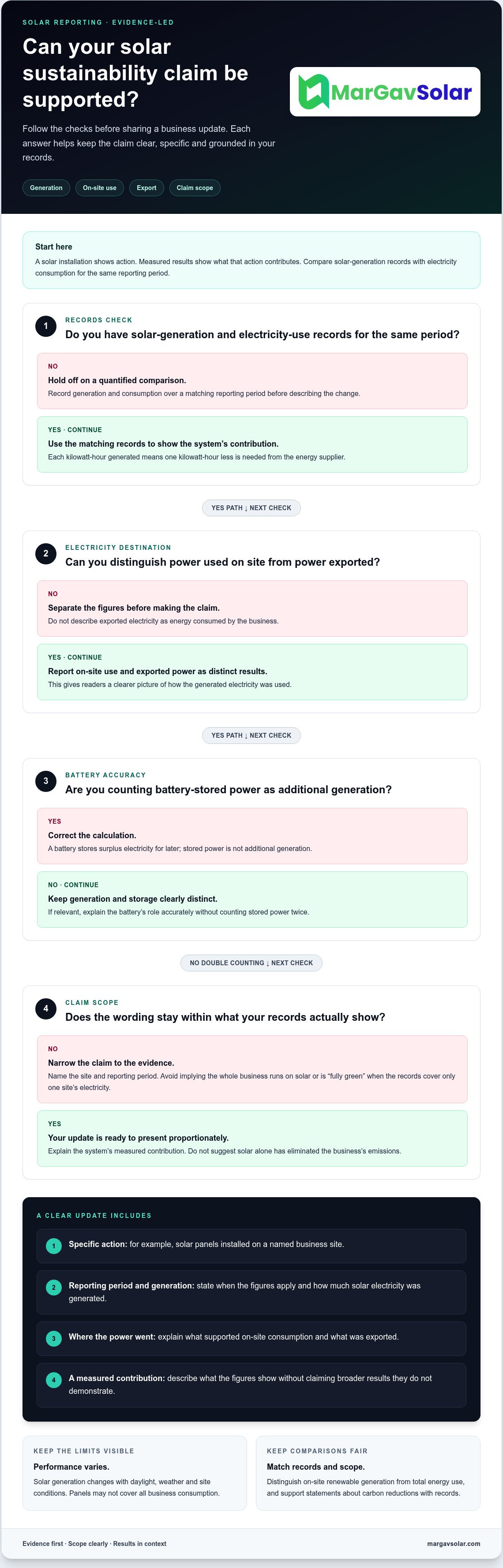
Build each public statement from the business’s records. Compare solar-generation data with electricity consumption for the same period, then explain whether the generated power was used on site or exported. If a battery stores surplus electricity for later, describe its role accurately. Don’t count stored power as additional generation.
Before publishing a sustainability update, use this simple sequence:
- State the specific action, such as installing solar panels on a named business site.
- Give the reporting period and the amount of solar electricity generated.
- Explain how much supported on-site consumption and how much was exported.
- Describe the environmental contribution without claiming broader results the figures don’t show.
For example, a business could report that its panels generated electricity during a stated period and supplied part of the site’s consumption. It could clarify that the figures relate to that property, not all company operations. This gives readers useful context and avoids suggesting that solar alone has eliminated the business’s emissions.
Keep the same distinctions across customer communications, staff updates and sustainability reports. If a company website says solar supports its environmental work, explain the system’s actual role. Avoid broad labels such as “fully green” when the evidence covers only one site’s electricity.
Reputation grows from consistency between a claim and the action behind it. A business can show progress by updating figures as operating records change, correcting outdated statements and explaining what its solar data measures. Customers can then understand the contribution without mistaking one energy measure for a complete account of environmental performance.
Solar power can form part of a wider plan alongside efforts to reduce energy use and emissions. Present each measure separately, with evidence suited to that measure. For instance, distinguish a reduction in electricity drawn from the supplier from a broader claim about the business’s carbon footprint.
Demonstrating progress towards Net Zero
The UK government has committed to net zero emissions by 2050. Businesses can show how solar energy contributes by reporting measured generation alongside electricity use, rather than treating installation alone as proof of progress. This creates a clearer account of what changed and where further energy efficiency work may help.
Start with consistent records. Compare solar generation and site electricity consumption across matching reporting periods, and note changes in operations. Separate electricity used on site from energy exported. This helps customers and colleagues understand the system’s contribution without implying that solar covers every business activity.
Generation can vary across the year. UK solar panels can generate enough electricity to cover all a business’s energy needs during some of the sunniest months, from May to October. Reporting performance over a full year gives a broader view than selecting a high-output period alone.
A billing example recorded 7,682 kWh of solar generation between 30 June 2020 and 31 December 2020. The figure illustrates the value of recording actual output over a defined period. A business can use the same approach, matching its own solar data with consumption records for the corresponding dates.
Unisurge International consumed 331,110 kWh of renewable electricity in 2024-25 and saved 68.5 tonnes of carbon in that period. These figures connect energy use with an environmental result while keeping the reporting period visible. A business can follow this approach by documenting both its electricity use and the related carbon outcome.
For a useful progress update, include the following details:
- The reporting period covered by the figures.
- Solar electricity generated and the portion used on site.
- Any exported electricity, kept separate from on-site consumption.
- How the results relate to the business’s wider sustainability work.
Keep system capacity and generation figures distinct. Capacity describes the installation; generation records show the electricity it produced. Reporting both helps readers understand the system’s scale and its actual contribution over the stated period.
Electricity bills can help businesses track purchased power alongside solar output, but energy prices can change independently of consumption. Report bill changes separately from environmental progress. A lower bill is not a direct measure of reduced emissions, as price changes may also affect it.
Use the findings to identify the next practical step: pinpoint when the business still relies on supplied electricity, then assess opportunities to improve energy efficiency. Repeating the same reporting method makes progress easier to follow and gives customers a grounded account of the business’s contribution towards national net zero goals.
How can a UK business demonstrate its environmental credentials by installing solar panels?
Start by matching the installation to the business’s actual electricity needs. A building audit can assess suitable system size, expected generation, annual electricity savings and investment break-even time. These findings help explain why the project fits the site, rather than presenting panels as a standalone environmental gesture.
Next, assess the roof and available outdoor space. A business considering solar is advised to have at least 20 square metres of roof space. Flat roofs can also accommodate panels when suitable mounting equipment is used, while parking areas or open ground within the premises boundary may provide alternatives.
Use realistic generation estimates in public communications. In the UK, one kilowatt of solar panels usually produces between 800 and 1,000 kilowatt-hours of electricity per year. Actual output depends on the site and system, so present the estimate as expected generation, not as a guaranteed result or a measure of total business emissions.
Installation details can also show how the project was planned for the property. Solar panels can generate electricity in cloudy weather and throughout the year without direct sunlight. Where roof sections are shaded, boosters can help the system run to its full potential. Explain relevant site conditions when describing the installation’s expected contribution.
For a credible evidence trail, keep project documents together from assessment through operation. Useful records include:
- The building audit and its estimated generation figures.
- The installed system’s capacity and commissioning information.
- Electricity generation and consumption records for matching periods.
- Maintenance records that help explain changes in system performance.
Installation quality matters too. Solar panel installation must comply with the Microgeneration Certification Scheme (MCS). This gives businesses a clear standard to reference when describing how the system was installed, while generation records show what it produces in practice.
Planning permission is another site-specific consideration. Roof-mounted solar panels on UK businesses can usually use permitted development rights without planning permission, although exceptions may apply. Describe the project’s planning position accurately, especially where the building or proposed work has particular constraints.
Finally, distinguish the installation’s contribution from the business’s wider environmental performance. For example, when working with MarGav Solar, you can state that panels generate renewable electricity for a particular site, then explain how that power relates to the site’s consumption. This evidence-based wording gives customers a concrete action to understand without claiming solar alone makes the entire business green.
Solar installations generate electricity for the business, while making clear that this is one contribution rather than proof of overall environmental performance. Adoption provides context: over a million homes, businesses, and landowners in the UK installed solar panels in the past decade, and the UK has had over 1.7 million solar panel installations, mostly residential. Tesco plans to install solar panels across 100 of its stores over the next three years. These examples show that commercial solar is an established option, not evidence of this business’s own results.
Many UK businesses that install commercial solar panels see a return on investment within a few years, while solar panels usually last 20 to 30 years overall. Present those points as general context, not as a promise about the site. Keep claims tied to recorded performance and explain any limits.
What UK rules apply to businesses making green or sustainability claims about solar power?
For a UK business, solar claims should match their supporting evidence. Describe the installation, site and reporting period, then explain what the figures measure. Saying that solar panels generate electricity at one premises is clearer and more precise than saying the whole business is “green”. Keep public wording aligned with the records behind it.
Use a simple review before publishing a website statement, customer update or sustainability report:
- Identify the exact claim and the business activity it covers.
- Match it to generation, consumption or export records for the same period.
- Explain whether the figures apply to one site or the whole organisation.
- Remove broad wording that the evidence cannot demonstrate.
For example, if records show solar generation at one warehouse, say that the warehouse generates renewable electricity. Don’t imply that every office, vehicle or supplier uses solar power. If the system exports surplus electricity, distinguish it from electricity used on site. Clear boundaries help customers understand the claim without assuming it covers more than it does.
Be precise with carbon statements. Electricity generated by solar can reduce the amount a business needs from its supplier, but that alone doesn’t quantify the company’s total carbon footprint. A claim about reduced emissions needs a defined comparison, consistent periods and a clear explanation of what the calculation includes. Don’t present an estimate as a measured result.
Words such as “zero-carbon”, “carbon-neutral” or “100% renewable” make broad claims. Use them only when the business has evidence that supports the full meaning readers may attach to them. If the evidence covers a particular site, activity or period, name that boundary in the same statement. A photograph of panels can show an installation, but not its output or emissions impact.
Keep an evidence file for each published claim. Include dated generation records, electricity consumption data, the calculation method and a copy of the wording used. When figures change, update the claim instead of carrying forward an old result. This helps staff answer customer questions consistently and prevents brief marketing language from overstating the data.
Before release, ask someone unfamiliar with the project to read the statement. If they could reasonably interpret it as covering all company operations, tighten the wording to identify the site or activity. For installation details and generation expectations, discuss a solar project for your business as part of building an evidence-based sustainability account.
Commercial solar power can help UK businesses reduce their carbon dioxide emissions and support sustainability commitments, but general benefits do not establish the result at a particular site. If the UK reaches 40GW of solar capacity by 2030, solar energy could cover 15% of the nation's annual power requirements; present that as a conditional national projection, not a measure of one company’s impact. Commercial solar panels typically range from 400 watts to 600 watts in power output, but rated output is not the same as recorded generation.
Likewise, the scheme’s lease and power purchase agreement have a term of 25 years, and solar panels for businesses in the UK have average payback times of about 3-6 years. Those figures describe terms and typical economics, not proof of emissions savings. Keep them distinct from site-specific environmental claims.
MarGav Solar: Residential Solar PV Systems
MarGav Solar helps businesses and households explore solar panels, battery storage and EV chargers. These options can support on-site renewable electricity use and align energy choices with sustainability goals. Solar panel maintenance and cleaning can also help care for an existing system over time.
For a business, the useful next step is to clarify the site’s energy needs and the evidence it wants to report. Consider how solar generation, storage or EV charging could fit into its wider plans, then keep environmental claims tied to measured outcomes.
Contact MarGav Solar to discuss your solar and energy goals.
Make your next energy decision count
Solar can become part of a business’s long-term environmental work when its role is clear and its results are reported honestly. Connect your energy goals with the needs of your premises, then consider how on-site generation could fit into daily operations. For anyone considering how to show their business is green with solar, a well-matched plan is more useful than a broad claim.
MarGav Solar offers Residential Solar PV Systems, Battery Storage Solutions and EV Charging Points. These options can help shape an energy plan around your property and the way you use electricity. Choose the direction that supports your priorities, whether that means exploring solar generation, storage or charging infrastructure.
Talk to MarGav Solar about your energy plans and take a practical next step towards a more sustainable business. A clear plan gives you a solid foundation for action and credible communication.
Frequently Asked Questions
Why is Solar PV a green energy solution for businesses?
Solar PV generates electricity from daylight without burning fuel at the point of generation, helping a business reduce its reliance on electricity supplied from the grid. For a Staffordshire business, the contribution depends on how the generated power fits the site’s operating pattern. Solar panels also have manufacturing and installation impacts, so describe the environmental benefit accurately rather than presenting the technology as impact-free.
What evidence can a business use to substantiate claims that its solar power is green?
Keep a clear evidence trail: inverter generation records, meter readings, electricity bills and installation documents can each support different parts of a claim. Inverter data can show output, while meter readings help establish electricity use at the premises. Label forecast figures as estimates and measured results as actual performance. A Staffordshire business can organise records by site and reporting period for easier review.


