

What if the biggest benefit of workplace EV charging isn’t the charger itself, but the time and hassle it can save employees? The employee benefits of workplace EV charging are most meaningful when access fits people’s routines, whether they need a convenient top-up during the day or a place to charge while they work.
It’s reasonable to ask whether chargers will be used enough to justify the investment, or whether access will feel fair to staff with different shifts, commutes and vehicles. Workplace charging won’t suit every employee in the same way. Under current UK rules, electricity an employer provides for charging at work is tax-free for employees, including when they charge a personal EV.
This guide explains how workplace charging can improve employees’ day-to-day experience and how it compares with other EV-related benefits. It also covers fair access, likely use and practical management, with questions to help you assess whether a workplace solution fits your organisation. Where suitable, charging can be planned alongside solar PV and battery storage as part of a commercial energy solution, including for workplaces in Staffordshire.
Key Takeaways
- Understand how the employee benefits of workplace EV charging depend on employees’ actual charging needs, not simply the number of chargers installed.
- Separate access to a workplace charger from vehicle schemes, then compare which option better fits different employee circumstances.
- Use staff feedback and a structured site assessment to shape fair access rules and a practical energy plan.
- Consider how workplace charging could work alongside solar PV and battery storage as part of a tailored commercial energy solution.
- Explore how MarGav Solar’s commercial EV charging experience can help inform planning for your property and team.
What Are the Employee Benefits of Workplace EV Charging?
Workplace EV charging means providing employees with access to electric vehicle chargers at or near their place of work. The employer makes charging available, but doesn’t necessarily provide the vehicle, pay for it or arrange a lease. Employees may charge a car they already own or drive, subject to the organisation’s access policy and the facilities available.
Workplace charging is an access benefit for employees who drive an EV; it isn’t a car scheme. The distinction matters because its value comes from being able to charge during time already spent at work. An employee might arrive with a low battery, plug in while carrying out their usual duties, then leave with more charge than they had at the start of the day. The benefit depends on how access fits their routine, not on the employer supplying a vehicle.
Charging equipment varies by power and connector, so the right arrangement depends on the site and the vehicles employees bring. For general background on equipment and terminology, see EV charging station types and standards. For employees, the practical benefit is simple: a convenient place to charge can reduce the need to plan a separate stop around a working day.
How workplace charging can fit into an employee benefits package
For staff who drive an EV, workplace charging can be a useful amenity, much like other facilities that make time at work more convenient. It may support an organisation’s sustainability aims and complement wider travel or wellbeing initiatives, while still being valuable on its own.
It won’t suit everyone equally. Employees who don’t drive, use public transport, work remotely or have convenient home charging may place less value on access than colleagues with different circumstances. Positioning it as one option in a broader benefits package helps avoid presenting it as a universal perk.
Workplace charging versus EV salary sacrifice
Workplace charging and EV salary sacrifice address different needs. Charging gives employees access to a place to charge a vehicle. A salary-sacrifice arrangement, where offered by an employer, is a way for an employee to obtain or lease an electric vehicle through an employment scheme. One concerns charging access; the other concerns the vehicle itself.
Employers can assess them separately or consider how they might work alongside each other. A charging point may help someone who already drives an EV, while a vehicle scheme may be relevant to an employee considering switching cars. Neither automatically meets every staff member’s needs, and each involves different decisions about eligibility, administration and use.
Keeping the distinction clear makes internal conversations more useful. Explain what employees would receive, who could access it and how it would fit their working patterns, rather than grouping both options under a general “EV benefit”. Staff can then express interest on a clear basis, and employers can assess which option is relevant to their team.
How Workplace EV Charging Improves Employees’ Everyday Experience
The difference often shows up in the rhythm of an ordinary working day. An employee who can charge while already on site may not need to add a separate stop to their journey, rearrange errands around a public charger or spend break time looking for somewhere to plug in. Workplace access won’t remove every charging task, but it can make some journeys easier to plan.
Workplace charging adds convenience by letting employees charge while they’re already on site. That benefit may matter most to staff whose home or travel arrangements make charging less straightforward. The employee benefits of workplace EV charging depend on whether access is available when people need it and whether the arrangements fit the way they work.
Convenience for different commutes and home-charging situations
Consider an employee who lives in a flat or a home without suitable off-street parking. Charging at home may not be convenient, so access at work could provide another place to charge as part of their normal routine. Workplace access can also help someone with home charging who wants to plan for a longer journey or a change in weekly travel.
Workplace charging is an additional option, not a complete replacement for every other way of charging. Its usefulness depends on practical details such as whether staff are on site, their shift patterns and how many people need a charger at the same time. Clear rules for booking, time limits or moving a vehicle can make access more predictable and reduce uncertainty for colleagues.
A visible sustainability benefit employees can experience
A charging point makes an organisation’s support for electric driving tangible. Employees can see and use the facility, rather than encountering sustainability commitments only in internal communications. A charger on its own doesn’t establish an organisation’s overall environmental performance; it’s one practical part of wider activity.
Plug In America’s discussion of workplace charging considers how businesses connect it with sustainability aims and employee experience. For an employer, the useful question is how a facility would fit existing plans and serve the people who can use it. Where appropriate, workplace charging can also sit alongside solar PV and battery storage in a wider property energy plan.
Before introducing chargers, ask staff how they travel, when they’re on site and what would make access workable. Feedback from EV drivers can indicate likely demand, while input from other employees helps keep the policy clear and fair. This gives the organisation a practical basis for deciding how charging could support everyday journeys. For Staffordshire organisations considering that step, commercial EV charging solutions can be planned in relation to the property and its energy needs.
Workplace EV Charging Compared with Other Employee Benefits
Start by identifying the need an EV-related benefit should meet. A charger may be valuable to staff who already drive electric vehicles, while a vehicle scheme or broader travel benefit may help employees in different circumstances. Comparing options by purpose, access and administration makes it easier to judge likely usefulness without assuming one will suit the whole workforce.
Charging access or salary sacrifice: which need does each address?
Workplace charging supports employees who already drive a compatible EV and can use a charger at work. Salary sacrifice concerns obtaining or leasing a vehicle through an employer-arranged scheme. Eligibility, employee choice and administration can differ, so assess the options separately, or consider them together if they address distinct staff needs.
| Benefit | Who may benefit | What is provided | Access conditions | Management needs |
|---|---|---|---|---|
| Workplace charging | Employees who drive an EV and attend a site with charging access | Use of workplace charging facilities | Depends on site attendance, charger availability and any access policy | Set clear rules for access, shared use and day-to-day operation |
| EV salary sacrifice | Employees who want to obtain or lease an EV through an employer-arranged scheme | A route to a vehicle, subject to the scheme’s terms | Depends on scheme eligibility and the employee’s choice | Requires scheme administration and clear employee information |
| Broader travel benefits | Employees whose journeys or preferred transport options vary | Support for travel beyond workplace charging or a vehicle scheme | Depends on the benefit offered and who can use it | Define eligibility and explain how the benefit fits existing arrangements |
How to judge fairness and usefulness across the workforce
Concern about underuse is reasonable, but charger numbers alone won’t show whether the benefit is worthwhile. Consider how many employees drive EVs, how often they’re on site and whether their working hours overlap. A charger at a site with low attendance may serve fewer people than one at a busy workplace. Shift patterns also affect who gets a fair opportunity to use shared facilities.
Staff feedback can help distinguish immediate demand from future interest. Ask about vehicle use, site attendance and charging needs, while recognising that not everyone commutes by car or wants an EV. Then consider practical arrangements such as booking, time limits or priority for employees who need regular access. Review actual use after launch and adjust the rules as patterns become clearer.
Keep the infrastructure decision separate from the employee-value assessment. Installation and site planning concern the property and energy setup; usefulness concerns who can access charging and whether it fits their routine. The employee benefits of workplace EV charging are strongest when those questions are considered together, rather than treating installation alone as proof that staff needs are being met.
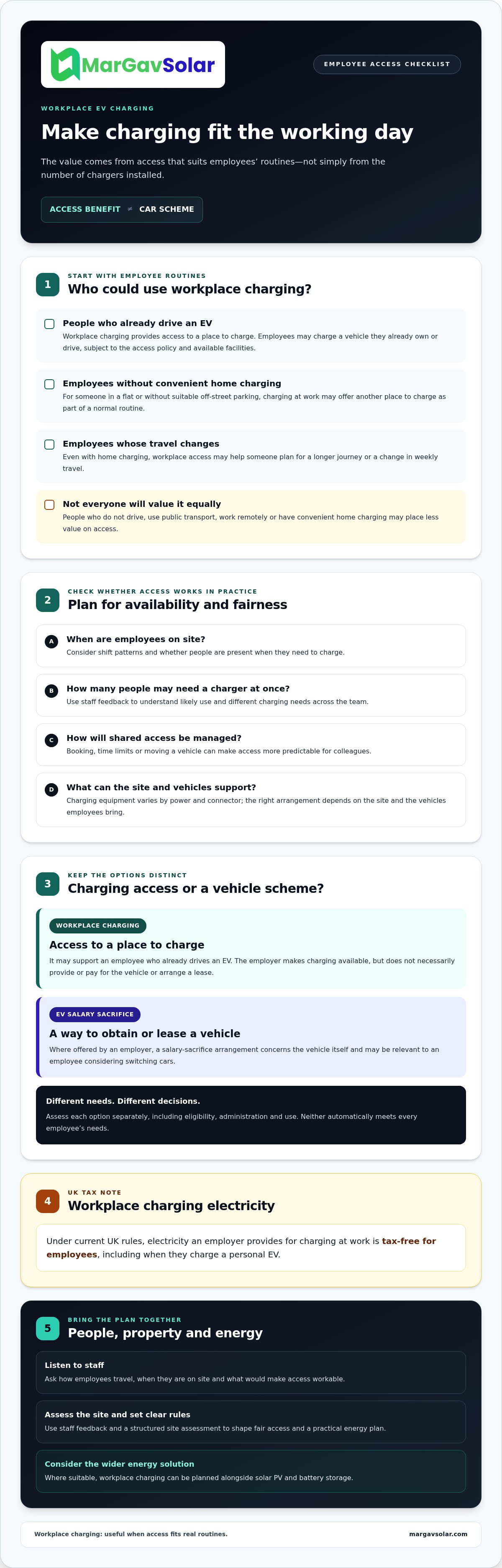
How Employers Can Assess Workplace EV Charging for Their Team
A useful assessment starts with employees’ real routines, then tests whether the property can support a practical solution. Work through these five steps to move from initial interest to a plan you can review and adjust over time.
- Understand staff needs. Ask whether employees currently drive EVs, how often they attend the site and what charging access would help with. Include different shifts and working patterns, and don’t assume everyone commutes by car. Keep feedback focused on relevant needs rather than collecting unnecessary personal information. Treat responses as an indication of demand, not a promise that every employee will always have a charger available.
- Assess the site. Review the parking layout, electrical capacity and potential charger locations before deciding how many charge points the workplace needs. Cable routes, distance from the electrical supply and the way parking spaces are used can affect the installation scope. These details are property-specific, so a site assessment helps shape a realistic plan instead of relying on assumptions.
- Set an access policy. Decide how employees will use the chargers and explain the arrangements clearly. Depending on expected demand, options might include booking, time limits or shared-use rules. Consider how the policy works for people on different shifts and staff who attend less frequently. A transparent approach helps employees understand what to expect and how to raise access issues.
- Plan energy use. Consider how charging would fit the site’s wider energy needs. Where suitable, assess whether solar PV or battery storage could form part of the same commercial energy plan. The right combination depends on the property and project, so consider charging alongside existing energy infrastructure rather than as an isolated addition.
- Review the arrangement. After charging becomes available, compare actual use with the needs identified at the outset. Gather staff feedback, note access conflicts and consider whether working patterns or demand have changed. Use what you learn to update the policy or inform future decisions about the charging setup.
Before making financial or employee-benefit decisions, check current official UK guidance on tax treatment, employer reporting and any grant eligibility. Rules and scheme conditions can change, so avoid relying on outdated summaries when budgeting or communicating the benefit.
A structured assessment helps employers judge whether the employee benefits of workplace EV charging are likely to match their team’s needs and the site’s capabilities. MarGav Solar provides commercial EV charging, solar PV and battery-storage solutions that can be considered together for a property and project. Discuss a workplace EV charging plan as part of your organisation’s wider energy approach.
Planning a Workplace EV Charging Solution with MarGav Solar
A workplace charging project should start with the people who may use it and the property where it will be installed. Consider which employees need access, when they’re on site and how shared charging could fit their working day. Then assess the building, parking layout and electrical setup to shape an approach around the organisation’s requirements. For employers in Staffordshire, planning around the specific workplace helps connect staff needs with the site’s energy setup.
MarGav Solar provides commercial EV charging alongside solar PV and battery storage. Support includes consultation, professional installation and long-term maintenance, with the solution tailored to the property and project. This lets employers consider where chargers could go and how charging fits into the site’s wider energy plans and ongoing use.
Consider EV charging alongside solar PV and battery storage
Charging, on-site generation and storage can be considered together where appropriate. A site assessment can help establish how available space, electrical capacity and energy needs relate to the project. Solar PV or battery storage may be relevant parts of that discussion, but the right configuration depends on the property. Don’t assume a particular level of savings or energy self-sufficiency in advance.
For organisations exploring solar as part of a wider property plan, MarGav Solar’s Solar Panel Installation in Staffordshire: A Comprehensive Guide offers related background on solar projects.
Explore the next step for your workplace
Before a consultation, bring together a clear picture of employee needs, site considerations and energy goals. Useful starting points include staff feedback on EV use and attendance, the parking layout, known constraints around the electrical setup, and any plans for solar PV or battery storage. These details help frame the discussion without assuming every employee travels by car or will use charging in the same way.
With over 20 years of industry experience, MarGav Solar supports commercial and residential energy projects through consultation, installation and ongoing maintenance. Its EV charging work can be considered alongside solar PV and battery storage where suitable. The EV Charging Points in Staffordshire: The 2026 Homeowner’s Guide provides additional background on EV charging, although a workplace project needs to be tailored to its own site and users.
The employee benefits of workplace EV charging depend on a solution that works in practice, from charge-point locations to access arrangements. A considered conversation can connect staff needs with the property’s energy requirements and help identify sensible next steps. Discuss a workplace EV charging project with MarGav Solar.
Make Workplace Charging a Benefit That Works in Practice
Turn interest into a clear decision by asking what would need to be true for charging to make a difference to employees. Think about how you’ll recognise a useful outcome, such as staff finding it easier to plan working-day journeys or having fair, reliable access to shared chargers. A clear measure gives you a stronger basis for deciding how the project should develop over time.
The employee benefits of workplace EV charging aren’t defined by installing equipment alone. They come from matching employee needs with a workable site plan and access arrangements. Bringing those elements together early can help your organisation make a considered choice, whether you’re exploring charging on its own or as part of a wider workplace energy project.
MarGav Solar can help you discuss your property’s requirements and the energy solutions that may suit your project. Discuss a workplace EV charging project with MarGav Solar and take a practical next step towards charging that supports your team.
Frequently Asked Questions
Can workplace EV charging help employees who cannot charge at home?
Yes. Workplace charging can give employees without a practical home setup another opportunity to charge during their working week. For example, someone who rents a flat without access to off-street parking may be able to include a workday charge in their routine. The employee benefits of workplace EV charging still depend on being on site when a charger is free, so staff may need to plan around other charging options too.
Is workplace EV charging a taxable employee benefit in the UK?
Under current UK rules, electricity an employer provides at the workplace for charging an employee’s electric vehicle is exempt from Benefit-in-Kind tax, including for a personal vehicle. This relates to the electricity used for charging, not every possible EV-related arrangement. Employers should check up-to-date HMRC guidance on the specific setup and any applicable reporting requirements before setting a policy or explaining the tax position to staff.
Can employees charge plug-in hybrid vehicles at workplace chargers?
Often, yes, if the vehicle can connect to the charger and the workplace’s equipment and arrangements support it. Plug-in hybrids have a rechargeable battery as well as an engine, so an employee may use a workplace point to charge the battery. Before setting access rules, establish which vehicle types and connectors the facility can serve, then explain any limitations clearly so drivers know what to expect.
How can employers manage workplace EV chargers when several employees need them?
Use a clear process that matches expected demand, such as a booking system for busy periods or shared-use rules for employees who need shorter charging sessions. Make responsibilities clear, including how users report a problem and what to do if a charging space is occupied. Review usage patterns and staff feedback after the policy has been in place, then adjust arrangements if particular shifts or teams regularly miss out.
Do employers need to offer workplace EV charging to every employee?
There’s no universal rule that an employer must provide charging as a benefit to every employee. However, requirements for charging infrastructure can apply to certain new or substantially renovated buildings under relevant building regulations, which is separate from who may use workplace chargers. Employers should check current official guidance for their building and make access policies clear, consistent and appropriate to their workforce.
Can workplace EV chargers use electricity from solar panels?
They can be considered together as part of a site’s energy plan where the property and system design are suitable. Solar generation, battery storage and EV charging need to be assessed in relation to the site’s electrical setup and energy use. For a business in Staffordshire, a property-specific assessment can help determine whether solar PV could form part of a wider workplace charging project, without assuming a particular configuration or saving.


