

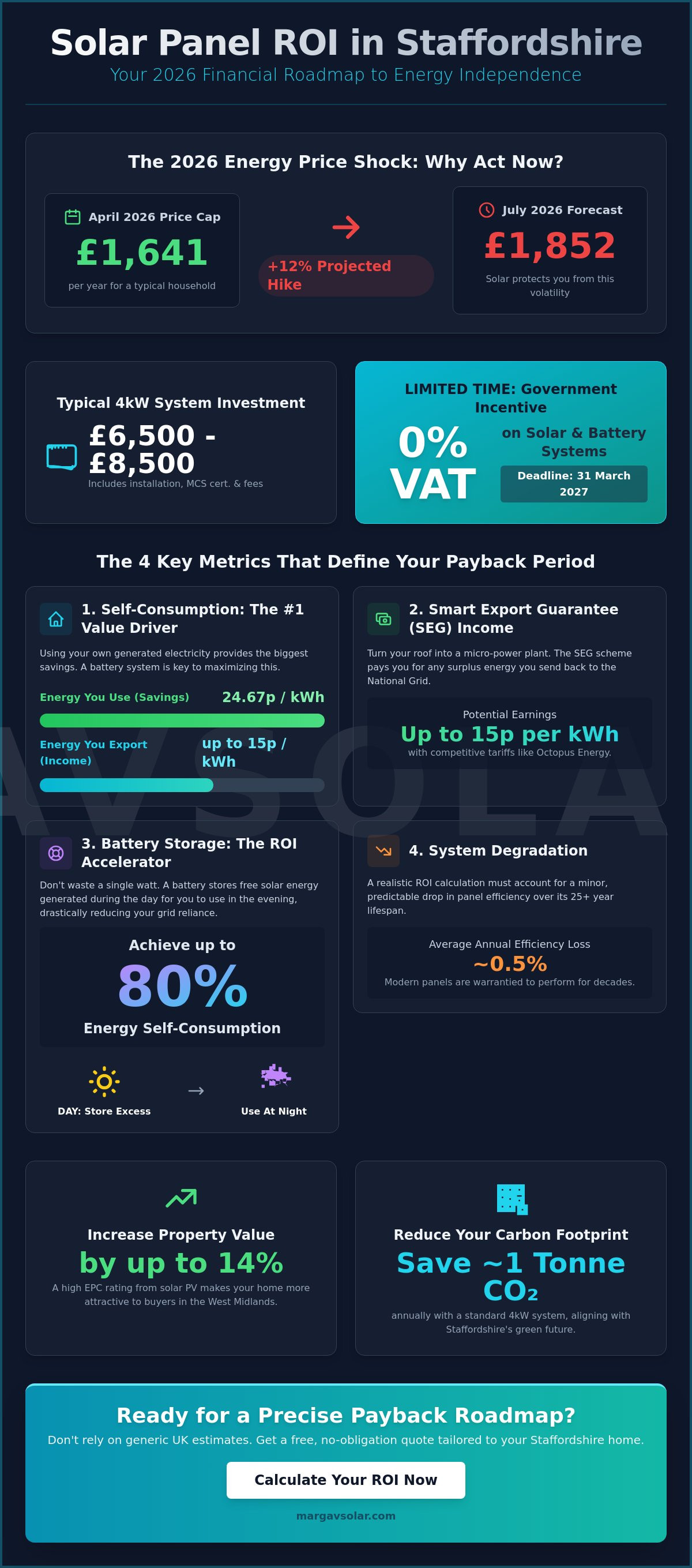
Why are Staffordshire homeowners rushing to install solar panels when the April 2026 energy price cap just settled at £1,641? It's because savvy residents know that forecasts for July 2026 already predict a sharp rise to approximately £1,852, making long-term energy independence more valuable than ever. You might feel overwhelmed by conflicting national data or worry that Staffordshire's specific weather won't provide enough yield to justify the £6,500 to £8,500 investment for a standard 4kW system. It's frustrating to plan your finances when you aren't sure if a solar panel ROI calculator UK tool actually reflects local sunlight hours or the 24.67p per kWh electricity rate you're currently paying.
We agree that generic estimates don't work for your home, which is why this guide provides a precise 2026 payback roadmap tailored to the West Midlands. You'll discover how to lock in 0% VAT before the March 2027 deadline and learn why a battery storage system is the key to hitting 80% self-consumption. We'll also address new industry shifts, such as the May 2026 GivEnergy cloud subscription fees, so your profit margins remain protected. By the end of this article, you'll have a clear year-by-year schedule showing exactly when your solar investment starts paying you back.
Key Takeaways
- Learn how to define your break-even point by balancing local installation costs against regional energy yields and smart export income.
- Use a professional solar panel ROI calculator UK strategy to navigate 2026 price cap fluctuations and secure the current 0% VAT incentive.
- Discover how battery storage and the GivEnergy Cloud ecosystem can accelerate your payback curve by doubling your household's self-consumption.
- Understand the impact of Staffordshire-specific irradiance levels and local grid application processes on your system's long-term financial performance.
- Identify why professional maintenance and NICEIC certification are essential for protecting your profit margins and ensuring insurance-backed ROI.
Understanding Solar Panel ROI in Staffordshire for 2026
Calculating the Return on Investment (ROI) for solar energy in Staffordshire isn't just about spreadsheets; it's about identifying the exact moment your system stops being a cost and starts being a revenue stream. Solar ROI represents the financial crossover point where your cumulative utility bill savings and Smart Export Guarantee (SEG) payments equal your initial installation outlay. When you use a solar panel ROI calculator UK tool, you're tracking the journey toward "Energy Independence." For a typical 4kW Staffordshire installation costing between £6,500 and £8,500, this period is shrinking. This acceleration is driven partly by the 0% VAT rate on solar and battery hardware, which remains in effect until 31 March 2027. By removing that 20% tax burden, the government has lowered the barrier to entry for West Midlands residents.
Beyond the initial purchase, the Smart Export Guarantee serves as a secondary ROI driver. While rates vary, suppliers like Octopus Energy offer up to 15p per kWh for the excess energy you send back to the grid. This turns your roof into a micro-power plant. Over a 25-year system lifespan, ROI is the total financial gain realized after the equipment has paid for itself. Professional solar panel installation ensures these components work at peak efficiency to reach that break-even point as fast as possible.
The 2026 Energy Landscape in the West Midlands
The Ofgem price cap for April to June 2026 is fixed at £1,641 per year, with electricity rates averaging 24.67 pence per kWh. However, market forecasts for July 2026 suggest a jump to approximately £1,852. Staffordshire homeowners are prioritizing solar to hedge against these 12% price hikes. Understanding the Energy Return on Investment is vital here; it measures the ratio of energy delivered to the energy used in its manufacture. In 2026, the financial return is directly tied to this efficiency. ROI in this context is the total net profit generated over the 25-year life of your panels after the initial capital is recovered.
Environmental vs. Financial Returns
Staffordshire's transition from its industrial coal heritage to a green future provides a unique backdrop for solar adoption. Financial returns aren't limited to monthly bills. High EPC ratings, achieved through solar PV, can increase property values across the West Midlands by up to 14%. When you use a solar panel ROI calculator UK strategy, remember that these "hidden" gains often outweigh the direct energy savings. Carbon offset metrics for the Midlands show that a standard 4kW system saves roughly 1 tonne of CO2 annually, aligning your financial goals with local environmental targets.
The Solar Payback Calculation: 4 Key Metrics to Track
Relying on a basic solar panel ROI calculator UK formula often leads to inaccurate expectations. To get a true picture of your 2026 savings, you must track four specific metrics that go beyond simple equipment costs. These variables determine whether your system pays for itself in seven years or twelve. Accuracy here is the difference between a rough estimate and a reliable financial forecast.
- Total System Cost: Professional solar panel installation in Staffordshire typically ranges from £6,500 to £8,500 for a 4kW array. This figure must include all scaffolding, MCS certification, and grid application fees to be accurate.
- Annual Self-Consumption: This is the most valuable metric. Every kilowatt-hour (kWh) you generate and use yourself saves you the full 24.67p grid rate. In contrast, selling that energy back only earns you a fraction of that price.
- SEG Income: The Smart Export Guarantee allows you to sell surplus energy. The UK government's solar drive highlights that these payments contribute significantly to shortening the payback period, provided you choose a competitive tariff.
- System Degradation: You must account for a 0.5% annual drop in output. While modern panels are highly efficient, they lose a tiny bit of potency every year. A realistic ROI model factors this in over a 25-year period.
Calculating Your Self-Consumption Ratio
Your "Daytime Load" is the biggest factor in Staffordshire ROI. If your house is empty from 9 am to 5 pm, your self-consumption might be as low as 25%. You're essentially giving away cheap green energy. By using smart appliances to wash clothes or heat water during peak sunlight, you can shift this load. Without a battery, hitting 30% is a success. With a battery, you can push that ratio to 80%, keeping your generated power for evening use when grid prices are highest. If you're unsure how your roof's orientation impacts these metrics, requesting a technical site survey is the best way to get accurate data.
Income from the Smart Export Guarantee (SEG)
As of May 2026, SEG providers offer varied rates that directly impact your solar panel ROI calculator UK results. Octopus Energy remains a leader, though their "Outgoing Octopus" rate dropped to 12p per kWh in March 2026. E.ON Next also provides competitive fixed rates. However, relying on an "Export Only" strategy is a poor financial move. Since you're buying grid power at 24.67p and selling it at 12p, you lose 12.67p on every unit you don't store. This "profit delta" is why battery storage has become a standard requirement for maximizing Staffordshire solar returns.
Maximising ROI with Battery Storage and GivEnergy Cloud
In 2026, the conversation around solar panels has shifted from "how many panels can I fit" to "how much energy can I store." While we established in previous sections that self-consumption is the key to profit, solar battery storage is the engine that drives that profit home. By adding storage, you're no longer at the mercy of the sun's schedule. A typical 4kW system with a battery costs between £10,000 and £14,000 in May 2026, but it allows you to capture energy that would otherwise be sold back to the grid for a lower rate. This technology enables "Time-of-Use" tariff arbitrage. You can charge your battery from the grid during cheap off-peak hours and use that power when prices peak. Data from the Energy Saving Trust confirms that while the initial outlay is higher, the long-term savings from avoiding high-tariff grid energy are substantial.
Modern lithium-ion units now come with 10-year warranty cycles, ensuring your investment is protected well into its most profitable years. When you run a solar panel ROI calculator UK simulation, you'll see that the increased self-consumption from 30% to 80% often offsets the higher upfront cost much faster than expected. This is especially true in Staffordshire, where local weather patterns can be unpredictable; storage provides a buffer that keeps your home running on green energy even during overcast West Midlands afternoons. It's a strategic move that transforms a simple rooftop installation into a fully managed domestic power station.
The GivEnergy Advantage for Staffordshire Homes
The GivEnergy Cloud ecosystem is a game-changer for regional ROI. It automatically manages your energy flow, deciding when to store, discharge, or export based on your specific tariff. It's important to be aware that as of May 2026, GivEnergy has introduced a subscription fee for its "Premium Tier" cloud features. While local access remains free, these smart integrations are what maximize your yield. Staffordshire installations using these automated systems have seen significant improvements in efficiency. They ensure the battery is never sitting idle when it could be saving you money by discharging during expensive peak hours.
ROI Comparison: With vs. Without Battery
Comparing the two paths reveals a stark difference in 25-year profit margins. Without a battery, your savings are limited to daylight hours. With a battery, your "break-even" point occurs faster because you're avoiding the 24.67p grid rate for almost the entire day. By using a solar panel ROI calculator UK approach that factors in these storage benefits, you'll find the "Battery Path" offers a more resilient financial shield. The following breakdown illustrates the profit delta over a 25-year lifespan:
- Without Battery: 30-40% self-consumption; higher reliance on 12p SEG export rates; 9 to 12 year payback period.
- With Battery: 60-80% self-consumption; minimal grid reliance; 7 to 9 year payback; significantly higher total 25-year net profit.
Staffordshire Regional Factors Affecting Your Solar Yield
National averages are often misleading because they rely heavily on South Coast irradiance data. If you use a generic solar panel ROI calculator UK tool, it might overestimate your generation by 10% to 15% compared to what you'll actually see in the West Midlands. Staffordshire receives approximately 900 to 1,000 kWh per kilowatt-peak (kWp) annually. While this is slightly lower than Devon, modern N-Type monocrystalline panels are specifically engineered to thrive in the diffuse, overcast light common in our county. A 4kW system here still reliably delivers around 3,400 kWh of electricity per year, which is nearly the full requirement for a typical UK household using 3,600 kWh.
Local geography matters just as much as the weather. In rural areas like Cannock Chase or the industrial zones near Stoke-on-Trent, particulate matter can accumulate on your glass. Dust from farming or leftover industrial soot can reduce your yield by 5% to 8% if left unmanaged. Property orientation also shifts the ROI curve. While South-facing roofs are the gold standard, a South-West or South-East split often aligns better with the evening energy peaks of Staffordshire families. This alignment ensures you're generating power when you're actually home to use it, rather than exporting it all at noon.
Local Grid Constraints and ROI
Staffordshire homeowners must navigate the Western Power Distribution (WPD) application process. If your local grid is congested, WPD may impose export limitations via G98 or G99 regulations. These bottlenecks can trap your energy on-site, making it impossible to earn SEG income from excess power. In these scenarios, inverter upgrades are essential. A smart, modern inverter can manage these grid constraints more effectively, ensuring your system doesn't shut down when the local network reaches capacity. To ensure your roof is compatible with current grid limits, you should request a local site assessment before purchasing equipment.
Weather Patterns: Beyond the "Grey UK" Myth
Don't let the "Grey UK" myth discourage your investment. The yield difference between Staffordshire and the South Coast is shrinking thanks to temperature coefficient improvements in 2026 hardware. Panels actually lose efficiency when they get too hot; the cooler, breezier climate in the Midlands helps maintain optimal operating temperatures. This means that on a bright but cool May afternoon in Stafford, your panels might actually outperform a system in a sweltering southern location. Using a solar panel ROI calculator UK strategy that accounts for these "cool-efficiency" gains provides a much more accurate picture of your 25-year profit margins.
Securing Your Investment: Why Professional Installation Wins
Your 25-year profit margin depends entirely on the integrity of the initial installation. While a low-cost quote from a "Solar Cowboy" might look appealing on paper, poor workmanship often leads to micro-cracks or water ingress that destroys your system's efficiency. These hidden failures won't show up on a generic solar panel ROI calculator UK tool, but they'll certainly show up on your energy bills. This is why NICEIC certification is non-negotiable. It ensures your system meets rigorous safety standards, which is a prerequisite for most insurance policies and the Smart Export Guarantee payments we discussed earlier.
MarGav Solar brings over 20 years of local expertise to every Staffordshire rooftop. We understand the specific structural challenges of regional building types, from heritage tiles to modern industrial sheds. A professional install means your hardware is optimized for the next quarter-century, protecting the capital you've invested in your home's future. When you're calculating long-term returns, the reliability of the installer is just as important as the efficiency of the panels.
Maintenance: Protecting Your 25-Year Profit
Many homeowners forget that dirty panels can lose up to 15% of their output due to local particulate matter. While DIY cleaning seems like a simple way to save money, using the wrong chemicals or abrasive tools can permanently scratch the glass and void your warranty. Professional solar panel maintenance includes more than just a wash; it involves checking electrical connections and updating inverter firmware. Our monitoring software allows us to detect underperformance in real-time, often identifying a faulty string or shading issue before it impacts your monthly savings. It's a small ongoing cost that secures a much larger long-term return.
Next Steps: Your Personal Staffordshire ROI Audit
Generic estimates are a starting point, but your home deserves a tailored strategy. To move beyond a basic solar panel ROI calculator UK estimate, you'll need a site-specific audit. When you're ready to proceed, have your last 12 months of energy bills and your approximate roof dimensions prepared. If you're planning to install an EV charging point or upgrade your battery storage in the future, mention these during your consultation. MarGav Solar will use this data to create a precise payback schedule, giving you total confidence in your Staffordshire solar investment.
Take Control of Your Staffordshire Energy Future
The 2026 energy landscape presents a unique opportunity for Staffordshire homeowners to hedge against the predicted July price cap increases. By combining high-efficiency panels with smart battery storage, you can shift your household from being a grid-dependent consumer to a self-sufficient producer. You've seen how localized factors like West Midlands irradiance and NICEIC-certified maintenance directly impact your long-term profit margins. While a standard solar panel ROI calculator UK estimate offers a useful starting point, it cannot account for your specific roof orientation or the nuances of local grid capacity.
MarGav Solar provides the local accountability and technical precision needed to maximize every kilowatt-hour. With over 20 years of Staffordshire expertise, our team of NICEIC Certified Installers and GivEnergy Platinum Partners ensures your system is optimized for the next 25 years. Don't leave your financial returns to chance with generic national data. It's time to get a clear, data-driven roadmap for your home's energy transition.
Get Your Custom Staffordshire Solar ROI Audit from MarGav Solar and start your journey toward lower bills and a greener footprint today.
Frequently Asked Questions
What is the average payback period for solar panels in Staffordshire in 2026?
The average payback period for solar panels in Staffordshire currently ranges between 7 and 12 years. This timeframe depends on your household's annual consumption and how effectively you use the 24.67p per kWh energy you generate. Using a professional solar panel ROI calculator UK strategy helps pinpoint this date by factoring in the 0% VAT incentive available until March 2027.
Does the Smart Export Guarantee (SEG) significantly improve ROI?
The Smart Export Guarantee acts as a secondary financial driver rather than the main source of profit. While export rates from suppliers like Octopus Energy reach up to 15p per kWh, your primary savings come from avoiding the 24.67p grid price. It's a useful way to monetize the surplus energy that your battery cannot store, but self-consumption remains the priority.
How much does a 4kW solar system cost in the UK with installation?
A typical 4kW solar panel system in the UK currently costs between £6,500 and £8,500 as of May 2026. This price includes professional installation, scaffolding, and MCS certification. If you choose to add battery storage, the average cost increases to between £10,000 and £14,000, which significantly changes the long-term savings profile of the investment.
Can I include an EV charger in my solar ROI calculation?
You should definitely include EV charging in your calculations because it drastically increases your self-consumption ratio. By using solar power to charge your vehicle instead of buying grid electricity or petrol, you accelerate the system's break-even point. Displacing expensive fuel costs often shortens the total payback period by several months or even years.
What happens to my ROI if I move house before the payback period ends?
If you move house before the payback period ends, you'll likely recoup the remaining investment through an increased property sale price. Data shows that homes with high EPC ratings and solar installations can see a value increase of up to 14%. The solar panel ROI calculator UK model treats this as a lump-sum return on your initial capital investment.
Is a solar battery worth the extra cost for a Staffordshire home?
A solar battery is worth the investment for most Staffordshire homes because it doubles your self-consumption from roughly 35% to 75% or higher. With energy price caps predicted to rise to approximately £1,852 in July 2026, storing your own power is the most effective way to avoid expensive peak-time grid rates and maximize your independence.
How does shading from Cannock Chase trees affect my ROI?
Shading from local foliage in areas like Cannock Chase can reduce your solar yield by 10% to 25% if not managed with the right technology. Using power optimizers or micro-inverters ensures that a single shaded panel doesn't drag down the performance of the entire array. A professional site survey is essential to map these local shading patterns accurately before installation.
Are there any Staffordshire-specific grants for solar in 2026?
Staffordshire residents can access the Warm Homes: Local Grant, which runs from 2025 to 2028 for eligible low-income households. Additionally, the 0% VAT rate on solar and battery storage remains active until 31 March 2027. The ECO4 scheme also provides funding for energy efficiency upgrades through March 2026 for those meeting specific low-income or social housing criteria.


