
Did you know that while your solar panels are designed to last 25 years, the average inverter typically reaches its retirement age after just 10 to 12 years of service? If your system was installed during the peak Feed-in Tariff years between 2010 and 2015, you are likely part of the 65% of Staffordshire homeowners now facing a silent system failure. It's incredibly frustrating to see your energy bills climb while your solar display remains blank or flashes a confusing error code. You've invested in green energy, so you shouldn't have to worry about losing your FIT payments or struggling to find a reliable local technician.
This guide explains exactly how to manage inverter replacements to restore your home's peak performance and secure your financial returns. We'll cover the specific warning signs to watch for, the latest 2026 hardware standards, and how a modern upgrade can improve your energy conversion efficiency by up to 15%. From understanding local MCS regulations to choosing a qualified technician in Stafford or Stoke-on-Trent, we've compiled everything you need to get your system back on the grid.
Key Takeaways
- Learn how to identify the critical warning signs that your solar system’s "brain" is failing, from persistent fault codes to total screen blackouts.
- Understand why modern smart technology makes inverter replacements a more cost-effective and future-proof investment than attempting to repair outdated, out-of-warranty hardware.
- Follow our essential pre-installation checklist to accurately verify your current solar array’s capacity and warranty status before you commit to an upgrade.
- Navigate the specific UK grid regulations for Staffordshire homeowners, ensuring your new setup complies with National Grid’s G98 or G99 notification requirements.
- Discover how partnering with local experts to install Newcastle-under-Lyme’s own GivEnergy systems can transform your solar setup into a high-performance smart energy hub.
Signs Your Solar Inverter Needs Replacing
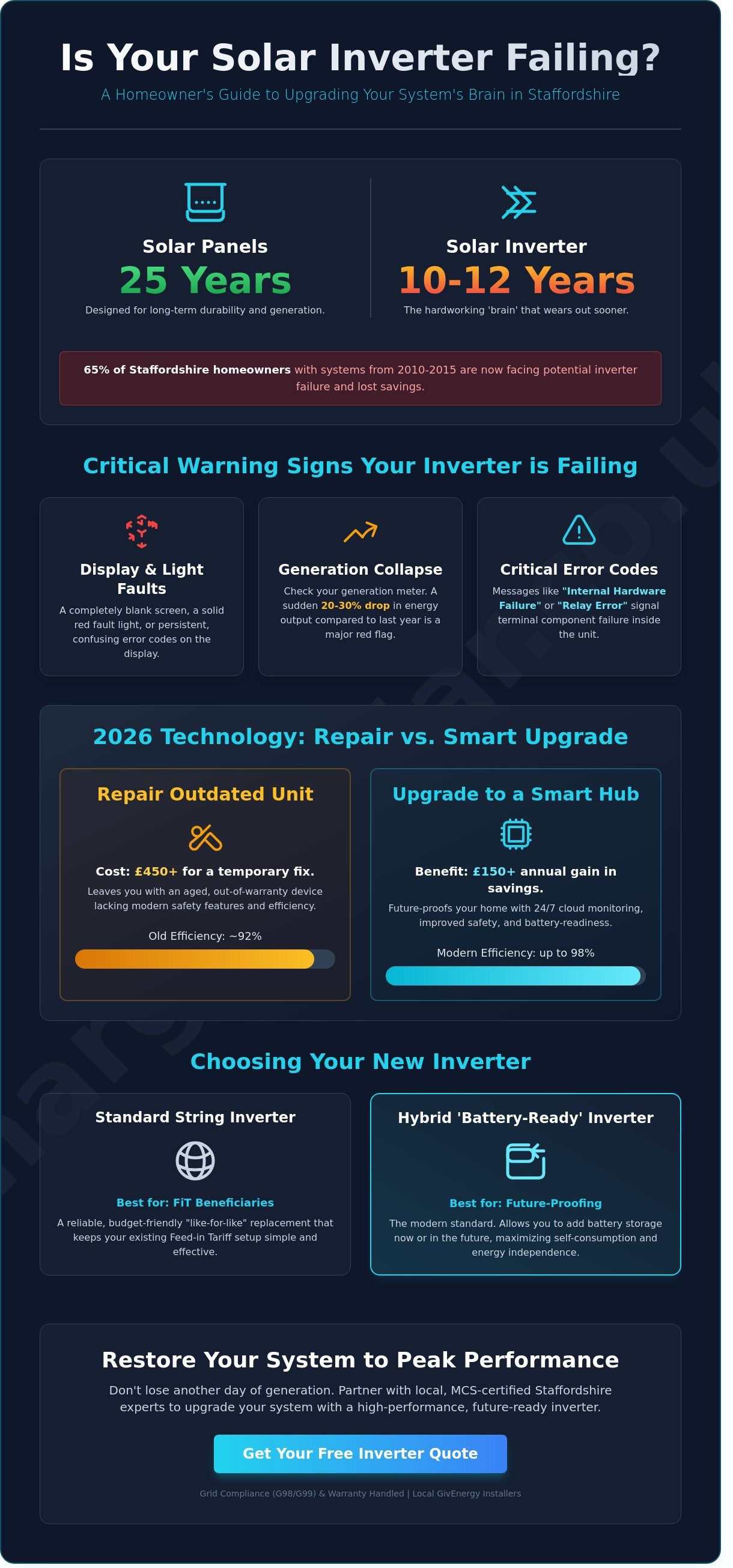
Your solar inverter acts as the brain of your entire energy system. While solar panels often boast 25-year warranties, the inverter works significantly harder, converting raw Direct Current (DC) into usable Alternating Current (AC) for your home. Most industry data suggests a typical lifespan of 10 to 12 years. If your system was installed during the initial Feed-in Tariff peak between 2011 and 2015, you've likely reached the point where inverter replacements become a necessity rather than a luxury.
Staffordshire homeowners face specific environmental challenges that accelerate component wear. In areas like the Staffordshire Moorlands, damp winters and high humidity levels often penetrate older casings that have lost their airtight seal over a decade of service. This moisture ingress leads to internal corrosion, often manifesting as intermittent "Isolation Fault" messages on your display during misty mornings or heavy rainfall. If your screen is completely black or showing a solid red fault light, the internal capacitors have likely reached the end of their functional life.
Monitoring your generation meter is the most reliable way to spot a failing unit. Don't just rely on the inverter's own display, as a faulty internal logic board can report false data. Check the physical meter provided by your energy supplier. If your weekly generation logs show a sudden 20% or 30% drop compared to the same period in 2024 or 2025, the inverter is struggling to synchronise with the grid.
Decoding Common Error Messages
Understanding the difference between a temporary glitch and a terminal failure saves time and money. A "Grid Fault" often indicates that the local National Grid voltage is too high or low, which isn't a fault with your hardware. However, "Internal Hardware Failure" or "Relay Error" usually signals that the mechanical components inside the unit have seized. You can attempt a "hard reset" by switching off the AC isolator first, followed by the DC isolator. Wait exactly five minutes for the internal charges to dissipate before switching the DC back on, followed by the AC. If the error persists, the unit requires professional attention. Sometimes, what looks like a dead inverter is simply a tripped DC isolator located near the panels, which can be checked safely without opening any electrical housing.
The Performance Gap: Why Efficiency Drops
Older inverters utilise legacy Maximum Power Point Tracking (MPPT) technology that's significantly less reactive than modern 2026 standards. This leads to a "silent failure" where the unit appears to be running but fails to extract the maximum possible energy from your roof. As components age, their thermal resistance increases, meaning more of your solar energy is lost as heat instead of being sent to your appliances. A 5% efficiency loss in 2026 can cost homeowners £150 or more annually in lost savings and export payments. Modern inverter replacements offer 98% efficiency ratings, ensuring you capture every kilowatt-hour your panels produce.
2026 Inverter Technology: Repair vs. Smart Upgrade
In 2026, the humble solar inverter has transitioned from a basic DC-to-AC converter into a sophisticated smart home energy hub. If your original system was installed during the solar boom of the mid-2010s, your current unit is likely reaching the end of its functional life. When these older units fail, homeowners often face a choice between a patch-up job or a full system evolution. Repairing an out-of-warranty inverter is rarely a sound investment. A specialist repair often costs upwards of £450 for parts and labour, yet it leaves you with an aged device that lacks modern safety features and efficiency standards.
Opting for inverter replacements allows you to jump from 92% efficiency to the 98% benchmarks seen in 2026 models. Modern units integrate 24/7 cloud monitoring via 4G or Wi-Fi as standard. This data allows you to see exactly how your home consumes power in real-time, rather than waiting for a quarterly electricity bill to spot a fault. For many in Staffordshire, the upgrade is the first step toward adding battery storage to capture excess generation that would otherwise be exported for a minimal return.
Standard String Inverters vs. Hybrid Models
If you are one of the many UK homeowners still benefitng from the Feed-in Tariff (FiT), a like-for-like string inverter is a reliable, budget-friendly option. It maintains your current setup without complicating your existing generation meter readings. However, hybrid inverters have become the dominant choice for Staffordshire residents. These units are "battery-ready," meaning you can plug in a storage system like those from Newcastle-under-Lyme based GivEnergy without needing additional equipment later. You must ensure your installer checks the voltage compatibility, as 2026 inverters often have different "start-up" requirements than the 10-year-old panels currently on your roof.
Microinverters: A Different Approach
Properties in leafy areas or those with complex, multi-faceted rooflines should consider switching to a microinverter architecture. Instead of one central box, a small inverter is fixed behind every individual panel. This prevents a single shaded panel from dragging down the performance of the entire array. While the initial cost of these inverter replacements is typically 25% higher than a string system, the increased energy yield in shaded conditions can be significant. If your home suffers from shadows cast by tall trees or neighbouring chimneys, you can request a technical assessment to see if a microinverter swap would maximise your 2026 generation levels.
The Ultimate Solar Inverter Replacement Checklist
Successful inverter replacements require careful preparation before an engineer arrives at your Staffordshire property. Missing a single technical detail can lead to system mismatches or lost generation. Follow this five-step checklist to ensure your new hardware performs optimally from day one.
- Step 1: Verify warranty status. Locate the serial number on the side or underside of your unit. Most manufacturers, such as SMA or Fronius, provided five-year warranties on systems installed around 2018. If your system is older than this, it is likely out of cover, but it is always worth checking the manufacturer’s online portal first.
- Step 2: Identify peak kW rating. Your replacement must match the total kilowatt peak (kWp) of your solar array. If you have 4kW of panels on the roof, installing a 3kW inverter will cause "clipping," where you lose potential energy during peak summer hours.
- Step 3: Check for DC optimisers. Look for small black boxes tucked under your roof panels or check your original handover pack. If your system uses SolarEdge technology, you must use a compatible SolarEdge unit. Standard string inverters cannot communicate with these optimisers.
- Step 4: Evaluate future battery needs. If you plan to add energy storage by 2027, consider a hybrid inverter now. While a standard string inverter is cheaper, a hybrid model manages both panels and batteries, saving you the cost of a second installation later.
- Step 5: Confirm MCS certification. Ensure the new model is listed on the MCS product database. This is a mandatory requirement for maintaining your Smart Export Guarantee (SEG) payments and ensuring the equipment meets UK grid standards.
Technical Specifications to Gather
Count the number of "strings" or pairs of DC cables entering your current device. Most Staffordshire homes use one or two strings; your new unit needs enough MPPT trackers to manage these independent circuits. Measure the physical footprint of the existing unit too. Modern inverters often require more clearance for airflow than 2012 models. Finally, test the Wifi signal strength in your loft or garage. Modern monitoring apps require a stable connection to provide real-time data to your smartphone.
Financial and Legal Considerations
Inverter replacements shouldn't jeopardise your Feed-in Tariff (FIT) or SEG payments, provided the total system capacity remains unchanged. Always keep the NICEIC or MCS installation certificate provided by your installer as proof for your home insurance provider. When reviewing quotes, compare the value of warranty extensions. Upgrading from a 5-year to a 10-year manufacturer warranty typically costs between £200 and £350, which offers significant protection against future component failure through to 2036.
Navigating Local Staffordshire Regulations and Grid Requirements
Upgrading your solar technology isn't just a hardware decision. It's a regulatory one. National Grid Electricity Distribution, which manages the network across Staffordshire, enforces strict protocols to ensure grid stability. When you plan inverter replacements, the capacity of your new unit determines which paperwork path you must follow. If your new inverter exceeds the 3.68kW threshold on a single-phase supply, you cannot simply install it and inform the grid later. You need prior permission via a G99 application.
Staying compliant prevents potential fines or forced disconnections. Many homeowners in areas like Cannock Chase or the Staffordshire Moorlands face unique challenges. Properties in these locations might be subject to stricter building control or conservation area rules. MarGav Solar handles every stage of this administrative burden. We manage the DNO (Distribution Network Operator) notifications and ensure your system meets the latest Engineering Recommendation standards, so you don't have to decode complex grid codes yourself.
Working with National Grid in the Midlands
The 3.68kW limit is the "fast-track" boundary for domestic properties. If your inverter replacements stay within this limit, your installer follows the G98 process. This allows for a "fit and inform" approach where the grid is notified within 28 days of commissioning. However, if you're upgrading to a 5kW or 6kW inverter to support a larger battery array, the G99 process applies. This requires an advance application. We've seen cases where local grid constraints in older parts of Stafford or Tamworth lead to specific export limitations. Our team uses local knowledge to negotiate these constraints, ensuring your system is approved without unnecessary delays.
Choosing a Staffordshire-Based Installer
Proximity is vital for long-term system health. A local installer provides rapid response times that national companies often struggle to match. If a fault occurs during a peak generation month like July, waiting two weeks for a technician could cost you £50 or more in lost energy savings. We've built a reputation over 20 years by providing reliable service to homeowners in Leek, Lichfield, and beyond. You can verify our local references easily; we've likely worked on a property in your postcode. This local expertise means we understand the specific electrical characteristics of Staffordshire's housing stock, from Victorian terraces to modern developments.
- G98 applications for systems under 3.68kW per phase.
- G99 applications for higher capacity or complex battery storage.
- Building control compliance for Staffordshire's 1,000+ listed buildings and conservation zones.
- Full administrative management of all DNO paperwork by our specialist team.
Don't risk your feed-in tariffs or grid connection by ignoring the paperwork. Our experts ensure your upgrade is fully legal and optimised for the local grid. Contact MarGav Solar to manage your local grid applications today.
Professional Inverter Replacement Services with MarGav Solar
Choosing the right partner for inverter replacements shouldn't be a gamble for your home's energy future. At MarGav Solar, we've refined an end-to-end workflow that removes the guesswork from the process. We start with a comprehensive diagnostic to confirm your unit has actually failed rather than suffering from a minor string issue. Once we verify the fault, our team manages the full removal and hardware installation. We don't just swap the box on the wall; we configure your cloud monitoring setup so you can track your solar yields from your smartphone the moment we leave your property.
We prioritise hardware from industry leaders like GivEnergy. Because they're based right here in Newcastle-under-Lyme, Staffordshire residents benefit from local supply chains and excellent UK-based technical support. Our fixed-price installation contracts provide total financial clarity. The price you're quoted is the price you'll pay. We don't add hidden call-out fees or unexpected wiring charges halfway through the job.
Modern energy needs have changed significantly since many original systems were installed. We ensure your new inverter integrates seamlessly with the latest green technology. Whether you're planning to add a 7kW EV charger or a high-capacity battery storage system, we calibrate the new unit to manage these heavy loads efficiently. This approach transforms your solar array from a simple generator into a smart energy hub ready for 2026 and beyond.
The MarGav Maintenance & Repair Edge
Our service extends far beyond the day of installation. We provide scheduled technical inspections and ongoing support to ensure your new unit lasts for its full 10 to 15-year design life. We're committed to turning Staffordshire homes into high-performance energy centres that reduce reliance on the National Grid. With over 20 years of local expertise in renewable energy, our engineers understand the specific grid requirements and housing stock across the West Midlands.
Get Your Personalised Replacement Quote
Upgrading your solar system starts with a professional technical consultation. To help us provide an accurate assessment, please include a clear photo of your current inverter and any fault codes displayed on the screen when you get in touch. This allows our team to identify the correct mounting and wiring requirements before we even arrive at your door. You can start the process today by clicking the link below.
Future-Proof Your Staffordshire Solar Energy Today
Modernising your solar array ensures you aren't left behind as UK energy standards evolve. Upgrading to a smart system by 2026 allows you to take full advantage of flexible export tariffs and advanced battery storage integration. When managing inverter replacements, it's vital to select hardware that meets current G98 grid compliance standards to ensure your home remains safely connected to the local network. A well-timed upgrade can often improve system yield by up to 15% compared to older, degrading string inverters.
MarGav Solar provides over 20 years of industry expertise across the Midlands. As NICEIC certified and MCS accredited installers, we guarantee that every installation adheres to the latest safety and performance regulations. Our team specialises in GivEnergy and other premium brands to provide Staffordshire homeowners with reliable, high-efficiency solutions. Don't let an outdated component diminish your return on investment or compromise your energy security.
Book your expert inverter health check in Staffordshire today
Take control of your home's power and enjoy the peace of mind that comes with a professionally certified solar system.
Frequently Asked Questions
How much does a solar inverter replacement cost in the UK in 2026?
A standard solar inverter replacement in 2026 typically costs between £800 and £1,400 for a 4kW domestic system. This price range includes the hardware and professional labour. If you opt for a high-specification hybrid model, costs often rise to £1,800 or more. Your final bill depends on the unit's capacity and the complexity of your existing electrical setup.
Can I replace my solar inverter myself to save on labour costs?
You shouldn't replace a solar inverter yourself because it involves high-voltage DC and AC electrical work. UK Building Regulations, specifically Part P, require that competent persons perform such installations to ensure safety. Most manufacturers will void your 10-year warranty if a certified MCS installer doesn't carry out the work. Hiring a professional keeps your home insurance valid and your system compliant.
Will replacing my inverter affect my Feed-in Tariff (FIT) payments?
Replacing your inverter won't stop your Feed-in Tariff payments if the new unit's capacity matches your original system. You're required to notify your FIT licensee about the hardware change and provide the new serial number. According to Ofgem guidelines, your generation and export rates remain the same as long as you don't add extra solar panels to the array.
How long does it take for a professional to swap an inverter?
Professional inverter replacements usually take between 2 and 4 hours to complete. This window includes the physical mounting of the unit, connecting the DC strings, and configuring the monitoring software. If your current system requires updated DC isolators or significant rewiring to meet 2026 safety standards, the technician might need up to 6 hours for the full installation.
Should I upgrade to a hybrid inverter if I don’t have a battery yet?
Upgrading to a hybrid inverter is a wise investment if you plan to install battery storage within 24 months. These units are battery-ready, which eliminates the need for a second expensive inverter later. However, hybrid models cost roughly 40% more than standard string inverters. If you have no intention of adding storage, a standard unit is a more cost-effective choice for your home.
What is the standard warranty for a new solar inverter in 2026?
The standard manufacturer warranty for a new solar inverter in 2026 is 10 years. Premium brands like GivEnergy or SolarEdge frequently offer 12-year terms, with optional extensions reaching 20 years for a fee of approximately £250. You should also ensure your installer provides a separate 2-year workmanship guarantee to cover the installation itself against technical faults.
Does a faulty inverter mean my solar panels are also broken?
A faulty inverter doesn't mean your solar panels are broken. Solar panels have a lifespan of 25 to 30 years, while inverters usually require replacement every 10 to 12 years. If your system stops generating, it's 85% more likely to be an inverter failure than a panel issue. A simple diagnostic test by a technician can confirm if your panels are still performing at their expected 80% efficiency.
Why is my inverter making a loud buzzing or clicking noise?
Occasional clicking is normal when the system starts up at dawn, but loud buzzing often signals a failing internal fan or a loose connection. If the noise level exceeds 45 decibels, it's a sign that internal components are overheating or vibrating excessively. You should book an inspection immediately to prevent a total system shutdown or potential electrical fire hazards in your loft or garage.


