

You can’t control energy prices, but you can influence how much electricity your home uses and where some of it comes from. Ofgem’s price cap for October to December 2026 puts a typical household’s annual energy bill at £1,723 when paying by Direct Debit, a 4% rise on the previous quarter. The cap limits unit rates and standing charges, not the total you’ll pay. Understanding how to avoid rising electricity prices starts with practical choices at home and a review of your tariff.
It can be difficult to know which changes are worth making, whether support is available, or whether solar and a battery require a major upfront commitment. This guide covers ways to reduce avoidable electricity use, compare tariffs and support options, and assess whether generating and storing electricity at home could suit your plans.
Start with everyday energy use, then review tariffs and eligible support before considering solar PV and battery storage as longer-term options. The right approach depends on your home and circumstances. For Staffordshire households, a tailored assessment can help connect the property’s potential with its energy needs.
Key Takeaways
- Learn how to avoid rising electricity prices by focusing on what you can influence, including household consumption and tariff choices.
- Use bills, meter readings or smart-meter data to identify appliances and routines that may be driving electricity use.
- Compare tariffs by unit rates, standing charges and terms. Consider time-of-use options only if they suit your household routine.
- Assess whether solar panels could generate electricity for your home and whether a battery could store some of it for later.
- Build a practical plan: review usage, test changes and track bills before assessing whether home generation suits your Staffordshire property.
How rising electricity prices affect your household, and what you can control
An electricity bill includes more than one charge. The unit rate is what you pay for each kilowatt-hour (kWh) you use. The standing charge is a daily amount for maintaining your connection, charged even when you use very little electricity. Your tariff sets the rates and terms, while your consumption determines how many units you’re billed for. Using less can reduce the consumption charge, but it won’t remove the standing charge or set the price your supplier charges per unit.
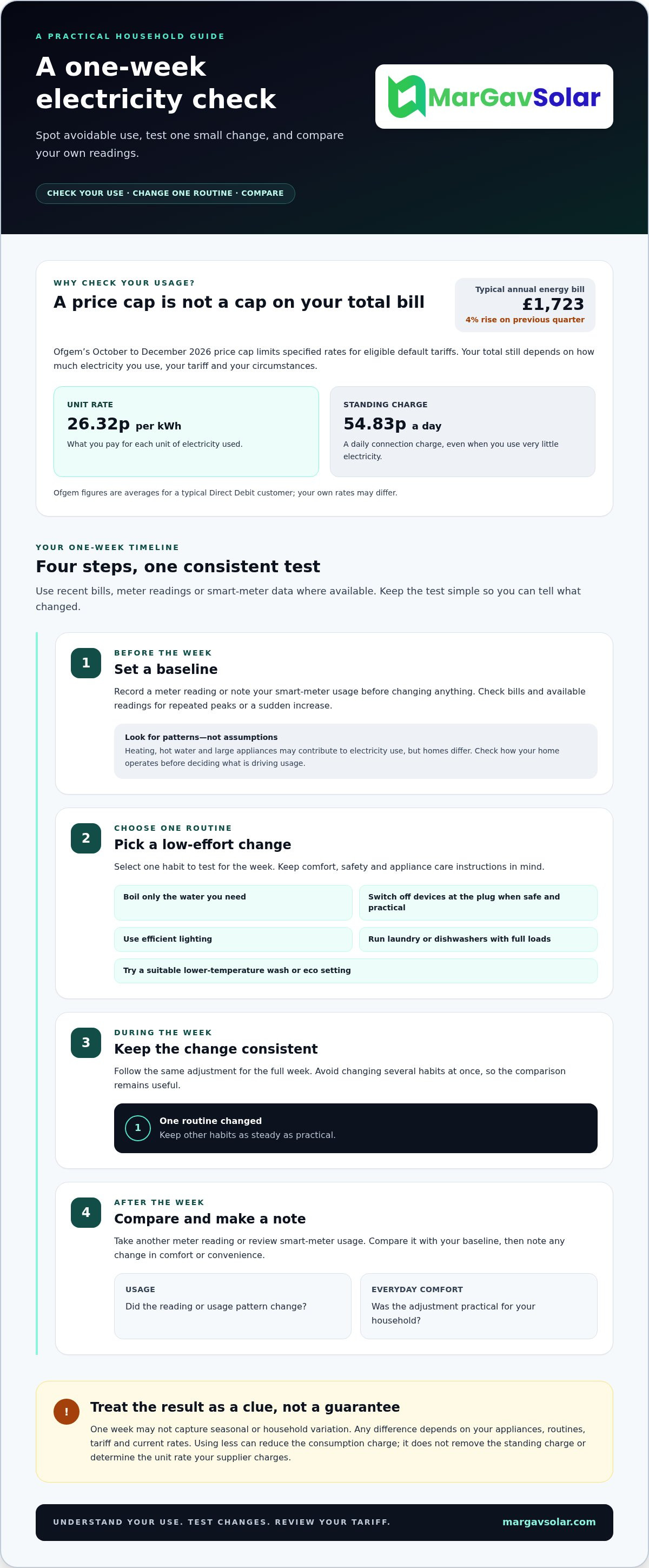
For households on a price-capped default tariff, Ofgem limits the unit rates and standing charges suppliers can charge. The cap is not a limit on your total bill: use more electricity and your bill can still be higher. Rates also vary by region and payment method. Ofgem’s October to December 2026 figures for a typical Direct Debit customer average 26.32p per kWh for electricity and 54.83p a day for the standing charge. Your own rates may differ. The overview of Electricity billing in the UK also explains how these charges contribute to a household bill.
This distinction matters when deciding how to avoid rising electricity prices. You can review your consumption and tariff, but you can’t personally control wholesale market costs or energy policy. Market changes may affect the rates available to you, while changes to your routine affect how much electricity you consume. The impact on your bill depends on your tariff, appliances, home and when you use electricity.
Using less changes how much electricity you buy; changing your supply changes where some of it comes from or the terms on which you buy it. Solar PV may generate electricity for household use, while a battery can store some generation for later. Neither guarantees protection from future price changes or removes standing charges. The benefit depends on the home, system and usage pattern.
Which parts of an electricity bill can a household influence?
You can focus on consumption by identifying which appliances and routines use electricity. You can also review tariff terms to understand how the unit rate and standing charge affect your costs. The Ofgem cap limits specified rates for eligible default tariffs, not your total bill, and it doesn’t promise that bills won’t rise. Check your actual tariff and usage rather than relying on a typical household figure.
What makes a rising-price strategy realistic?
No single action guarantees protection from future price changes. Start with recent bills, meter readings or smart-meter data, then group possible steps into three categories: immediate habit changes, tariff decisions and home improvements such as solar PV or battery storage. This staged approach gives you a baseline and helps you judge whether a measure suits your household instead of assuming it will work for everyone.
How to cut household electricity use without sacrificing everyday comfort
Focus first on electricity your household doesn’t need, rather than sacrificing comfort you value. Try simple habit changes, then consider settings or improvements if your usage records point to a larger opportunity. There’s no universal savings figure: results depend on your appliances, routines, tariff and current rates. Treat estimates as guides, and compare your own usage before and after a change.
Which everyday habits can reduce avoidable electricity use?
Start with low-effort adjustments. Switch off devices at the plug when it’s safe and practical, use efficient lighting, boil only the water you need in the kettle, and run dishwashers or washing machines with full loads. Wash clothes at a lower temperature when suitable for the fabric and appliance. Choose eco settings when they meet your needs, but don’t change settings in ways that compromise safe operation or appliance care instructions.
Keep comfort in view. You don’t need to switch off equipment that must stay on or change a routine that matters to your household. The Energy Saving Trust offers independent advice on household energy use. Use general guidance as a starting point, then judge changes against your own meter readings.
How can you spot your biggest electricity loads?
Check bills and meter or smart-meter data, if available, for patterns across days and seasons. A sudden increase or regular peak can help you decide what to investigate. Heating, hot water and large appliances may contribute to electricity use, but homes differ: some heating and hot water systems use gas, while others are electric. Check how your home operates before assuming a particular appliance is the main cause.
If you already have solar panels, compare generation and household use across similar periods to spot changes in system performance. Shading, weather and the time you use electricity can affect what you see. The solar panel maintenance guide explains what ongoing care involves.
Try this one-week check:
- Choose one routine to change, such as kettle filling, standby use or laundry settings.
- Record a meter reading or note smart-meter usage before you begin.
- Keep the change consistent for the week without altering several habits at once.
- Compare the readings afterward and note any changes in comfort or convenience.
One week may not capture seasonal or household variation, so treat the result as a clue rather than a guarantee. If your existing solar generation appears lower than expected, a tailored assessment can help you understand system performance and possible next steps. MarGav Solar provides solar maintenance and residential solar assessments for Staffordshire homes through solar system support.
How to compare electricity tariffs and support options sensibly
A tariff is useful only if its terms suit how your household uses electricity. Before comparing offers, note your current unit rate, daily standing charge, contract length, exit terms and payment conditions. Use current tariff information because rates and offers can change. Then check your own consumption rather than relying on a typical household estimate. The Citizens Advice energy support pages offer practical guidance on understanding bills and comparing energy options.
A side-by-side check can keep the decision grounded in your routine:
| What to compare | What to check against your household |
|---|---|
| Unit rate | How much electricity you use, and whether usage is concentrated at particular times |
| Standing charge | The daily fixed charge, even on days when you use little electricity |
| Terms and payment | Contract length, exit conditions and the payment method required |
| Time-of-use periods | Whether your regular appliance use can fit the tariff’s lower-rate windows |
Compare the full terms, not just a headline rate. A lower unit price at certain times may not suit you if most of your electricity use happens outside those periods, or if another charge offsets the difference.
Could a time-of-use tariff suit your household routine?
Find the exact off-peak hours and rates in the tariff terms, then compare them with your usual schedule. If you can regularly run suitable appliances during lower-rate periods, the tariff may be worth considering. But shifting use doesn’t automatically reduce costs. Check the full tariff, including higher-rate periods and standing charges, and make sure the change fits your routine.
A short usage log can help you assess the fit. Note when major appliances run over several typical days, then compare those times with the tariff’s cheaper periods. A smart meter may help you review usage by time if it provides that information. The aim is to understand the tariff before switching, not to reorganise everyday life around a rate that may not work for your home.
Where can eligible households find help with bills?
Support depends on scheme rules, location and personal circumstances. Check current guidance rather than assuming you qualify or will receive help automatically. For winter 2026-27, the Warm Home Discount is a one-off £150 electricity-bill discount for eligible low-income households. In England and Wales, Core Group eligibility depends on qualifying benefits and being with a participating supplier on the qualifying date. Scotland has different rules, including an application process for some households.
The scheme reopens in October 2026, with payments due between November 2026 and 31 March 2027. Review the latest GOV.UK Warm Home Discount guidance for the rules that apply where you live. Comparing tariffs can help with day-to-day costs. A tailored Staffordshire solar assessment can help you consider whether home generation fits your longer-term plan.
Can solar panels and battery storage help limit exposure to electricity prices?
Solar PV can reduce the amount of electricity a household buys from the grid by generating power at home. Output varies with the system, roof orientation and shading, weather, and time of year. Electricity used while panels are generating can meet household needs directly. If generation and demand don’t line up, some electricity may be exported instead. Solar can change how much you draw from the grid, but it won’t shield you from every price change.
Keep the limits in mind. Panels don’t remove the standing charge, and a home may still need grid electricity when generation is low or demand exceeds the system’s output. Solar and a battery also don’t guarantee a bill-free home or a particular payback period. Their practicality as a way to manage exposure to electricity prices depends on the property and how the household uses power.
When might residential solar PV be worth exploring?
Consider whether the roof can accommodate a suitable system, when your household uses electricity and whether there’s regular daytime demand. Homes with people in during the day, or appliances that can sensibly run while panels are generating, may use more solar electricity directly. Routines can change, and generation varies, so a tailored assessment can help bring these factors together. The Staffordshire solar installation guide explains key considerations for the process.
When considering how to avoid rising electricity prices, treat solar as one part of a longer-term plan, not a fixed-price guarantee. Reviewing bills and usage patterns can show when your home needs electricity and how that compares with likely generation. This gives you a more realistic basis for assessing how solar might affect grid reliance than assuming every home will get the same result.
What can a home battery add, and what can it not do?
A battery can store some electricity generated by solar panels for later use, such as in the evening when panels are producing less. This can shift some household use from grid electricity to stored solar generation. The practical benefit depends on system design, generation, battery capacity, household demand and timing. A battery doesn’t generate electricity itself and isn’t automatically right for every home.
Consider the whole setup. If your household uses most electricity during daylight, direct solar use may already meet some of that demand. If more use happens later, storage could be worth assessing. A solar battery storage guide explains how storage may fit into a home system. MarGav Solar provides residential solar PV and battery storage in Staffordshire, with tailored assessments to consider the property and its usage. Arrange a Staffordshire solar assessment to explore whether generation or storage fits your household’s longer-term plans.
Build a practical plan to manage electricity bills in Staffordshire
A clear sequence can turn uncertainty into decisions you can review and adjust. Start with the information you already have, make manageable changes, then consider whether a different tariff or home generation fits your circumstances. This approach won’t control future energy prices or guarantee a particular bill, but it can help you understand your usage and choose your next step with more confidence.
What should you do first, next and later?
Begin with recent bills, meter readings or smart-meter information, if available. Note your tariff, how much electricity you use and any recurring patterns, such as higher use at certain times. Add household routines that may affect demand, including when you’re home and when appliances run. This creates a useful baseline before you make changes.
Next, try practical, low-effort adjustments and record what you changed. Compare later readings with your baseline, accounting for differences in weather, visitors or household routines that could affect use. Once you understand your consumption, review current tariff terms against your actual pattern. Revisit tariff choices and solar suitability when household needs, usage or energy terms change.
A simple record can keep the process manageable:
- Review: Keep bills and meter readings together, and note changes in routine.
- Adjust: Try one or two suitable usage changes at a time.
- Compare: Check current tariff rates, standing charges and terms against your use.
- Assess: Consider home generation after you have a clearer picture of demand.
Changing one thing at a time makes it easier to see what may have helped. Avoid drawing conclusions from a single bill if your household’s usage or tariff changed during the comparison period.
How can a tailored solar assessment inform your next step?
If home generation is worth exploring, an assessment can relate your property and household usage to the available options. MarGav Solar supports residential solar PV projects in Staffordshire from consultation through installation. Battery storage can also be considered where it fits the home’s assessed energy needs, helping store some solar generation for later use. Neither option removes standing charges or guarantees a specific bill outcome.
This can help you decide whether solar belongs in your longer-term plan instead of treating it as an automatic answer to rising prices. Explore residential solar solutions and consider how a tailored assessment could inform your decision.
Take the next step towards a more resilient home
You can’t decide what energy prices will do, but you can make thoughtful choices about how your household uses and generates electricity. If you’re considering how to avoid rising electricity prices, use the next step to understand what could suit your home, not to expect a particular bill or saving.
For Staffordshire homeowners, a tailored assessment can connect your property and energy needs with possible residential solar PV and battery storage options. MarGav Solar brings over 20 years of industry experience and supports home solar projects from consultation through installation and maintenance. EV charging points are also available for households planning to charge an electric vehicle at home.
Solar won’t remove every electricity cost, and the right setup depends on your circumstances. A considered plan can still help you decide whether home generation belongs in your longer-term energy plans.
Explore residential solar solutions and take an informed next step towards a home energy plan that works for you.
Frequently Asked Questions
Can I completely avoid rising electricity prices at home?
No. You can’t control market prices or guarantee that your electricity bill won’t rise. You can look for ways to use less electricity or rely less on grid supply at certain times. To understand how to avoid rising electricity prices, compare usage over similar periods and review whether changes to routines or home generation suit your circumstances. No measure guarantees a bill-free home, and standing charges may still apply.
How can I reduce my electricity bill without installing solar panels?
Check your bills and meter readings to see whether your use has changed, then choose a few practical habits to test. For example, avoid leaving suitable devices on standby, use full appliance loads and boil only the water you need. Compare tariffs using current terms, and check whether you’re eligible for support. Keep notes on usage and routines so you can judge whether a change is useful for your household.
Is a time-of-use electricity tariff always cheaper?
No. A time-of-use tariff may suit a household that can regularly use electricity during its lower-rate periods, but rates and conditions vary. Check the cheaper hours, other unit rates, standing charge and relevant terms. Then compare those details with when you actually use appliances. If most of your demand falls in higher-rate periods, switching or shifting routines may not work out as expected.
Can solar panels protect me from electricity price rises?
Solar panels can generate electricity for your home, which may reduce the amount you buy from the grid while generation meets household demand. Output varies with the system and conditions, and your home may still need grid electricity at other times. Standing charges also remain. For a Staffordshire home, an assessment can relate likely generation to your property and usage without promising a fixed saving or protection from every price change.
Do I need a battery with solar panels to lower my electricity bills?
No, a battery isn’t automatically necessary. It can store some solar electricity for later use, which may be relevant if your household often uses power after panels are generating. The practical value depends on your usage pattern, system design and priorities. If most of your demand coincides with generation, direct use may already be a key part of the picture. Assess the whole home setup rather than assuming storage is right for everyone.
What should I check before switching electricity tariffs?
Compare unit rates, daily standing charge, contract duration, exit terms and payment conditions using current tariff information. Consider whether a time-of-use tariff’s lower-rate hours line up with your household’s regular demand rather than assuming you can shift every appliance. Use recent bills or meter data to understand your consumption, and compare full terms instead of choosing on a headline rate alone. Check how the tariff applies to your meter and payment method.
What help is available if I am struggling with energy bills?
Check current GOV.UK and Citizens Advice guidance to find support that may apply to your situation. The Warm Home Discount, for example, has eligibility rules that depend on circumstances and location. Not every household qualifies, and some people may need to apply. Rules and dates can change, so verify the latest requirements before relying on a payment. In Staffordshire, Citizens Advice can also explain where to seek local help with energy concerns.


