
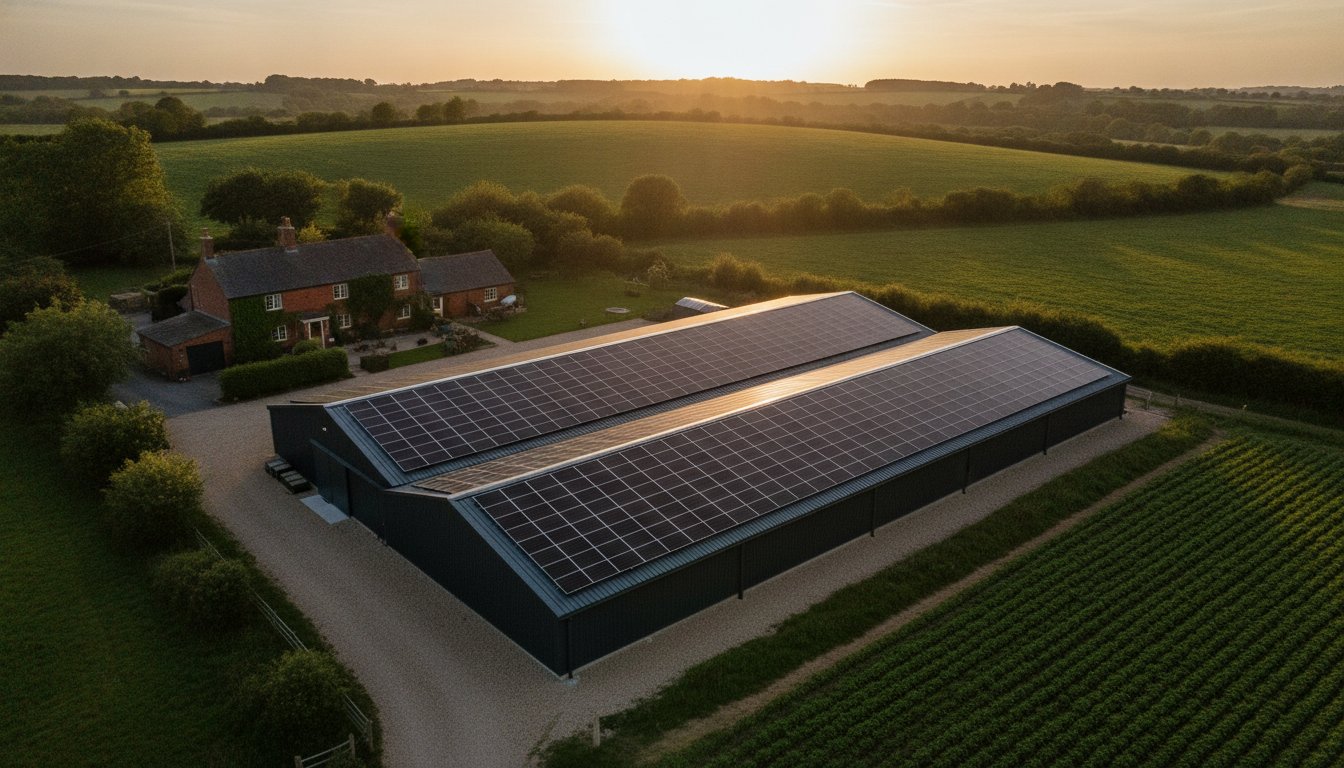
Could your farm's most profitable "crop" in 2026 be harvested from the roof of your grain store rather than the soil of your fields? With energy prices remaining a volatile burden for Staffordshire's dairy and arable sectors, it's understandable why you're looking for long-term stability. You've likely seen the headlines regarding the local "Stop the Solar Land Grab" campaign or the June 2026 planning refusal in Eccleshall, which makes ground-mounted arrays feel like a regulatory minefield. It's a frustrating position when you have underutilised barn roofs and a clear need for energy independence.
This guide explores tailored agricultural solar solutions Staffordshire farmers can use to bypass planning hurdles and lower overheads effectively. We'll show you how to navigate the current landscape after the closure of the Improving Farm Productivity Grant, using the Annual Investment Allowance and the Sustainable Farming Incentive to your advantage. You'll discover how a typical five to seven year payback period can lead to over 25 years of energy security. We'll preview how to transform your rooftops into high-yield assets and diversify your income through grid exports, all while protecting your productive acreage and satisfying local planning sensitivities.
Key Takeaways
- Learn how to evaluate your barn roofs for agricultural solar solutions Staffordshire to avoid the planning hurdles associated with ground-mounted systems.
- Understand how to utilize Permitted Development Rights to bypass full planning applications for specific agricultural building installations.
- Discover how battery storage solutions can support 24/7 farming operations like automated milking by storing surplus energy for peak evening demand.
- Identify the critical role of professional solar panel maintenance and cleaning in preserving efficiency within dusty rural environments.
- Use the Annual Investment Allowance to offset capital costs and achieve energy independence with a typical five to seven year payback period.
Why Agricultural Solar is a Strategic Move for Staffordshire Farms
Staffordshire's agricultural landscape is shifting. It's no longer just about the price of wheat or milk; it's about the price of the kilowatt-hour used to process them. For dairy farms in the Weaver Hills or arable units across the Trent Valley, energy-intensive operations like automated milking, refrigeration, and grain drying have become major financial vulnerabilities. Implementing agricultural solar solutions Staffordshire wide offers a way to flip this script, turning overhead costs into a predictable, fixed asset. A well-designed solar PV system acts as a 25-year hedge against the UK's volatile energy markets, providing a level of budget certainty that traditional utility contracts can't match. To further manage your overheads, greencompare.co.uk provides a comparison service for commercial utility procurement and business finance solutions that can help secure better rates for the power you still draw from the grid.
Beyond the immediate balance sheet, there's a growing pressure from the top of the supply chain. UK supermarkets are increasingly demanding lower carbon footprints from their suppliers to meet their own Net Zero targets. Transitioning to renewable energy isn't just a "green" choice; it's a strategic move to secure your place in the modern supply chain. Staffordshire is uniquely suited for this transition. With annual solar irradiance in the Midlands typically reaching between 1,450 and 1,550 kWh/m²/year, our county provides the high-yield conditions necessary for a rapid return on investment. As land-use debates continue across the county, many farmers are exploring agrivoltaics (dual-use solar) to maintain grazing while generating power, ensuring that every acre works twice as hard.
Lowering Operational Overheads
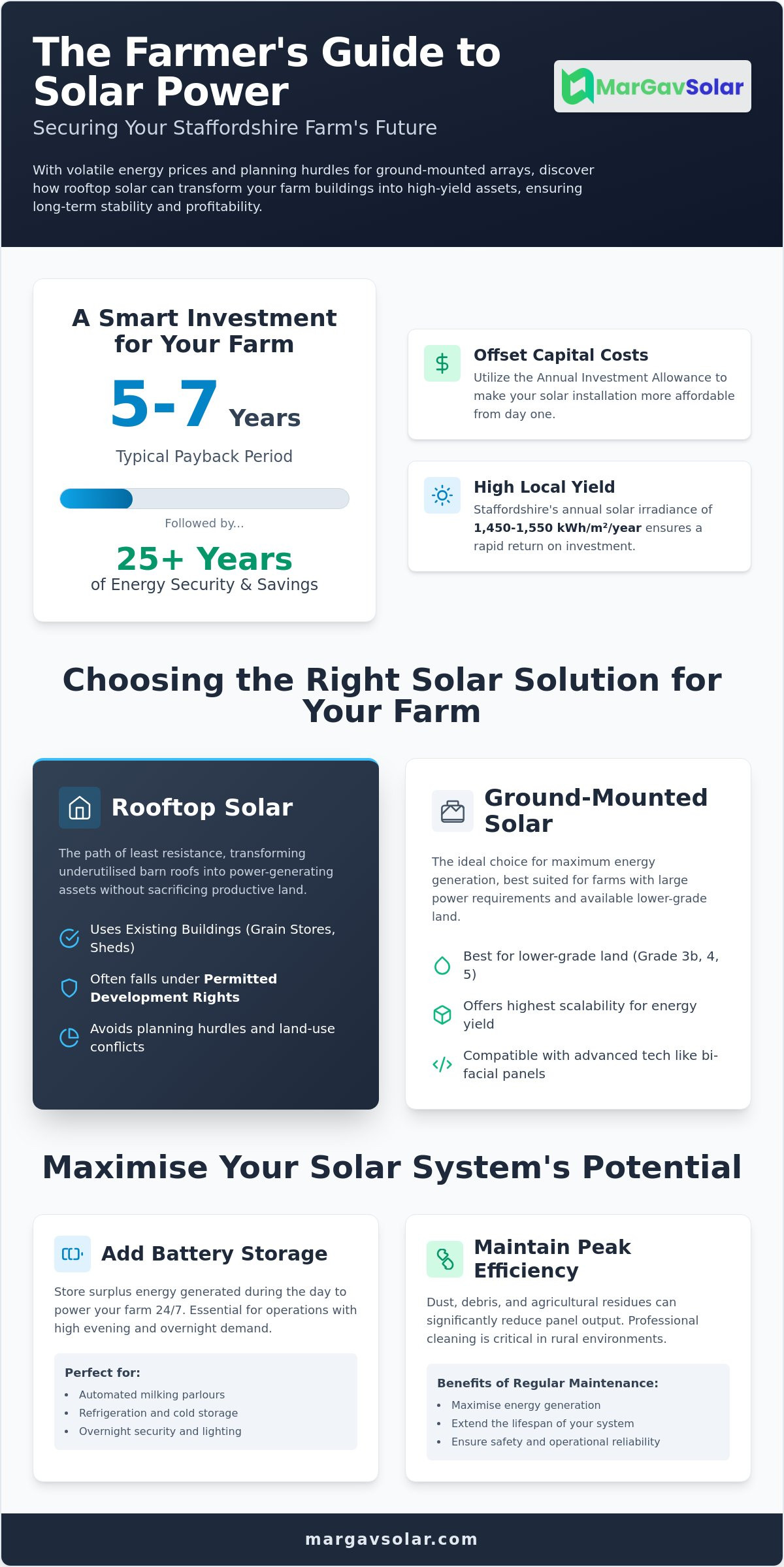
Solar energy is most effective when it aligns with your farm's "energy peaks." For many Staffordshire farms, the highest demand occurs during summer harvesting and grain drying, which perfectly matches peak solar output. By generating power on-site, you're effectively buying your electricity at a fraction of the current grid price. Based on data from Midlands Farm Solar 2026, a 50kWp agricultural system in Staffordshire typically sees a full payback within five to seven years.
Diversifying Farm Income via Grid Export
Your barn roofs are more than just shelter; they're potential revenue streams. Through the Smart Export Guarantee (SEG) or larger commercial power purchase agreements, you can sell surplus energy back to the grid. This transforms underutilised roof space into a passive income source that isn't tied to crop yields or livestock prices. Furthermore, achieving energy independence significantly boosts long-term farm valuation. Future buyers or successors will see a business that's protected from energy inflation and equipped with modern, sustainable infrastructure, making the entire holding a more resilient investment.
Choosing the Right Solution: Rooftop vs. Ground-Mount Solar
Deciding between rooftop and ground-mounted arrays is the first major hurdle for any farm. In Staffordshire, where the "Stop the Solar Land Grab" campaign has gained significant traction, the choice often comes down to balancing maximum energy yield against the preservation of high-quality soil. Rooftop systems are generally the path of least resistance for planning. Ground-mounted systems, however, offer higher scalability if you have lower-grade land available. It's a trade-off between using existing footprints and dedicating field space to energy production.
Rooftop Solar for Farm Buildings
Most agricultural solar solutions Staffordshire projects begin with the barn roof. Modern grain stores and machinery sheds are ideal because they often provide large, unobstructed surfaces. You'll need to evaluate the pitch and orientation; south-facing is best, but east-west splits can provide a more consistent energy curve throughout the day. Structural load is a critical factor. Older timber frames or buildings with asbestos roofing require specialist assessment before installation. Despite these technical hurdles, rooftop systems are frequently favoured because they often fall under Permitted Development Rights, avoiding the lengthy planning battles associated with field-based arrays.
Ground-Mounted Systems and Land Use
If your rooftop space is limited or your energy needs are massive, ground-mounted systems are the logical step. These are best suited for Grade 3b, 4, or 5 land where crop yields are naturally lower. In open Staffordshire landscapes, bi-facial panels are particularly effective. These panels capture sunlight on both sides, using light reflected from the ground to boost the total energy harvest. You don't have to sacrifice production for power. Many farmers adopt best practices for agricultural solar by integrating sheep grazing or biodiversity strips between the rows.
This dual-use approach maintains the land's agricultural status while generating a steady energy harvest. The mounting frames must be tailored to the specific soil types found in the county, from heavy clays to sandier loams, to ensure the structure withstands high winds over its 25-year lifespan. Ensuring your system remains at peak performance is vital, so consider a professional solar panel maintenance and cleaning schedule to prevent dust and organic debris from hindering your output. This proactive care ensures your investment continues to pay dividends long after the initial installation.
Navigating Planning Permission and Local Regulations in Staffordshire
Planning in Staffordshire isn't straightforward. Recent decisions, such as Stafford Borough Council's June 2026 refusal for a project in Eccleshall, highlight a tightening grip on rural land use. Local authorities are under significant pressure from campaigns like "Stop the Solar Land Grab," which prioritises food security over energy generation. To succeed, your application for agricultural solar solutions Staffordshire must be meticulous. If you're operating within the South Staffordshire Green Belt, you'll likely need to prove "Very Special Circumstances" to gain approval. This usually involves demonstrating that the local benefits of your specific renewable project clearly outweigh any perceived harm to the landscape's openness.
Your Agricultural Land Classification (ALC) report is the most important document in your bid. Planning officers heavily scrutinise whether a project sits on "Best and Most Versatile" (BMV) land, which includes Grades 1, 2, and 3a. If your site falls into these categories, expect significant resistance. However, rooftop installations often bypass these headaches. Under Permitted Development Rights, many agricultural buildings can host solar arrays without a full planning application, provided they meet specific size and height criteria. It's always wise to consult the UK government planning guidance for solar farms to understand how national policy interacts with local Staffordshire restrictions.
The Planning Process in Staffordshire
Councils in Stafford, Lichfield, and Uttoxeter are increasingly focused on the "Sequential Test." The Sequential Test is a planning requirement that compels developers to prove they've prioritised brownfield land or lower-grade agricultural sites over more productive farmland. When presenting your case, don't just talk about carbon; talk about how on-site generation keeps your farm business viable. Balancing food security with energy security is the only way to win over sceptical planning committees. You'll also need to address visual impact and glint and glare concerns, especially if your farm is near heritage sites or busy rural roads.
DNO Applications and Grid Connection
Securing planning permission is only half the battle. You also need a G99 application approved by the District Network Operator (DNO), usually National Grid in this region. This is your technical permission to connect your system to the local power lines. In rural Staffordshire, grid capacity can be tight. If the local substation is at its limit, you might face high costs for infrastructure upgrades. MarGav Solar manages this technical liaison, ensuring your system design matches what the grid can actually handle. Starting this process early prevents you from spending money on planning for a system that the grid simply can't support.
Maximising ROI: Battery Storage and Smart Integration
Solar panels on your grain store are a brilliant start, but their value is capped if you're still buying expensive grid power for your 4 AM milking session. The true financial potential of agricultural solar solutions Staffordshire lies in the synergy between generation and storage. By adding industrial-grade battery systems, you're no longer at the mercy of the sun's schedule. You can capture the massive energy surges produced during the midday peak and deploy that power when your machinery needs it most. This approach transforms your solar array from a daytime supplement into a comprehensive, around-the-clock energy strategy.
The Power of Battery Storage for Agriculture
Agricultural operations aren't just larger versions of residential setups; they have unique technical demands. Most farm machinery requires a robust 3-phase power supply to handle high-draw motors and cooling systems. When you scale your battery capacity, you're building a buffer that can handle these heavy industrial loads without tripping or reverting to the grid. Beyond the daily savings, batteries provide critical backup power. For poultry or dairy farmers, a grid outage can be catastrophic for livestock welfare. A well-integrated battery system ensures that ventilation and automated feeding systems remain operational during a local blackout. Discover more about how these systems work in our guide to Solar battery storage in Staffordshire.
Smart Energy Management
Owning the hardware is only half the battle; you also need to master the data. Smart monitoring platforms allow you to track farm-wide energy consumption in real time. You can automate high-energy tasks, such as water pumping or specific processing cycles, to trigger exactly when your solar output is highest. This level of control ensures you're using every kilowatt you produce rather than exporting it for a lower rate. You can learn how to master your data in our GivEnergy Cloud guide, which explains how to visualise your energy flow across multiple barn locations.
Modern farms are also seeing a shift in transport costs. By integrating EV charging points into your solar infrastructure, you can charge electric ATVs, 4x4s, and even staff vehicles using on-site generation. This diversifies your fleet's fuel sources and further reduces your reliance on external suppliers. If you're ready to secure your farm's energy future, it's time to explore our professional battery storage solutions. Investing in storage doesn't just improve your ROI; it builds the resilience necessary to thrive in a volatile energy market.
Partnering with MarGav Solar for Your Rural Energy Transition
Choosing a partner for your farm's energy transition is a decision that impacts your business for the next quarter-century. MarGav Solar offers 20 years of expertise in bespoke solar design for Staffordshire properties, ensuring that your system is built to last. We don't believe in one-size-fits-all kits. Instead, we provide end-to-end support, beginning with an intensive feasibility study that looks at your specific consumption patterns and structural constraints. Every installation is NICEIC-certified, reflecting our commitment to the highest safety and performance standards in the industry. We handle the technical complexities, so you can focus on running your farm.
Our approach goes beyond the initial installation. We understand that the rural sector has unique requirements that residential installers often overlook. Agricultural solar solutions Staffordshire projects require hardware that can withstand the rigours of farm life, from fluctuating temperatures to rural grid instability. We prioritise high-efficiency hardware that delivers the best possible return on investment, ensuring your 25-year hedge against energy markets remains solid. By managing everything from the initial design to the final connection, we ensure your transition to energy independence is as smooth as possible.
Long-Term Maintenance and Repair
Farms are notoriously challenging environments for sensitive electronics. Dust from grain stores, ammonia from livestock housing, and organic debris can accumulate on your panels, creating "hot spots" that reduce efficiency and can even damage the cells. This is where many systems fail to meet their projected ROI. Professional solar panel maintenance in Staffordshire is vital for preserving your system's health. We provide specialised cleaning and monitoring services to ensure your array continues to harvest every available kilowatt. We also offer inverter upgrades and replacements to keep your system at the cutting edge of technology throughout its lifespan.
Getting Started with a Rural Site Survey
The first step toward energy security is a professional consultancy. During a MarGav Solar agricultural site survey, we'll assess your barn roofs, evaluate your grid connection potential, and discuss how battery storage can bridge the gap during peak demand. It's a transparent process designed to give you a clear picture of your potential savings and payback period. You can read more about the steps involved in our solar panel installation in Staffordshire guide. When you're ready to take control of your farm's overheads, contact MarGav Solar for a bespoke agricultural quote and start your journey toward a more resilient, independent future.
Securing Your Farm's Energy Future in Staffordshire
Staffordshire's agricultural landscape is evolving, and implementing tailored agricultural solar solutions Staffordshire wide is the most effective way to lock in long-term operational stability. You've seen how smart battery integration and a strategic approach to planning can turn underutilised barn roofs into powerful financial assets. By focusing on rooftop efficiency, you can avoid the regulatory hurdles currently facing larger ground-mounted projects while securing predictable energy prices for the next 25 years. It's a clear path to protecting your margins from the volatility of the UK energy market.
MarGav Solar brings over 20 years of industry experience and a team of NICEIC-certified installers to every project. We're specialists in high-efficiency rural systems that stand up to the rigours of farm life, from grain dust to the heavy demands of 3-phase machinery. Don't leave your farm's energy security to the whims of the national grid. Request a Bespoke Agricultural Solar Audit from MarGav Solar today. It's time to take control of your overheads and build a more resilient, independent future for your business. You've done the hard work in the fields; now let your infrastructure do the hard work for your bank balance.
Frequently Asked Questions
Do I need planning permission for solar panels on my barn in Staffordshire?
Most rooftop installations on agricultural buildings fall under Permitted Development Rights, meaning you often won't need a full planning application. However, there are specific limits on the size and height of the array, and you'll still need to notify your local council in Stafford or Lichfield before work begins. If your farm is in a conservation area or near a heritage site, stricter rules apply, so it's best to check with a professional before proceeding.
Can I install solar panels on 'Good Quality' agricultural land (Grade 1, 2, or 3a)?
Securing permission for ground-mounted systems on "Best and Most Versatile" (BMV) land is increasingly difficult in Staffordshire. Local planning authorities prioritising food security typically reject projects on Grade 1 or 2 land unless you can prove very special circumstances. When considering agricultural solar solutions Staffordshire farmers are usually advised to focus on rooftop systems or lower-grade Grade 3b and 4 land to avoid lengthy planning disputes and local opposition.
How much does a 50kW or 100kW agricultural solar system cost?
As of July 2026, industry data for the Midlands shows that a 50kWp system typically costs between £35,000 and £44,000. For larger 100kWp installations, you can expect a range of £60,000 to £74,000. These figures are industry averages and can vary based on your specific site requirements, such as roof condition or the distance to your grid connection point. Most Staffordshire farms see a full return on this investment within five to seven years.
What grants are available for agricultural solar in 2026?
Direct capital grants, such as Round 2 of the Improving Farm Productivity Grant, are currently closed as of July 2026. However, you can still utilise the Annual Investment Allowance (AIA) to deduct the full cost of the solar installation from your profits before tax, up to a £1 million limit. To ensure your business accounts are correctly handled for such investments, Mazuma offers expert guidance for UK limited companies and sole traders. Additionally, the Sustainable Farming Incentive (SFI) offers ongoing payments for farms that integrate biodiversity-positive practices, such as pollinator-friendly ground cover, around their solar arrays.
Will solar panels interfere with my farm's daily operations or machinery?
Rooftop solar systems are designed to be entirely non-intrusive, sitting safely above your daily workflows on grain stores or machinery sheds. Ground-mounted systems can be designed as "agrivoltaics," where the panels are raised high enough to allow sheep grazing or the growth of shade-tolerant crops underneath. This ensures your agricultural solar solutions Staffordshire project complements your existing farm operations rather than hindering them, allowing you to harvest both food and energy from the same acreage.
How long do agricultural solar panels last in a farm environment?
Modern solar panels are built to be incredibly durable, with most systems providing a service life of 25 to 30 years. In a farm environment, the primary challenge is the accumulation of dust from grain handling or livestock housing. Regular maintenance and professional cleaning are essential to prevent this debris from reducing your energy yield. With a consistent care schedule, your system will continue to provide energy security and lower overheads well into the 2050s.
Is my farm's roof strong enough to hold solar panels?
Most modern steel-framed agricultural buildings are more than capable of supporting the weight of a solar PV system. However, older timber-framed barns or structures with asbestos roofing require a professional structural survey before any installation begins. A survey ensures the roof can handle both the static weight of the panels and the dynamic "wind uplift" forces that occur during Staffordshire's winter storms. If your roof needs reinforcing, this is often factored into the initial design phase.
What is the difference between rooftop and ground-mounted solar for farms?
Rooftop solar is generally the most cost-effective and planning-friendly option as it uses existing footprints without sacrificing productive land. Ground-mounted systems are better suited for large-scale energy production if you have low-grade land available that isn't suitable for high-yield crops. While ground-mounted arrays offer easier access for maintenance, they face much higher scrutiny from Staffordshire planning committees compared to simple rooftop installations on existing farm sheds.


